Shapes and intermolecular forces
 Call Kai
 Learn
 Practice Test
 Spaced Repetition
 Match
 Flashcards
 Knowt Play
1/13

There's no tags or description
Looks like no tags are added yet.
14 Terms
What is the electron pair repulsion theory?
Electrons pairs around a central atom repel each other and arrange themselves as far apart as possible to minimise repulsion.
Linear shape
(Mention bonding pairs, lone pairs, bond angle)
Bonding pairs: 2
Lone pairs: 0
Bond angle: 180
Example: CO2

Trigonal planar
(Mention bonding pairs, lone pairs, bond angle)
Bonding pairs: 3
Lone pairs: 0
Bond angle: 120
Example: BF3

Tetrahedral
(Mention bonding pairs, lone pairs, bond angle)
Bonding pairs: 4
Lone pairs: 0
Bond angle: 109.5
Example: CH4

Trigonal pyramidal
(Mention bonding pairs, lone pairs, bond angle)
Bonding pairs: 3
Lone pairs: 1
Bond angle: 107
Example: NH3

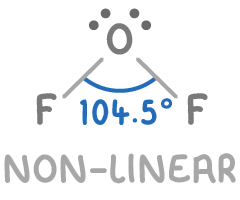
Non linear
(Mention bonding pairs, lone pairs, bond angle)
Bond pairs: 2
Lone pairs: 0
Bond angle: 104.5
Examples: H2O
Octahedral
(Mention bonding pairs, lone pairs, bond angle)
Bond pairs: 6
Lone pairs: 0
Bond angles: 90

What is electronegativity?
The ability of an atom to attract the bonding electrons in a covalent bond.
What is a polar bond?
A covalent bond in which the binding electrons are shared unequally between two atoms due to a difference in electronegativity
What is a London force
How strong is it compared to other 2 forces.
Weak intermolecular forces caused by temporary dipoles inducing dipoles in neighbouring molecules.
Weakest force and are present between all molecules.
What is a permenant dipole force?
How strong is it compared to the other 2 forces and where is it present?
Intermolecular forces of attraction between permanent dipoles inducing polar molecules. It is stronger than London forces but weaker than hydrogen bonding. Occur between polar molecules with permanent partial charges.
What is hydrogen bonding?
How strong is it compared to the other 2 forces and where is it present?
A strong intermolecular forces of attraction between + partial hydrogen atom bonded to N, O, F and a lone pair on an N , O or F
it is the strongest force out of the 3. Hydrogen bonding occurs strictly when hydrogen is bonded to F, O, N
Describe diagram of two water molecules hydrogen bonding,

Name anomalous properties of water
Ice is less dense than water where hydrogen bonds hold water molecules in an open lattice, keeping molecules further apart. But when ice melts, some hydrogen bonds break.
Water has relatively high melting and boiling points compared with other hydrides. This is because water molecules form strong hydrogen bonds between molecules which results in a high amount of energy needed to overcome these hydrogen bonds