LABORATORY EQUIPMENT AND SUPPLIES (copy)
 Call Kai
 Learn
Learn Practice Test
 Spaced Repetition
 Match
Match Flashcards
 Knowt Play
1/39

Earn XP
Description and Tags
Name | Mastery | Learn | Test | Matching | Spaced | Call with Kai | Chat |
|---|
No analytics yet
Send a link to your students to track their progress
40 Terms
To Contain
UNDER GLASS PIPETTES:
Holds but does not deliver the exact volume
To Deliver
UNDER GLASS PIPETTES:
Delivers the exact volume it holds
Blow out
UNDER GLASS PIPETTES:
Characterized by etched ring / bands near the mouth
Self - draining
UNDER GLASS PIPETTES:
Allowed to drain by gravity
To contain & To deliver
Glass Pipettes according to design:
Blow out & Self draining
Glass Pipettes according to its drainage characteristic:
Volumetric Pipet
WHAT PIPET?
Type:
Transfer Pipet
Design:
To Deliver ; Self-draining
Calibration Marks:
Single Capacity Mark
Other Comments:
Non viscous samples; standards

Ostwald-Folin Pipet
WHAT PIPET?
Type:
Transfer Pipet
Design:
To Deliver ; Blowout
Calibration Marks:
Single Capacity Mark
Other Comments:
Viscous samples

Serologic Pipet
WHAT PIPET?
Type:
Measuring Pipet
Design:
To Deliver ; Blowout
Calibration Marks:
Graduated down to tip Mark
Other Comments:
Serial dilution ; Measuring reagents

Mohr Pipet
WHAT PIPET?
Type:
Measuring Pipet
Design:
To Deliver ; Self-draining
Calibration Marks:
Graduated between 2 marks
Other Comments:
Serial dilution ; Measuring reagents

Piston
WHAT PART OF AUTOMATIC PIPETTE?
What is no. 1 ?

Air
WHAT PART OF AUTOMATIC PIPETTE?
What is no. 2 ?
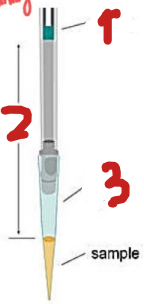
Disposable tip
WHAT PART OF AUTOMATIC PIPETTE?
What is no. 3 ?

Disposable piston
WHAT PART OF AUTOMATIC PIPETTE?
What is no. 4 ?

Disposable capillary
WHAT PART OF AUTOMATIC PIPETTE?
What is no. 5 ?
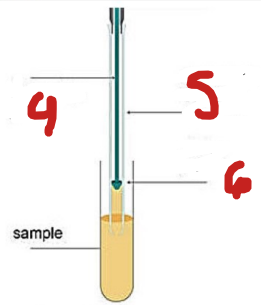
Piston seal
WHAT PART OF AUTOMATIC PIPETTE?
What is no. 6 ?
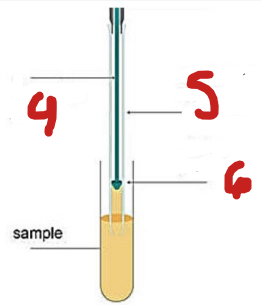
Air displacement
SEMI-AUTOMATIC MICROPIPETTORS
uses suction to draw sample into a disposable polypropylene tip; piston does not come in contact with the liquid
Positive displacement
SEMI-AUTOMATIC MICROPIPETTORS
operates like a hypodermic syringe; tips must be rinsed out
No air cushion; constant aspiration force; for high density or very viscous samples
Used for sampling in most discrete automated systems
Horizontal or swinging bucket
CENTRIFUGES TYPES:
tubes swing to a horizontal position during spinning causing heat build-up; speeds up to 3000 RPM; produces a tightly packed, flat sediment
Fixed-angle or angle-head
CENTRIFUGES TYPES:
tubes are at fixed angle (25-40°) when rotating; capable of higher speeds up to 7000 RPM with much less heat build-up; produces slanted sediment
Ultracentrifuge
CENTRIFUGES TYPES:
used to separate layers of different specific gravities; speeds up to 100,000 RPM; usually refrigerated to counter the heat produced due to friction
Used for Lipoprotein separation analysis
Cytocentrifuge
CENTRIFUGES TYPES:
for body fluid cell counts; low speeds of 200-200 RPM
Revolutions per minute;
CENTRIFUGES UNITS USED:
RPM meaning?
X x g (RCF)
Svedberg
CENTRIFUGES UNITS USED:
units used for ultracentri
RCF (xg) = (1.118 × 10^-5) x (r) x (RPM²) [radius in cm]
CENTRIFUGES UNITS USED:
Formula for Converting rpm to RCF?
Timer & Speed ; Temperature if refrigerated
CENTRIFUGES UNITS QC:
Parameters ?
Every 3 months
CENTRIFUGES UNITS QC:
Frequency ?
Analytic Reagent Grade (ACS)
REAGENTS CHEMICALS:
high degree of purity suitable for use in most analytical procedures
Ultrapure Grades
REAGENTS CHEMICALS:
for specific procedures such as chromatography, AAS, immunoassays, molecular diagnostics, and standardization techniques
Chemically Pure Grade
REAGENTS CHEMICALS:
impurity limitations not stated; not acceptable for research and laboratory techniques unless further purification is carried out or a reagent blank is included during analysis
United States Pharmacopeia/National Formulary Grade
REAGENTS CHEMICALS:
primarily used to manufacture drugs and purity standards may not meet assay requirements
Technical or Commercial Grade
REAGENTS CHEMICALS:
should not be used in the clinical laboratory
REAGENTS REFERENCE MATERIALS:
highly purified chemical that can be measured directly to produce a substance of exact known concentration and purity
ACS Primary Standard
purity tolerance value of 100 ± 0.02%
Standard Reference Materials
certified for use in clinical chemistry laboratories
Secondary standard
REAGENTS REFERENCE MATERIALS:
substance of lower purity with its concentration determined by comparison with a primary standard or SRM
Type I
REAGENT WATER:
purest type; recommended for Standard preparation
Type II
REAGENT WATER:
acceptable for most laboratory procedures including reagent preparation
Type III
REAGENT WATER:
can be used for some qualitative tests but not for routine analyses and reagent preparation; water source for the preparation of Type I or II water and for washing glassware
CLSI Specifications for Clinical Laboratory Reagent Water (CLRW) (Type 1)
Microbiological content <10 cfu/mL
Resistivity ≥10 MΩ·cm
Particulate matter – removed by passing through 0.22-μm filter
Total organic content <500 ng/g