Materials + Data Sheets
 Call Kai
 Learn
Learn Practice Test
 Spaced Repetition
 Match
Match Flashcards
 Knowt Play
1/20

Earn XP
Description and Tags
Advanced 3D Printing
Name | Mastery | Learn | Test | Matching | Spaced | Call with Kai | Chat |
|---|
No analytics yet
Send a link to your students to track their progress
21 Terms
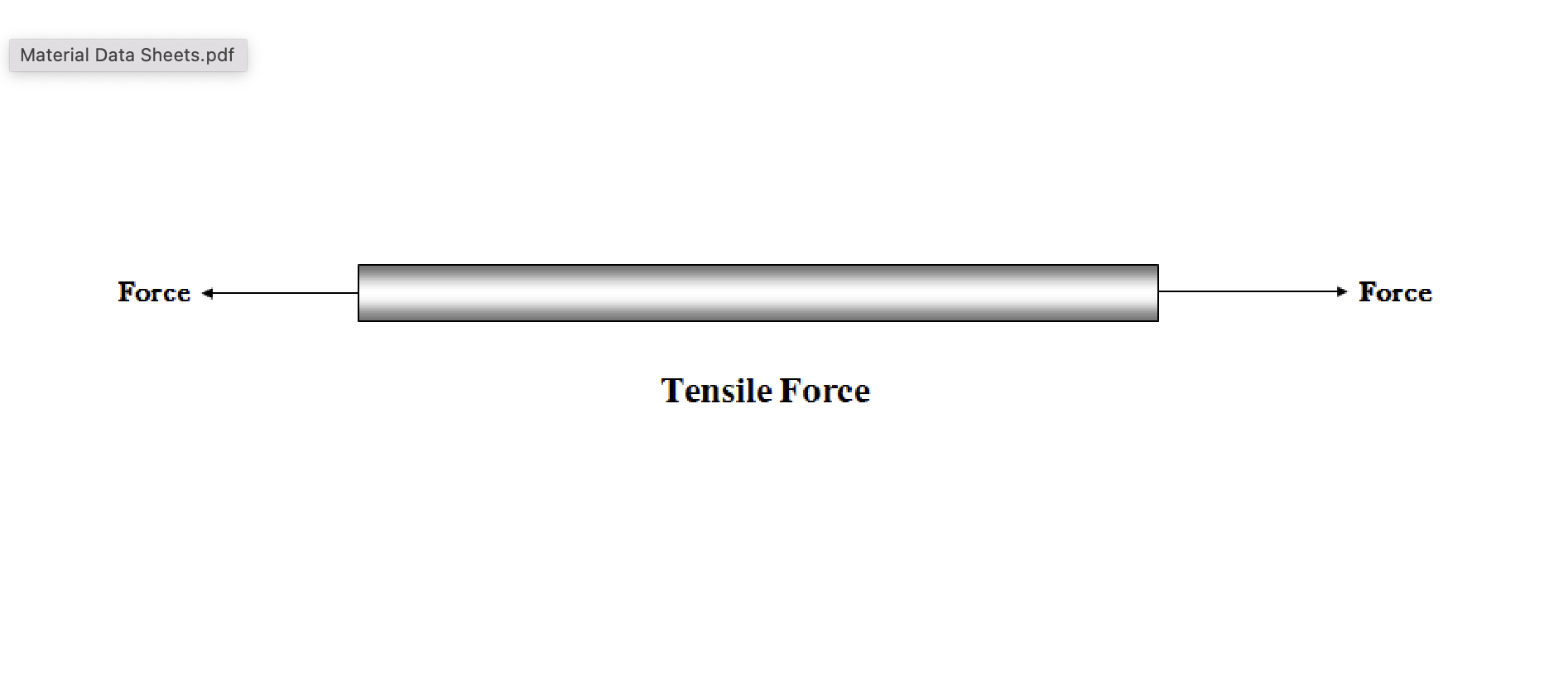
Tension
a “pulling” force
Apply force on both ends of an object, you are putting it in a state of tension
Apply force = reaction from object
Stretch

Compression
A pushing force
Apply force by pushing both ends of an object
Apply forces = material compresses

Flexural Force
A combination of tension and compression
Bend
Ex: Aluminimum is a good flexural force → airplane wing shaking

Anisotropic
(of an object or substance) having a physical property that has a different value when measured in different directions. A simple example is wood, which is stronger along the grain than across it.
Applies in Fused Deposition Modeling (FDM) some parts of the material are stronger than others based on how the material was built.
“Go with the grain” - Big Z, Surf’s Up (2007)

Tension load normal to layers
Part is weak

Tension load parallel to layers
Part is strong

Bending Load normal to layers
Part is strong
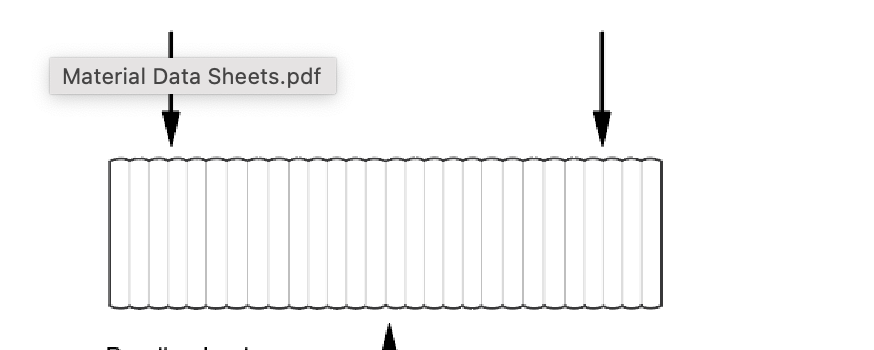
Bending load parallel to layers
Part is weak

Polymerization
The process of reacting monomer molecules together in a chemical reaction to form polymer chains or three dimensional networks.

Isotropy
The characteristic where a material's properties (like tensile strength and stiffness) remain the same across the X, Y, and Z axes.
Stress
The response of a material to force is dependent on the cross sectional area of the object being tested. Represented by the SIGMA symbol (σ)
Stress is the force
Stress is calculated by dividing the force applied by the area cross section.
Strain
The response of a material to stress is a deformation. We call this deformation strain. Represented by the EPSILON symbol (ε)
Strain is the reaction to the force (stress)
Refer to the stress and strain curve (strain X + stress Y)
Strain is calculated by dividing the length of the elongation by the original length of the sample.
Proportional limit of stress/strain
All materials will yield
Stress is proportional to strain at this point
Before the proportional limit (yield) is known as the …
Elastic region

Elastic Deformation
Force causes material to become elastically deformed and then snap back to their original form.
After the proportional limit (yield) is known as the …
Plastic region

Plastic Deformation
Force causes a shift to the crystalline structure of our solid, leading to a fracture/material failure.
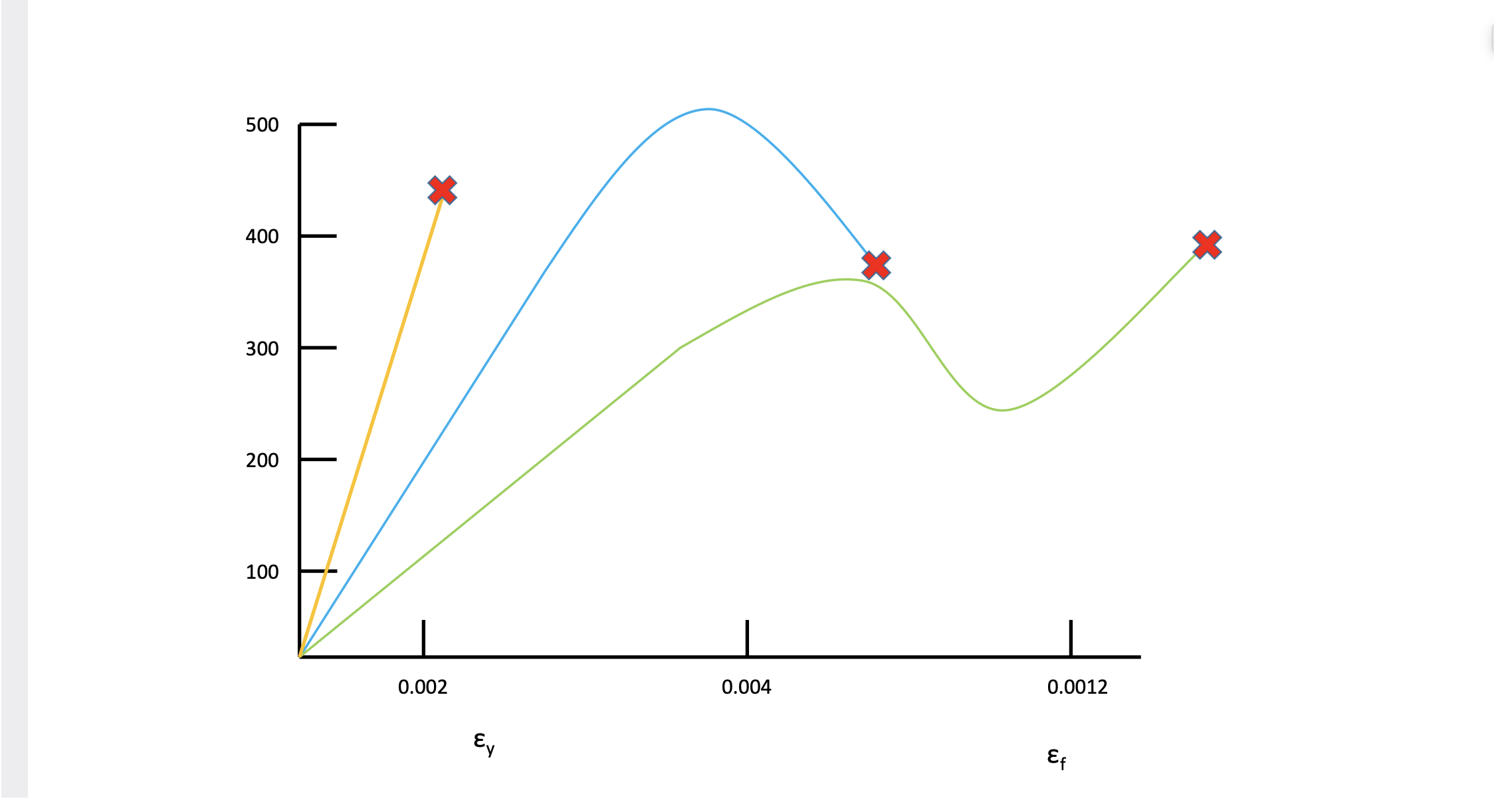
What material does the yellow curve represent?
Glass/ceramic

What material does the blue curve represent?
Metal

What material does the green curve represent?
Plastic
Ductility
Ductility describes how much a material can deform under tensile stress before fracturing.
Highly ductile materials can stretch or bend significantly, while brittle materials fracture with little deformation.
Material Breaks at the end of the stress/strain curve → Fracture Strain AKA ductility