9.4 Electron Configurations, Valence Electrons, and the Periodic Table
 Call Kai
 Learn
Learn Practice Test
 Spaced Repetition
 Match
Match Flashcards
 Knowt Play
1/18

There's no tags or description
Looks like no tags are added yet.
Name | Mastery | Learn | Test | Matching | Spaced | Call with Kai | Chat |
|---|
No analytics yet
Send a link to your students to track their progress
19 Terms
row
With each subsequent ___ (row/column), the highest principal quantum number increases by one.

column
As we move down a ______ (row/column), the number of electrons in the outermost principal energy level (highest n value) remains the same.

valence electrons
electrons that are most import in chemical bonding because they are held most loosely (easier to lose/share)

principal
For main-group elements, the valence electrons are those in the outermost _________ energy level.
d
For transition elements, we also count the outermost _ (s/p/d/f) electrons among the valence electrons (even though they are not in an outermost principal energy level).
valence
Elements in a column of the periodic table have similar chemical properties because they have the same number of _______ (core/valence).
core electrons
those electrons in a complete principal energy level and those in complete d and f sublevels; non-valence electrons

sublevels
Note that because of the filling order of orbitals, we can divide the periodic table into blocks representing the filling of particular ___________ (principal levels/sublevels).

s block
orbital block composed of first 2 columns on the left side of the periodic table (alkali metals and alkaline earth metals) and Helium

p block
orbital block composed of the 6 columns on the right side of the periodic table, include halogens and noble gases
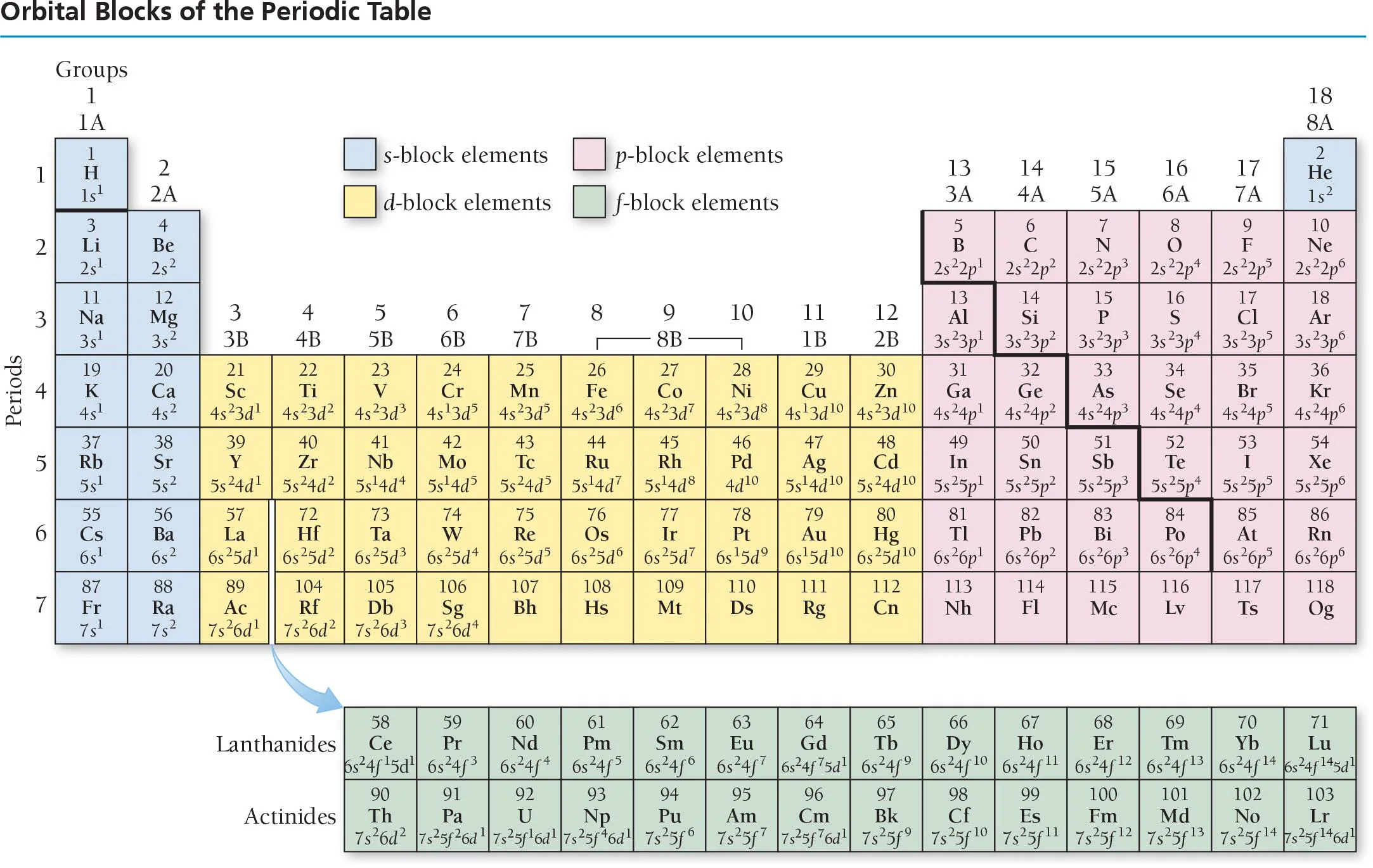
d block
orbital block composed of transition elements

f block
orbital block composed of lanthanides and actinides (inner transition elements)

number of valence electrons
With the exception of helium, the lettered group number of a main-group element is equal to the __________________________ (number of valence electrons/highest principal quantum number n) of that element.
highest principal quantum number
The row number of a main-group element is equal to the __________________________ (number of valence electrons/highest principal quantum number of that element.
d, f
The electron configurations of transition elements in the ___ (s/p/d/f) block and inner transition elements in the ___ (s/p/d/f) block exhibit trends different somewhat from those of the main-group elements.

1
The principal quantum number of the d orbitals that fill across each row in the transition series is equal to the row number minus _.
lower
The 4s orbital is generally _____ (lower/higher) in energy than the 3d orbital because it more effectively penetrates into the region occupied by the core electrons.
2
The principal quantum number of the f orbitals that fill across each row in the inner transition series is equal to the row number minus _.
inner transition
Within the ________________ (transition/inner transition series), the close energy spacing of the 5d and 4f orbitals sometimes causes an electron to enter a 5d orbital instead of the expected 4f orbital.