Anesthetic Machine
 Call Kai
 Learn
 Practice Test
 Spaced Repetition
 Match
 Flashcards
 Knowt Play
1/76

There's no tags or description
Looks like no tags are added yet.
77 Terms
what is the purpose of anesthetic machines
Anesthetic machines deliver precise amounts of oxygen and volatile anesthetic under controlled conditions to patients undergoing general anesthesia via a breathing circuit.
what are the 4 big, main components of the anesthetic machine
compressed gas
anesthetic vaporizer
breathing circuits
scavanging system
what are the 2 items under compressed gas
flow meter
o2 flush valve
Safety concerns with compressed gases (4)
Flammable
Pressurized release of gas cause injury
Dropped- become a projectile
Wrong gas hooked up
purpose of tank pressure gauge
Pressure of gas remaining in the compressed gas cylinder
what pressure is considered a full tank (range)
1900 - 2200 psi
at what pressure does a gas cylinder need to be replaced
below 500 psi
Must check O2 tank levels at …
the start of each day
purpose of Pressure reducing valve
reduces outgoing pressure to a usable level
what is the purpose for the Line pressure gauge
indicates the pressure in the intermediate-pressure gas line between the pressure-reducing valve and the flowmeters
what should the pressure be of the line pressure gauge (range)
40 - 58 psi
Intermediate-pressure gas line connects to the — —
anesthetic machine
Carrier gases must be delivered to patient at a controlled — —
flow rate
— is the primary carrier gas used in all anesthetic machines.
Oxygen
Flow rate expressed in
L/mins
non rebreathe circuit aka
bain
what are the 2 kinds of breathing circuits (long name)
non re-breathe
re-breathe
what is the induction and recovery rate for non rebreathe circuit
300 ml/kg/min
what is the maintenance rate for non rebreathe circuit
300 ml/kg/mins
rebreathe circuit aka
circle
what is the induction and recovery rate for rebreathe circuit
100 ml/kg/mins
what is the maintenance rate for rebreathe circuit
30 ml/kg/mins
If your calculated flow rate is less than 1 L/mins you will set it to …
1 L/mins
why cant we go less than 1 L/mins in flow rates
the concentration delivered to the patient can be unreliable
Round your calculated flow rate value up to the nearest …
100 ml/mins
purpose of o2 flush valve
Used to flush system of anesthetic gases
we Disconnect patient to avoid sending high pressures into lung and causing —
barotrauma
purpose of anesthetic vaporizer
vaporizes liquid inhalant anesthetic and mixes it with the carrier gases.
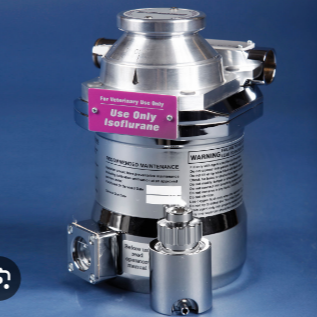
what kind of vaporizer
precision vaporizers
purpose of vaporizer outlet port
is the point where O2 and inhalant anesthetic exit the vaporizer on the way to the breathing circuit.
the Vaporizer Outlet Port connects to either … (2)
directly to the breathing circuit via a hose or
connects instead to the common gas outlet.
purpose of breathing circuits
The breathing circuit conveys the carrier gases and inhalant anesthetic to the patient and removes exhaled carbon dioxide.
what is a rebreathe
Patient rebreathes expired gases
Characteristic of Rebreathe (Circle)? (8)
Needs CO2 absorber
Slower changes in anesthetic depth after vaporizer dial changes
Less oxygen used
Less inhalant used
Lower cost
Less moisture loss
Less heat loss
For use on patient above 10 kg
define Non-rebreathing circuits (Bain hoses)
don’t rebreathe expired gas
Characteristics of Non rebreathe Systems? (9)
Co2 absorber not required
Rapid changes in anes depth occur with changes in vaporizer settings
Uses more oxygen
Uses more inhalation agents
Higher cost
Poor heat conservation
poor moisture conservation
Used for patients under 10kg
can be used for all normally though
The size of the bag reflects …
the net volume of the gas in the breathing system at any given time
functions of resevoir bag (5)
Space to accept expired air
Provides air needed to fill lungs
Used to observe patients respiration
Confirm ET tube placement by bag movement
Delivery of anesthetic gases or oxygen (“bagging”, IPPV)
what happens if the resevoir bag is too small (2)
Insufficient safety against pressure build up
Not large enough reserve volume for the patient to draw on inspiration
what happens if the resevoir bag is too large (3)
PPV is awkward
Monitoring spontaneous breathing difficult as minimal movement occurs
Unnecessary volume which can cause delay if you want to change the depth of anesthesia
how to calculate resevoir bag size
60 ml X body weight (kg)
in resevoir bags, If more than — ml away from an available bag size select the next size larger
100
what are the bag size options (4)
0.5 L
1 L
2 L
3 L
purpose of Carbon Dioxide Absorber
Contains granules that absorbed CO2 from exhaled air, and spit the clean air back out
what is the main ingredient in a Carbon Dioxide Absorber
Calcium Hydroxide
how to tell when the Carbon Dioxide Absorber is depleted (4)
Hard and brittle
Purple/pink vs white (caution)
6-8 hr of use
After 30 days
APL valve stands for
Adjustable Pressure Limiting Valve
purpose of Adjustable Pressure Limiting Valve (2)
Vents waste gases and pressure
Connects breathing circuits to the scavenging system
the APL valve Must remain fully open except (3)
Testing the machine for leaks
Testing cuff inflation on ET tube
IPPV (bagging)
why should u always try and use a cuffed et tubes (3)
The inflated cuff helps prevent leakage of air and gases around the tube and therefore reduces waste gas pollution in the operating room.
Use of a cuffed tube minimizes the risk of aspiration of blood, saliva, vomitus, and other material into the lungs.
Cuffed tubes prevent the animal from breathing room air, which may otherwise flow around the outside of the tube and dilute anesthetic gases. Adequate depth of anesthesia is difficult to maintain in animals breathing significant amounts of room air.
what are the 2 types of et tubes
high volume/low pressure
low volume/high pressure
what are some alternatives to et tubes (2)
Cole Tubes
Supraglottic Airway Devices (SGAD)
what are the advantages of cole tubes (3)
the flexibility of the baffles allows the release of airway pressure over 20 to 30 cm H2O, thus reducing the risk of barotrauma in the event that excess pressure builds up in the breathing circuit
less trauma to the tracheal mucosa due to the limited area of contact with the baffles
a sweeping motion created by the baffles that helps carry liquids out of the trachea during extubation
what does SGAD stand for
Supraglottic Airway Devices
Supraglottic Airway Devices aka
laryngeal mask airway
LMA stands for
laryngeal mask airway
what is the benefit of laryngeal mask airway
allows the anesthetist to manage the airway without invading the tracheal lumen
define dead space
spaces through which these gases travel but in which no gas exchange occurs.
The patient’s — — must be considerably more than the dead space volume in order for oxygen and anesthetic gas to reach the alveoli and for carbon dioxide to be eliminated
tidal volume
what are the 3 sources of dead spacee
anatomic
alveolar
mechanical
anatomic and alveolar dead space comprise — dead space
physiologic
In an average patient, when awake, normal tidal volume is estimated to be approximately (range)
10 - 15 ml/kg
Guidelines are that mechanical dead space should not exceed (range)
2 - 3 ml/kg
purpose of scavange tube
Function is to collect waste gas from the machine/circuit and conduct it for disposal outside the building
purpose of scavange system
disposes of excess and waste anesthetic gases
WAG stands for
waste anesthetic gases
what do WAGs cause (3)
dizziness
heachaches
birth defects
what are the 2 types of scavange
passive
active
a passive scavange system relies on …
the pressure in system (O2 flow rate) to push WAG to either go directly to the outside or through a charcoal filter
what is a type of passive scavange
charcoal filter
how do u know when to replace charcoal filter (2)
When weight increases by 50 grams it is time to discard
Discard after 12 hours
what is an example of an active scavange system (2)
vaccum to outside
fans to outside
define Anesthetic chambers
clear, aquarium-like boxes used to induce general anesthesia in small patients that are feral, vicious, or intractable, or that cannot be handled without undue stress
a leak test does not test for (3)
Oxygen gas cylinder to flow meter
Scavange system
The inner tube of the bain
if a leak test fails you should check (7)
Check breathing hoses
Check resevoir bags
Check ET tubes
Check CO2 absorber not sealed
Covering over unidirectional valve
Connection between pop off scavanger not tight
Vaporizer cap not replaced
how to set up anesthetic machine (11)
All maintenance is up to date
Turn oxygen on and ensure adequate levels
Check vaoprizer levels
Connect oxygen line to machine if not already
Select breathing circuit and resevoir bag to the machine
Connect circuit and resevoir bag to the machine
Connect scavange and make sure no kinks (+/- turn on/replace)
Perform leak test at minimum daily and after changing circuits (ideally before every patient)
Calculate oxygen flow rates
Select ET tubes
Ensure all other supplies are ready
procedure for a leak test (11)
turn o2 on
make sure o2 canister is above 500 psi
put something in end of tube
close APL valve
turn on o2 flow
watch meter go to 20 psi
turn off flow
count to 20 noting if it goes up or down
open APL valve
turn o2 off
flush