Haptic Perception
 Call Kai
 Learn
 Practice Test
 Spaced Repetition
 Match
 Flashcards
 Knowt Play
1/12

There's no tags or description
Looks like no tags are added yet.
13 Terms
Sensitivity to Touch
Sensitivity to Touch
Tactile acuity: Ability to detect fine details through touch.
Measured using: Physical gratings (raised ridges).
Low spatial frequency: Fewer, widely spaced ridges → easier to distinguish.
High spatial frequency: More, closely spaced ridges → harder to distinguish.
Key Finding: Touch and vision both depend on spatial frequency to detect details.
Exploratory Movements
Exploratory Movements
Different hand movements detect different object properties:
Lateral Motion (rubbing): Texture
Pressure (pressing): Hardness
Static Contact (touching): Temperature
Unsupported Holding (lifting): Weight
Enclosure (grasping): Overall shape and volume
Contour Following (tracing): Exact shape
Key Takeaway: Different hand movements help us perceive different object properties through touch.
Weinberg et al. (1970)
Weinberg et al. (1970)
Method: Recognized 20 geometric objects using vision, hands, or mouth.
Procedure: Studied objects, then completed a recognition test.
Results:
Vision: 99%
Hands: 90%
Mouth: 74%
Key Finding: Touch is highly effective for recognizing 3D objects, nearly as accurate as vision.
Klatzky et al. (1985)
Klatzky (1985)
Study: Identify 100 objects by touch.
Free hand movement: 96% accuracy.
Restricted movement: 20% accuracy.
Conclusion: More freedom to explore → more haptic (touch) information → better object recognition.
Skin & Touch
Skin & Touch
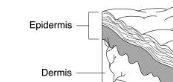
Skin: One of the body's largest organs.
Functions: Protection, insulation (warmth), and sensing touch.
Two skin layers:
Epidermis: Outer layer, mostly dead cells.
Dermis: Inner layer, living cells and receptors.

4 Mechanoreceptors (Touch Receptors)
4 Mechanoreceptors (Touch Receptors)
Merkel Discs: Pressure, fine details, texture.
Meissner Corpuscles: Light touch, low-frequency vibration.
Ruffini Cylinders: Skin stretching.
Pacinian Corpuscles: Deep pressure, high-frequency vibration.
Key Takeaway: Different skin receptors detect different types of touch.
Temporal Properties of Mechanoreceptors
Temporal Properties of Mechanoreceptors
- Slowly Adapting (SA): Fire continuously while stimulus is present (sustained response).
Receptors: Merkel discs & Ruffini cylinders.
- Rapidly Adapting (RA): Fire when stimulus starts and stops (transient response).
Receptors: Meissner & Pacinian corpuscles.
Key Takeaway: SA = continuous pressure; RA = changes in touch.

Mechanoreceptors — Response Patterns
Mechanoreceptors — Response Patterns
- Slowly Adapting (SA): Sustained response → fire throughout stimulation.
SA1: Merkel discs
SA2: Ruffini cylinders
- Rapidly Adapting (RA): Transient response → fire when stimulus starts and stops.
RA1: Meissner corpuscles
RA2: Pacinian corpuscles
Key Takeaway: SA = continuous firing; RA = firing at changes (on/off).
Spatial Properties of Mechanoreceptors
Spatial Properties of Mechanoreceptors
Receptive Field (RF): Area of skin where a receptor detects touch.
Punctate RF: Small, precise boundaries.
Diffuse RF: Large, fuzzy boundaries.
Receptor | Adaptation | RF Size |
|---|---|---|
Merkel | Slow (SA1) | Small |
Ruffini | Slow (SA2) | Large |
Meissner | Fast (RA1) | Small |
Pacinian | Fast (RA2) | Large |
Key Takeaway: Small RF = precise touch; Large RF = less precise touch.
Mechanoreceptors — Stimulus Properties
Mechanoreceptors — Stimulus Properties
Receptor | Adaptation | RF Size | Detects | Frequency |
|---|---|---|---|---|
Merkel | Slow | Small | Steady pressure | 0.3–3 Hz |
Ruffini | Slow | Large | Skin stretching | 15–400 Hz |
Meissner | Fast | Small | Flutter/movement | 3–40 Hz |
Pacinian | Fast | Large | Vibration | 10–500 Hz |
Key Takeaways:
Slow adapting: Merkel & Ruffini (sustained touch).
Fast adapting: Meissner & Pacinian (changing touch).
Small RF: Merkel & Meissner (precise).
Large RF: Ruffini & Pacinian (less precise).
Two Pathways for Haptic Perception
Two Pathways for Haptic Perception
1. Reflex Pathway: Mechanoreceptors → Spinal Cord → Motor Neurons (muscles)
Automatic response; does not reach brain.
2. Ascending Touch Pathway: Mechanoreceptors → Spinal Cord → Brain Stem → Thalamus → Somatosensory Cortex
Reaches brain for conscious touch perception and analysis.
Key Takeaway: Reflex = automatic response; Ascending = conscious touch perception.
Thalamus — Center-Surround Receptive Fields
Thalamus — Center-Surround Receptive Fields
Vision (LGN): Center-surround organization.
Touch: Similar center-surround organization.
Excitatory Center (+): Touch increases neuron firing.
Inhibitory Surround (−): Touch decreases neuron firing.
Key Takeaway: Both vision and touch use center-surround receptive fields to improve spatial discrimination.
Somatosensory Cortex
Somatosensory Cortex
Function: Processes complex touch (orientation, direction, shape).
Somatotopic Map: Body parts mapped to specific areas of the cortex.
Cortical Magnification: Sensitive body parts receive more brain space, regardless of physical size.
Fingers: More cortical space, small/densely packed RFs → precise touch.
Arms: Less cortical space, large/sparsely packed RFs → less precise touch.
Lips: Receive disproportionately large cortical representation.
Sensory Homunculus: Body diagram showing cortical magnification (larger body parts = more brain space devoted to them).
Key Takeaway: Greater touch sensitivity = more cortical space + smaller, densely packed receptive fields.
These notes now cover all the important testable concepts from your slides without unnecessary details.