13: One Compartment PK
 Call Kai
 Learn
 Practice Test
 Spaced Repetition
 Match
 Flashcards
 Knowt Play
1/17

There's no tags or description
Looks like no tags are added yet.
18 Terms
Why is quantitative prediction of human PK critical?
Needed to accurately project human dosage and dosing regimen for safety and efficacy of drugs
Central compartment
highly perfused organs (liver, kidneys, heart), blood
Peripheral compartment
poorly-perfused tissues (fat, muscle)
One-compartment model
(most widely used)
All tissues are combined into one well-stirred/mixed compartment; administered dose distributes instantaneously into body
Two-compartment model
similar tissues are combined into one of two compartments;
rapid distribution to central compartment then slow distribution into peripheral compartment
one compartmental Vd
volume of compartment (only one Vd for one compartment)
When does one compartmental PK apply?
When the drug distributes rapidly into its distribution volume
One compartmental Cp
concentration in compartment
One compartmental Ab
Amount of drug in the compartment is the amount of drug in the body
What kind of elimination is plasma concentration influenced by in one compartmental PK?
first-order elimination
How does plasma concentration act in IV infusions?
Gradually increases until it reaches steady state (SS after 3-5 half lives)

A
absorption dominant
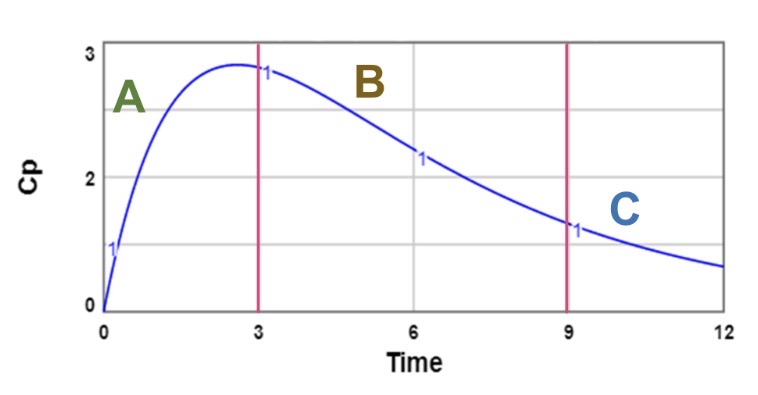
B
elimination dominant

C
ONLY elimination
(for most accusation elimination rate constant, take points from this region)
IV dose one compartmental PK
first-order elimination
Oral dose one compartmental PK
first order absorption, first order elimination
Four parameters required for an oral dose in one-compartmental model
CL (elimination) & Vd (distribution)
F, ka (absorption)
What makes a larger Cmax?
if extent or rate of absorption increases