Chapter 29: Assessment of Hematologic Function and Treatment Modalities
 Call Kai
 Learn
 Practice Test
 Spaced Repetition
 Match
 Flashcards
 Knowt Play
1/149

There's no tags or description
Looks like no tags are added yet.
150 Terms
What happens to bone marrow response with aging?
Bone marrow response decreases.
What can result from decreased bone marrow response?
Leukopenia or anemia.
What factors contribute to decreased bone marrow response?
Diminished production of growth factors.
Diminished response to growth factors.
DNA damage in stem cells.
What is immunosenescence?
An age-related decrease in immune system response due to diminished production and function of blood cells.
What systems can hematologic diseases reflect defects in?
Hematopoietic, hemostatic, or mononuclear phagocyte systems.
What are the two types of defects associated with hematologic diseases?
Quantitative: Increased or decreased cell production.
Qualitative: Defective functional capacity.
What are the initial symptoms of hematologic conditions often like?
Initial symptoms are often minimal.
What is required to diagnose hematologic conditions?
Extensive laboratory tests.
Why is continued monitoring of hematologic conditions important?
Continued monitoring through specific blood tests is essential. Trends in test results help assess patient response to interventions.
What are the components of a hematologic diagnostic evaluation?
Health history
Physical assessment
Diagnostic evaluation
Hematologic tests
What are the main hematologic tests used in diagnostic evaluation?
CBC
Peripheral smear (morphology)
Coagulation tests: PT, INR, aPTT
Bone marrow aspiration and biopsy
What are the common hematologic studies, and what does a CBC identify?
Common tests include a complete blood count (CBC) and peripheral blood smear.
A CBC identifies the total number of leukocytes, erythrocytes, and platelets. It also includes hemoglobin, hematocrit, and RBC indices.
Blood is typically obtained through venipuncture.
What is a peripheral blood smear, and what information does it provide?
A manual examination of blood that is spread on a glass slide, stained, and examined under a microscope.
It provides information about the shape, size, and appearance of blood cells.
What are the coagulation tests, what do they evaluate, and what is needed for accurate results?
Coagulation tests include prothrombin time (PT), international normalized ratio (INR), and activated partial thromboplastin time (aPTT).
They evaluate clotting ability and the effectiveness of anticoagulant medications.
Accurate results require the correct blood volume in the test tube.
What do bone marrow aspiration and biopsy assess, and what can they identify?
They assess blood cell formation and the quantity and quality of blood cells. They can also document infection or tumors within the bone marrow.
What specialized tests can be performed on a bone marrow aspirate, and what are they useful for?
Cytogenetic analysis and immunophenotyping.
These tests are useful for identifying malignant conditions and determining prognosis.
Where are bone marrow aspiration and biopsy samples obtained in adults?
Aspiration: Iliac crest or sternum.
Biopsy: Posterior iliac crest.
How is the patient prepared for a bone marrow aspiration and biopsy?
Explain the procedure, risks, benefits, and alternatives.
Administer a local anesthetic before introducing the bone marrow needle. Aspiration causes brief, sharp pain, and relaxation techniques can help ease discomfort.
Informed consent is required.
Where can bone marrow aspiration and biopsy be performed?
At the bedside or in Radiology (CT-guided).
What is a bone marrow biopsy, and why is it performed?
A bone marrow biopsy is performed with aspiration and is called a bone marrow exam.
A tissue sample is used to study bone marrow architecture and confirm diagnoses.
How is a bone marrow biopsy performed, and what should the patient feel?
A special biopsy needle is used, and the skin is punctured with a surgical blade.
The needle is advanced into the marrow cavity, and a portion of marrow is cored out.
The patient should feel pressure but should not feel pain.
What is the postprocedure care following a bone marrow biopsy?
Apply pressure to the site and cover it with a sterile dressing.
Warm tub baths and mild analgesic agents are recommended for discomfort.
Avoid aspirin-containing analgesics and rigorous activity for 1 to 2 days.
What are the potential complications of a bone marrow biopsy, and who has an increased risk?
Potential complications include bleeding and infection.
Risk is increased in patients with a low platelet count or altered platelet function.
What are the three coagulation tests, and what do they evaluate?
PT (prothrombin time), INR (international normalized ratio), and aPTT (activated partial thromboplastin time).
INR and aPTT evaluate clotting ability and the effectiveness of anticoagulant medications.
PT has been replaced by the standardized INR test.
How are coagulation tests performed, and what is required for accurate results?
Specific reagents are mixed into a plasma sample, and the time it takes for a clot to form is measured.
Accurate results require the correct blood volume in the test tube.
What are the two main purposes of coagulation tests?
Screening tools for clotting ability.
Monitoring the therapeutic effectiveness of anticoagulant medications.
What are the normal PT and INR values?
Normal PT: 11-13.5 seconds (results vary across laboratories).
Normal INR: 0.8-1.1.
INR is calculated from the PT result to ensure standardized tracking across laboratories.
What medication does PT/INR monitor, and what are the therapeutic INR ranges?
PT/INR monitors therapeutic levels of Warfarin (Coumadin).
INR 2.0-3.0: A-fib, DVT, PE.
INR 2.5-3.5: Mechanical heart valve.
What medication does aPTT monitor, and what are the normal and therapeutic values?
aPTT monitors therapeutic levels of Heparin.
aPTT therapeutic level: 30-40 seconds (or 25-35 seconds, depending on the laboratory and chemical activators used).
Normal PTT: 60-70 seconds (without activator).
What is a peripheral blood smear, and how is it performed?
A peripheral blood smear is part of a CBC.
Blood is spread on a glass slide, stained, and examined under a microscope.
Blood for a CBC is typically obtained through venipuncture.
What information does a peripheral blood smear provide, and which blood cells are examined?
It provides information about the shape, size, and appearance of blood cells.
Examination includes erythrocytes, platelets, and leukocytes.
Why is cellular morphology important, and what is the role of peripheral smear examination?
Cellular morphology is important for accurate diagnosis of hematologic disorders.
Peripheral smear examination is a manual process that is crucial for identifying hematologic conditions.
What is bone marrow aspiration, and where is it typically performed in adults?
Semifluid bone marrow is aspirated through a large needle, typically from the iliac crest or sternum in adults.
What are the steps involved in a bone marrow aspiration procedure?
Skin is cleansed using aseptic technique.
Local anesthetic is administered.
Bone marrow needle is introduced.
Stylet is removed, syringe is attached, and a small volume of blood and marrow is aspirated.
What does the patient experience during bone marrow aspiration, and how can discomfort be eased?
The patient feels pressure as the needle is advanced and sharp but brief pain during aspiration. Relaxation techniques help ease discomfort.
What nursing interventions should be performed during a bone marrow biopsy?
-Assist the patient in maintaining a comfortable position.
-Encourage relaxation and deep breathing.
-Inform the primary provider if pain occurs so additional anesthetic can be administered.
What are the potential complications of a bone marrow biopsy, and who is at increased risk?
Bleeding and infection. Risk is increased in patients with a low platelet count or altered platelet function.
What is a splenectomy, and why is it performed for hematologic disorders?
A splenectomy is the surgical removal of the spleen. It is used for conditions such as excessive destruction of blood cells and severe thrombocytopenia.
What are the advantages of laparoscopic splenectomy compared to open splenectomy?
Laparoscopic splenectomy has lower postoperative morbidity and shorter hospital stays compared to open splenectomy.
What are the potential postoperative risks and long-term complications of splenectomy?
Postoperative risks: Hemorrhage, increased clotting, and injury to surrounding organs and tissues.
Long-term risks: Life-threatening infections and venous thromboemboli.
What vaccinations and preventive treatments are recommended for patients undergoing splenectomy?
Vaccines for pneumonia, influenza, and meningococci.
Antibiotic prophylaxis for patients with an increased risk of serious infection.
What is therapeutic apheresis, and how does the process work?
Apheresis means separation. Blood is taken from the patient, passed through a centrifuge, and specific blood components are removed. The remaining blood is returned to the patient.
What are the three types of apheresis and what does each remove?
Plateletpheresis: Removal of platelets.
Leukapheresis: Removal of leukocytes.
Plasmapheresis: Removal of plasma.
What are the indications and uses of therapeutic apheresis?
Harvesting stem cells for peripheral blood stem cell transplant.
Removing dangerous substances like immune complexes and autoantibodies.
What is the purpose of hematopoietic stem cell transplantation (HSCT)?
HSCT offers the possibility of a cure for some hematologic disorders. Even when a cure is not possible, it can provide longer remission from disease.
What are the two types of HSCT, and how do they differ?
Allogeneic transplant: Stem cells come from a donor whose cells match the patient.
Autologous transplant: The patient's own stem cells are harvested and used.
What conditions can be treated with HSCT?
Severe aplastic anemia.
Some forms of leukemia.
Thalassemia.
Multiple myeloma.
What is therapeutic phlebotomy, and how is it performed?
Removal of a certain amount of blood under controlled conditions. It is similar to a blood donation procedure.
What are the indications for therapeutic phlebotomy?
Elevated hematocrits (e.g., polycythemia vera).
Excessive iron absorption (e.g., hemochromatosis).
What are the effects of therapeutic phlebotomy?
Produces iron deficiency over time.
Reduces the patient's ability to produce erythrocytes.
How is whole blood separated for blood component therapy, and why are components stored differently?
Whole blood is separated into erythrocytes, platelets, and plasma. Each component has a different storage life and processing requirements.
What are the characteristics and storage requirements of packed red blood cells (PRBCs)?
PRBCs are concentrated with a hematocrit of approximately 70%. They are stored at 6°C and can last up to 42 days with preservatives.
How are platelets and plasma stored, and how long do they last?
Platelets: Stored at room temperature and last for 5 days.
Plasma: Frozen immediately and lasts for 1 year if frozen.
What are examples of blood derivatives?
Albumin
Immune globulin
Factor VIII
Factor IX
Blood Component Therapy
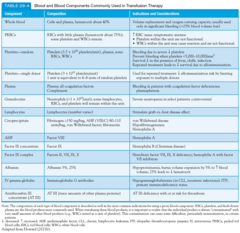
What is Factor VIII concentrate used to treat, and what additional condition can it help treat?
Used to treat hemophilia A. It contains von Willebrand factor, making it useful in treating von Willebrand disease.
What is Factor IX concentrate used to treat?
Used to treat factor IX deficiency (hemophilia B). It is also useful in treating congenital factor VII and factor X deficiencies.
What is plasma albumin used for?
Expands blood volume in hypovolemic shock. It is rarely used to increase circulating albumin concentration.
What is immune globulin used for, and what conditions may require it?
Replaces inadequate amounts of IgG. Used in chronic lymphocytic leukemia, HSCT, and autoimmune disorders.
What does the process of procuring blood and blood products involve?
Donation and processing. Blood donation involves examining and interviewing prospective donors.
What is directed donation, standard donation, and autologous donation?
Directed donation: Friends and family donate blood for a specific patient.
Standard donation: Involves venipuncture and blood withdrawal.
Autologous donation: Collecting a patient's own blood for future transfusion.
What is intraoperative blood salvage, and what is its purpose?
Replaces blood lost during surgery.
What is hemodilution?
Removing blood and replacing it with a solution before surgery.
What happens before a prospective donor can donate blood, and what is assessed?
Prospective donors are examined and interviewed before donating.
Their general health status is assessed, and risk factors are identified. There is no upper age limit for donation.
What factors determine blood donation eligibility?
Specific eligibility criteria related to medications, vaccinations, medical conditions, travel, lifestyle, and life events.
What are the minimum weight, temperature, and blood pressure requirements for blood donation?
Weight: At least 50 kg (110 lb) for a standard 450-mL donation.
Oral temperature: Should not exceed 37.5°C (99.6°F).
Systolic blood pressure: 80-180 mm Hg.
Diastolic blood pressure: 50-100 mm Hg.
What are the minimum hemoglobin requirement and waiting periods for blood donation?
Hemoglobin: At least 12.5 g/dL.
Between whole blood donations: Wait at least 8 weeks.
After receiving a blood transfusion: Wait 12 months before donating.
What travel history must be reviewed before blood donation?
Review travel destinations outside the United States and Canada within the past 3 years.
What is mentioned regarding HIV-positive donors taking medication?
Deferral periods apply to donors who are HIV positive and taking medication.
What is a directed blood donation?
A blood donation from friends or family members specifically for a particular patient.
Are directed donations safer than random blood donations? Why or why not
No. Directed donations are not safer than random donations because directed donors may not disclose risk factors that disqualify them from donating.
Why do many blood centers no longer accept directed donations?
Directed donations are not safer than random donations, and donors may fail to disclose risk factors that would disqualify them from donating.
What is standard blood donation, and how is the procedure performed?
Phlebotomy involves venipuncture and blood withdrawal.
Donors are placed in a semirecumbent position.
The skin over the antecubital fossa is cleansed with antiseptic, a tourniquet is applied, and venipuncture is performed.
Withdrawal of 450 mL of blood usually takes less than 15 minutes.
What care is provided to the donor immediately after blood withdrawal?
Donors hold the arm straight up and apply pressure with sterile gauze. A firm bandage is applied, and donors remain recumbent until able to sit up. They receive food and fluids and rest for 15 minutes
What discharge instructions should donors follow after standard blood donation?
Leave the dressing on.
Avoid heavy lifting, smoking, and alcohol.
Increase fluid intake.
Eat healthy meals.
What is autologous donation, and when is it useful?
Collecting a patient's own blood for future transfusion. It is useful for elective surgeries with high transfusion potential.
When and how is blood collected for autologous donation before surgery?
Preoperative donations are ideally collected 4-6 weeks before surgery.
Typically, 1 unit of blood is drawn each week.
Phlebotomies are not performed within 72 hours of surgery.
Iron supplements are prescribed to prevent depletion of iron stores.
What are the advantages of autologous blood donation?
Prevention of viral infections.
Safe transfusion for patients with transfusion reactions.
Prevention of alloimmunization.
What happens to autologous blood if it is not needed for transfusion?
The blood is discarded if not required and is never returned to the general donor supply.
What are the contraindications for autologous blood donation
Acute infection.
Severely debilitating chronic disease.
Hemoglobin level less than 11 g/dL.
Unstable angina.
Acute cardiovascular or cerebrovascular disease.
What is intraoperative blood salvage, and when is it used?
A replacement option for patients who cannot donate blood before surgery. It is used in vascular, orthopedic, or thoracic surgery.
How does intraoperative blood salvage work?
Blood lost into a sterile cavity is suctioned into a cell-saver machine. Whole blood or PRBCs are washed, filtered, and returned to the patient as an IV infusion.
Why can salvaged blood not be stored, and how does this procedure affect blood product needs?
Salvaged blood cannot be stored due to bacterial contamination. It decreases the need for autologous blood donation but does not eliminate the need for allogeneic blood products.
What is hemodilution, and when is it initiated?
Hemodilution is initiated before or after induction of anesthesia.
One to two units of blood are removed and replaced with a colloid or crystalloid solution. The blood is reinfused after surgery.
What is the advantage of hemodilution?
Fewer erythrocytes are lost during surgery due to dilution.
Which IV fluids are examples of colloids and crystalloids used in hemodilution?
Colloids: Albumin 5%, 25%.
Crystalloids: Normal Saline, Lactated Ringer's.
Which patients should avoid hemodilution, and what adverse outcomes are associated with it?
It is not recommended for patients at risk for myocardial injury.
It is associated with adverse outcomes in cardiopulmonary bypass and tissue ischemia, particularly in the kidneys.
What can cause excessive bleeding at the venipuncture site after blood donation?
A bleeding disorder or technique error. Technique errors include laceration of the vein, excessive tourniquet pressure, or insufficient pressure after needle withdrawal.
What can cause fainting during or after blood donation?
Emotional factors, vasovagal reaction, or prolonged fasting. Hypotension and syncope may also occur due to blood volume loss.
What should be done if a blood donor experiences faintness?
Have the donor lie down or sit with their head lowered below their knees.
Observe the donor for 30 minutes if faintness occurs.
What other complications can occur during blood donation?
Anginal chest pain: May occur in patients with unsuspected coronary artery disease.
Seizures: Can occur in donors with epilepsy, though the incidence is low.
What happens to blood samples immediately after donation?
Samples are taken immediately after donation for testing and typing.
Blood is tested for antibodies to HIV, HBV, HCV, HTLV-I/II, and syphilis.
Negative reactions are required for blood use.
What is nucleic acid amplification testing (NAT), and which viruses does it help detect?
NAT increases the ability to detect HBV, HCV, HIV, West Nile virus, and Zika virus.
How is donated blood screened for CMV and other pathogens?
Blood is screened for CMV and labeled CMV-positive if detected. Pathogen reduction technologies are used to reduce or inactivate pathogens.
Why is determining blood type important, and which blood typing systems are most important?
Determining blood type is crucial for transfusion safety.
The ABO and Rh systems are the most important.
Type O blood is used in emergencies when blood type is unknown.
What is the Rh factor, and what percentage of the population is Rh-positive
The Rh antigen is present in approximately 85% of the population, making them Rh-positive.
What compatibility testing is performed on packed red blood cells (PRBCs)?
PRBCs are tested for D antigen and ABO compatibility.
What is the purpose of leukocyte filtration, and when are leukopoor blood components used?
Leukocyte filtration reduces the likelihood of transfusion reactions and refractoriness.
Leukopoor blood components are used for patients with long-term transfusion needs.
Why are blood products irradiated, and what is an important consideration?
Irradiated blood products prevent transfusion-associated graft-versus-host disease. They have a shorter shelf life.
What should nurses know about administering blood products, and where can transfusions occur?
Know correct administration techniques, possible complications, and agency policies/procedures.
Transfusions occur in acute care hospitals, emergency situations, and outpatient settings.
Outpatient locations include infusion centers, ambulatory clinics, physicians' offices, and patients' homes.
Home transfusions are typically limited to PRBCs and factor components.
Verification and administration procedures are similar to hospital settings.