Computer Science GCSE - OCR Paper 1
 Call Kai
 Learn
 Practice Test
 Spaced Repetition
 Match
 Flashcards
 Knowt Play
1/189

There's no tags or description
Looks like no tags are added yet.
190 Terms
What makes a computer a computer?
Input - Process/Storage - Output
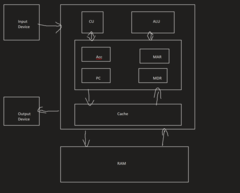
Diagram of Von Neumann Architecture
What does HTML stand for?
Hypertext Markup Language
What is the CPU made up of?
Control Unit (CU)
Arithmetic Logic Unit (ALU)
Cache
Registers
What does the CU do?
Tells everything else what to do
What does the ALU do?
It carries out all the arithmetic and logical operations such as addition. subtraction and logical operations
What is cache?
Very Small, Very fast memory for frequently used info near the CPU
What registers are there?
Accumulator (Acc)
Program Counter (PC)
Memory address register (MAR)
Memory Data Register (MDR)
What does the accumulator do?
Stores intermediate results of calculations in the ALU
What does the program counter do?
Holds the memory address of the instruction for each cycle
What does the memory address register do?
Holds any memory address about to be used by the CPU
What does the memory data register do?
Temporarily stores the data that has just been read from or the data needs to be written.
What does the CPU do?
processes data (fetch -> decode -> execute -> repeat)
CPU fetches next instruction from RAM, decodes it can carries it out
What is the speed of a CPU measured in
Hz (or more commonly GHz)
What are the main factors effecting the speed of the CPU?
- Size of the Cache
- Number of cores (programs have to be written to make use of the cores)
- The clock speed. Overclocking can be done by increasing the voltage going to the CPU
What is the purpose of an embedded system
to control the device and to allow a user to interact with it
Examples of Embedded Systems
Microwave Ovens
Washer-dryers
Car dashboards
Calculators
Sat-Navs
Digital Cameras
List the three types of storage
Primary storage
Secondary Storage
Tertiary Storage
Give examples of Primary Storage
RAM
ROM
Register
Cache
Give examples of Secondary Storage and what might be stored on it
HDD/SSD
The OS
Programs
Data
What might tertiary Storage be for
backups/archives of large amounts of data
Features of Primary Storage
- ROM is read-only
- All others are volatile
- Relatively small capacity compared to secondary (GBs)
- Very Fast Access time
Features of Secondary Storage
- Non-Volatile
- Much Larger Capacity (TBs)
- Relatively slow access times
What is Meant by volatile
All data is lost when power is lost.
What is ROM
Read Only Memory
Small peices of memory soldered to the motherboard that contain the very first instructions (bootstrap) of the computer. It is non volatile. It runs firmware called BIOS (Basic Input Output System)
What is RAM?
Random Access Memory
Temporary Storage of data being executed by the CPU. It is volatile but is much faster than the SSD or HDD. It holds the OS when the computer is running
Describe what a POST is
When the computer boots up, the ROM tells the CPU how to get to the OS and other info on the hard disk and move it to RAM. It also makes it do a Power On Self Test to check everything is working.
What is virtual memory?
a portion of the hard disk designated to function as additional RAM when not enough real RAM is available
List the Three types of Secondary Storage
Magnetic (uses magnetism) - HDD
Optical (Uses laser Light) - DVD
Solid State (uses microchips) - SSDs
Why is secondary storage needed?
To store data and programs when the power is switched off
What are the properties of every storage device
Capacity
Speed
Portability
Durability
Reliability
Cost
List the three types of optical storage and the amount they can store
CD - 650MB
Blueray - 25GB
DVD - 4.7GB
filler ignore
.
How do optical storage devices store data?
Pits and Lands, based on the reflection of the laser we can tell which it is.
State the properties of optical storage
- Cheap
- Portable/Lightweight
- Quite Slow
- Can get scratched easily
List the three types of magnetic Storage
Floppy Disk
HDD
Tape
State how Magnetic storage devices store Data
are negatively or positively magnetised to represent a 1 or a 0
State the properties of magnetic storage
Cheap
Large Capacity
Fragile
Heavy
List the three types of Solid State Storage
SSD
USB memory Stick
Memory Cards
State the properties of solid state storage
Durable
Fast access times
More expensive per GB
Limited read/write
Not as large as HDDs
What does a bit represent?
a single 1 or 0
What is a nible?
4 bits
What is a byte?
8 bits
what is a kilobyte (KB)
1000 bytes
What is a Megabyte (MB)
1000 kilobytes
What is a Gigabyte (GB)
1000 Megabytes
What is a Terabyte (TB)
1000 gigabytes
What is a petabyte (PB)
1000 Terabytes
How do the columns go in Binary for a single byte
128 | 64 | 32 | 16 | 8 | 4 | 2 | 1
What is the smallest number in 1 byte
00000000 => 0
What is the largest number in 1 byte
11111111 => 255
How many unique numbers in 1 byte
256
How many unique numbers in 2 bytes
65,536
What is 0+0 in a binary column?
0
what is 1+0 in a binary column?
1
What is 1+1 in a binary column
0, carry a 1 to the next column
what is 1+1+1 in a binary column?
1, carry a 1 to the next column
A binary shift left by n spaces will
multiply by 2^n
a binary shift right by n spaces will
divide by 2^n
What happens if a shift results in a number "going off the edge"
when you try the shift the other direction, a 0 is added, no matter what the original value was
What is a character set
A list of all the letters, numebrs, symbols and control characters that can be represented by the computer
How is a character set represented on a computer
Each character is given a unique binary number
What does ASCII stand for
American Standard Code for Information Interchange
How many bits are used (and consequently how many characters can be formed) in ASCII
7 bits (128 characters)
How many bits are used (and consequently how many characters can be formed) in Extended ASCII
8 bits (256 characters)
What were number codes 0-31 used for in ASCII
special instructions to the computer
How many bits are used (and consequently how many characters can be formed) in Unicode
16 bits (65,536 characters)
How are images represented?`
in pixels
What does bpp mean and what is it?
bits per pixel. It is the number of bits used to represent the colours in each pixel
How many colours can be represented by 32 bpp
16,777,216 colours with 256 levels of transparency (alpha chanel)
What metadata about an image is needed
- Height
- Width
- resolution
- Bitdepth (bpp)
What is a bitmap
an image stored as an array of individual pixels
What is a vector image
An image made with mathematical formulas
How are we able to store sound in binary
It is converted into a series of binary numbers at regular intervals (samples) to represent the sound at each point so that it can be replayed later. Some quality is lost but depends on the bits per sample.
What two types of compression are there?
Lossless (nothing is lost in the compression)
Lossy (Some quality is lost)
When is lossy compression used?
Images/audio/video/etc when all of the quality isn't needed
When is lossless compression used
Text files/programs/other files when no information can be lost. Either because it will break the file or the original quality must be kept.
Why can't lossy compression be used on general files
because if any of the data is lost then parts of code may be lost and it may not work properly
Why is hexadecimal used?
- It's easier to read than binary
- It takes up less space when printed
- Easy to convert from Hex to Binary and vice versa
What does each digit of Hex represent?
1 nible of binary
what are the first 3 column headings of hex
256 | 16 | 1
How do the column headings work in Hex
Convert the hex number into denary and multiply it by the column heading
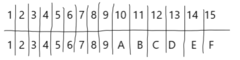
What represents what in Hex
What is a LAN
- Local Area Network
- A network that connects computers within a limited area such as a school or office
- All hardware is usually owned by the organisation using it
- Wired using UTP, fibre optics or WI-FI
- Computers connected with a switch
What is a WAN
- Wide Area Network
- Much larger and connect several LANs
- Connected with fibre optics, telephone lines and satellites
- Computers connected with a router
What is a client/server network?
A network that has a server that is used to manage things about the other computers such as logins, printing and file storage
Positives and negatives of a client server network
- Easier to manage security
- Easier to take backups
- Easier to install software on all computers
- Can be expensive to setup and maintain
- Requires IT specialist to maintain
- Server is a single point of failure
What is a peer-to-peer network?
A network without a central server in which all computers are equal and handle everything themselves such as logins, printing and file storage
Positives and negatives of a peer-to-peer network
- Very easy to maintain
- Specialist staff not needed
- No dependency on a single computer
- Cheaper to setup
- Network is less secure
- Users need to manage their own backups
- Can be difficult to maintain a well ordered file system
What is a NIC
- Network Interface Card
- Normally integrated, not a separate card
- Is the thing that turns the 1s and 0s into electrical impulses, or light etc
What is a WAP
- Wireless Access Point
- More convenient
- Less bandwidth than wired
- More of a security concern
- Is not as strong or reliable as a wired connection
- Does not connect to the internet, the WAP needs to be connected to the router

What is a Switch
- Used for connecting wired devices on a LAN
- Send data between things on a LAN
- Usually the heart of the network
- Knows what is on each port
What is a Hub
- Looks like a switch
- Does the same job as a switch
- Is easier to set up than a switch
- Is cheaper than a switch
- Is slower than a switch
- Doesn't know what is on each port
What is a router?
- Send data between networks
- It creates a WAN from lots of LANs
- You cannot connect to a WAN without a router
- Uses an IP (Internet Protocol) address to route traffic
What does UTP stand for?
- Unshielded Twisted Pair
- Copper cables
- Maximum bandwidth, security and reliability
What are Fibre optic Cables
- Uses light to transmit Data
- Cover much longer distance than copper
- The backbone of the internet uses fibre optics
What is WiFi?
- Transmits and receives data using radio waves
- Uses 2.4GHz and 5GHz
What is a star topology?
Where client machines are connected to a central switch or hub, which is usually in turn connected to one or more servers. Signals travel in either direction.
What is a mesh topology?
Mesh topology is a setup wherein each device is connected directly to every other device on the network.
What is a partial mesh topology
hybrid of mesh and hub-and-spoke topologies. designed to offer an optimal route between selected sites and avoiding expense of interconnecting every site.