Leukaemias
 Call Kai
 Learn
 Practice Test
 Spaced Repetition
 Match
 Flashcards
 Knowt Play
1/94

There's no tags or description
Looks like no tags are added yet.
95 Terms
Leukemias
Heterogeneous clonal hematopoietic progenitor and/or stem cell malignancy in which immature or mature hematopoietic cells proliferate and accumulate in the bone marrow, blood, and/or other tissues
Which 2 pathways from blood stem cell form what blood cell types

What type of cells are formed by granulocytopoeisis

By what process are platelets formed


Name them

Most common leukaemia type
AML = 90% of all acute leukemias in adults
(estimated 20,240 new cases and 11,400 deaths expected in the United States in 2021)
By what fold does risk increase for AML between 20 & 65 yrs
10 fold increase in risk
AML medial diagnosis age
68 years
How does survival compare for AML for children vs patients aged 45 vs 60+
Children 5-year survival = 70%.
45% 5-year survival for patients aged 45
<10% for those older than 60 years
Most common risk factor for AML
The most common recognized risk factor is previous exposure to radiation or chemotherapeutics which result in therapy-related AML (t-AML) and account for ~10% to 20% of all AML cases
Name 2 environmental exposures that can → AML
Environmental exposures linked to the development of t-AML include benzene and ionizing radiation
Latency period for AML after exposure
5 to 10-year latency period
Name the 3 primary mutations that transform normal HSC (haematopoietic stem cells) → pre-leukaemia HSC → Leukaemia stem cells
Primary mutations = DNMT3A, TET2, IDH1/2
Name the 4 secondary mutations that transform pre-leukaemia HSC → Leukaemia stem cells
Secondary mutation s= FLT3ITD, JAK2, NMP1, NRAS

AML symptoms
Pallor
Bone pain
Fever
Fatigue
Hepatosplenomegaly
Bruising & bleeding
How does a blood film of AML look

5 tests for AML
Diagnosis with BMAT
Flow Cytometry
Cytogenetics
FISH
Molecular analysis
7 classes of AML

What % blasts in the blood or bone marrow indicates acute leukaemia
20%
Do you need 20% blasts to diagnose leukaemia
No - Most AML-defining genetic abnormalities can establish AML without reaching the 20% blast threshold
Name 2 types of AML that require >20% blasts for diagnosis
BCR-ABL
CEBPA
Treatment for young, fit patients with AML
DA 3 + 10: (Daunorubicin x 3d) + (Cytarabine x 10 d)
FLAG-Ida: Fludarabine + Cytarabine + G-CSF + Idarubicin
Complete remission (CR) rate for AML treatment (DA 3 + 10 & FLAG-Ida)
70%
CR rate in AML with unfavourable chromosomal abnormalities / adverse cytogenetics
47%
CR rate in therapy related AML
51%
CR rate in secondary AML
39%
What 3 drugs are used in Older/Less fit AML patients to Maximise survival/Maintain Quality of Life
Azacitidine
Decitabine
Low-Dose Cytarabine
CR rate in Older/Less fit AML patients
30%
Median overall survival length for Older/Less fit AML patients
12 months
Mutation in APML
Acute promyelocytic leukemia is characterized by a balanced reciprocal translocation resulting in the fusion of the PML gene on chromosome 15 with the RARA gene on chromosome 17.
Hypergranular / Typical APL (M3) makes up what % of cases
60-70%
How does Hypergranular / Typical APL (M3) present on an FBC
Low WBCs
How does Hypergranular / Typical APL (M3) present on a blood film
Abnormal promyelocytes with numerous red to purple cytoplasmic granules that are typically darker and larger than normal neutrophil granules.
Identifiable faggot/matchstick cells with numerous Auer rods.

How does Hypogranular / Microgranular APL (M3v) present on a blood film
. Leukocytosis.
. Numerous abnormal promyelocytes readily identified on a peripheral blood smear.
. Irregular nucleus and granulations sparser and finer compared with the hypergranular form.
. Faggot cells with multiple Auer rods less commonly seen.

What’s the problem in APML
Coagulopathy causing early deaths with CNS and GI bleeds
Treatment for APML
ATRA (all trans retinoic acid)
What causes APL differentiation syndrome

Risk with APML is dependent on what
WCC at presentation
Drug Tx for APML
ATRA + ATO ± anthracycline
How else is APML treated
Management of differentiation
syndrome and coagulopathy
Pathogenesis of APL

How does retinoic acid work on APL

Most common leukemia in children
Acute lymphoblastic leukemia (ALL)
Prevalence of ALL in children & adults
ALL = 23% of all paediatric cancer diagnoses and 76% of leukemias among children <15 years of age)
20% of adult acute leukemias.
2 subtypes of ALL
B lymphoblastic
T lymphoblastic
How is ALL diagnosed & other tests
Diagnosis with BMAT
Flow Cytometry
Cytogenetics
FISH
Molecular analysis


How does treatment differ for fit vs unfit pts with ALL

What is DFS
Disease free survival
Are transfusions used in ALL
Yes - Support Hb and platelets
Tx for mucositis in ALL
Mucositis in ALL (acute lymphoblastic leukaemia) = inflammation and ulceration of the mucous membranes, particularly in the mouth and gastrointestinal tract, often caused by chemotherapy
A pump might be used for fluids & meds.
Parenteral nutrition might be used
How is TLS treated in ALL
Tumor Lysis Syndrome (life-threatening oncological emergency - massive number of leukaemia cells die very quickly) is treated with Fluids, rasburicase & allopurinol
What is sarcopenia
A loss of skeletal muscle mass and strength (can happen with long periods in bed)
What is the most prevalent lymphoid malignancy in North America and Europe
CLL
CLL is less common among what ethnicities
African & Asian
CLL median age at diagnosis
72
Is there a difference in prevalence between men & women in CLL
Yes - Men:Women = 2:1
Name a precursor condition that can progress to CLL.
Monoclonal B-cell lymphocytosis (MBL)
Sx of CLL
Asymptomatic- incidental finding in FBC
Anemia
Thrombocytopenia
Lymphadenopathy
Splenomegaly
Fatigue
Night sweats
Weight loss
Fever
How is CLL staged
RAI BINET

Grey = features that make it that stage
Green = Low/Intermediate/High

Name1 investigation that is sufficient to establish a diagnosis of CLL?
PB immunophenotyping
Which immunophenotype is characteristic of CLL
Lymphocytes CD5, CD19 CD20 CD23 +
Name 3 other investigations that can be done for CLL
Lymph node biopsy
Bone marrow biopsy
CT neck thorax abdomen pelvis
What is the purpose of the CLL-IPI?
Prognostic assessment and risk stratification
What is the range of CLL-IPI
0-10 points
What goes into calculating the CLL-IPI score
Age
Clinical stage
17p13 deletion and/or
TP53 mutation
IGHV mutation status
B2M level (mg/L)
What value for each of these gives what CLL-IPI score:
Age
Clinical stage
17p13 deletion and/or
TP53 mutation
IGHV mutation status
B2M level (mg/L)

What is considered low, intermediate, high and very high risk using the CLL-IPI score
Low-risk patients (score 0-1), 93.2%
Intermediate risk (score 2-3), 79.3%
High risk (score 4-6), 63.3%
Very high risk (score 7-10), 23.3%

These are all possible features of CLL

True/False Most patients never receive chemo for CLL
True - Majority of patients will never need treatment
What 3 things would need to be considered in the Tx of CLL
(- Mutated IGHV: More favourable prognosis; generally slower disease progression.
- Unmutated IGHV: Less favourable prognosis; generally faster progression.
- TP53 mutation / del(17p): High-risk disease. If treatment is indicated, targeted therapy is preferred over conventional chemoimmunotherapy.
- Comorbidities and quality of life: Influence which treatment is chosen and whether its benefits outweigh its risks.)


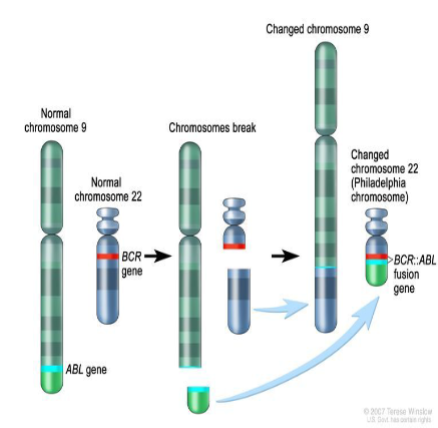
Mutation associated with CML
BCR-ABL1 fusion gene, which is usually derived from a balanced translocation between the long arms of chromosomes 9 and 22, t(9;22) (q34;q11), resulting in a derivative chromosome known as the Philadelphia (Ph) chromosome
CML accounts for what % of adult leukemia cases
15% to 20%
What is the worldwide annual incidence of CML per 100,000
1-2 cases per 100,000
Is there a gender predominance in CML
male-to-female ratio, 1.3:1 (male slight predominance)
CML median age of diagnosis in EU vs US
EU: 60 and 65 years
US 65 - 74
CML is what % of leukaemias in children
2% of all leukemias in children <15 years of age
9% of all leukemias in adolescents 15 to 19 years of age
Signs & symptoms of CML
Asymptomatic- incidental finding in FBC
Anaemia
Hepatomegaly
Thrombocytopenia/thrombocytosis
Splenomegaly
Fatigue
Night sweats
Weight loss
Fever
2 phases of CML
Chronic phase
Blast phase
In the scoring of CML what does the social score take into account & what is considered low/intermediate/high risk

In the scoring of CML what does the hasford score take into account & what is considered low/intermediate/high risk

In the scoring of CML what does the EUTOS score take into account & what is considered low/high risk

In the scoring of CML what does the ELTS score take into account & what is considered low/intermediate/high risk

How is CML diagnosed
BMAT
4 other investigations for CML
Flow Cytometry (blast phase)
Cytogenetics
FISH
RT-PCR
Drug treatment options for CML
TKIs
1st gen Imatinib
2nd gen Dasatinib
Nilotinib
Bosutinib
3rd gen Ponatinib
Supportive tests & treatment options for CML
Baseline echocardiogram, ECG
Control of BP
How is CML treatment monitored
BCR-ABL transcripts: Measure how much leukaemia-associated BCR-ABL mRNA is present in the blood
BCR-ABL mRNA levels aim for 3, 6, 12 months
- 3 months: Aim for ≤10%.
- 6 months: Aim for ≤1%.
- 12 months: Aim for ≤0.1% — this is Major Molecular Response
What is the difference in BCR-ABL mRNA levels in a molecular response (MR) of 4 vs 4.5
MR4: BCR-ABL has decreased by at least 10,000-fold (4-log reduction).
MR4.5: BCR-ABL has decreased by at least ~32,000-fold (4.5-log reduction)


Tempo = fast/slow
Diagnosis = PM/BM
Survival = variable/good/excellent
