I 8 - Drugs used in the treatment of bacterial infections 1 - inhibitor of metabolism
 Call Kai
 Learn
 Practice Test
 Spaced Repetition
 Match
 Flashcards
 Knowt Play
1/22

There's no tags or description
Looks like no tags are added yet.
23 Terms
What are the origins of antibiotics
Natural
• Made by soil bacteria and fungi
• Benzylpenicillin, erythromycin, vancomycin
semi -synthetic
• A natural core, chemically modified
• Amoxicillin from 6-aminopenicillanic acid (6-APA), amikacin from kanamycin
Fully synthetic
• No natural parent at all
• Sulfonamides, trimethoprim, quinolones
• Nitrofurantoin, metronidazole, oxazolidinones
• Strictly, these are antibacterials, not antibiotics
What do we have to consider when using antibiotics?
Most processes in mammals and bacteria are very similar; if we try to kill bacteria, we may also harm the host organism
Need to find a degree of selective toxicity - processes within bacteria which are more susceptible to antibiotics than the processes in the host
What are highly selective targets in bacteria?
Target | Why is it highly selective? |
|---|---|
Bacterial cell wall synthesis | Human cells lack cell walls. |
Dihydropteroate synthase (DHPS) | This enzyme is present in bacteria but absent in humans. |
Note - preferred as they allow bacteria to be inhibited with less harm to the host
What are less selective targets in bacteria ?
Less selective targets
These involve processes present in both bacteria and humans:
Protein synthesis.
Dihydrofolate reductase (DHFR).
Transcription.
DNA replication.
What antibiotic drug classes can be identified from name endings ?
Drug name ending | Drug class | Examples |
|---|---|---|
-cillin | Penicillins | Amoxicillin, flucloxacillin |
cef- / ceph- | Cephalosporins | Cefalexin, ceftriaxone |
-penem | Carbapenems | Meropenem, ertapenem |
-bactam | Beta-lactamase inhibitors | Tazobactam, avibactam |
-floxacin | Fluoroquinolones | Ciprofloxacin, levofloxacin |
-mycin | Often products derived from Streptomyces | Streptomycin |
-micin | Often products derived from Micromonospora | Gentamicin |
What are the main targets for antibacterial drugs ?
Main targets
Cell wall: Inhibition of cell wall synthesis.
Ribosomes: Inhibition of bacterial protein synthesis.
DNA/RNA: Inhibition of DNA replication or transcription.
Plasma membrane: Disruption of membrane function.
Metabolic enzymes: Inhibition of essential metabolic pathways.

What are the structures of Gram-positive and Gram-negative bacteria?
Feature | Gram-positive bacteria | Gram-negative bacteria |
|---|---|---|
Cell membrane | One cytoplasmic membrane | Inner and outer membranes |
Peptidoglycan | Thick layer | Thin layer |
Outer membrane | Absent | Present |
Lipopolysaccharide (LPS) | Absent | Present in outer membrane |
Drug entry | Generally fewer barriers | Outer membrane restricts drug entry |
Periplasmic space | Less prominent | Contains enzymes such as beta-lactamases |
What are the main structural differences between gram positive and gram negative bacteria ?
Gram-positive bacteria
Structure:
One cytoplasmic membrane.
Thick peptidoglycan layer.
No outer membrane.
Gram-negative bacteria
Structure:
Inner cytoplasmic membrane.
Thin peptidoglycan layer.
Outer membrane containing lipopolysaccharides (LPS).
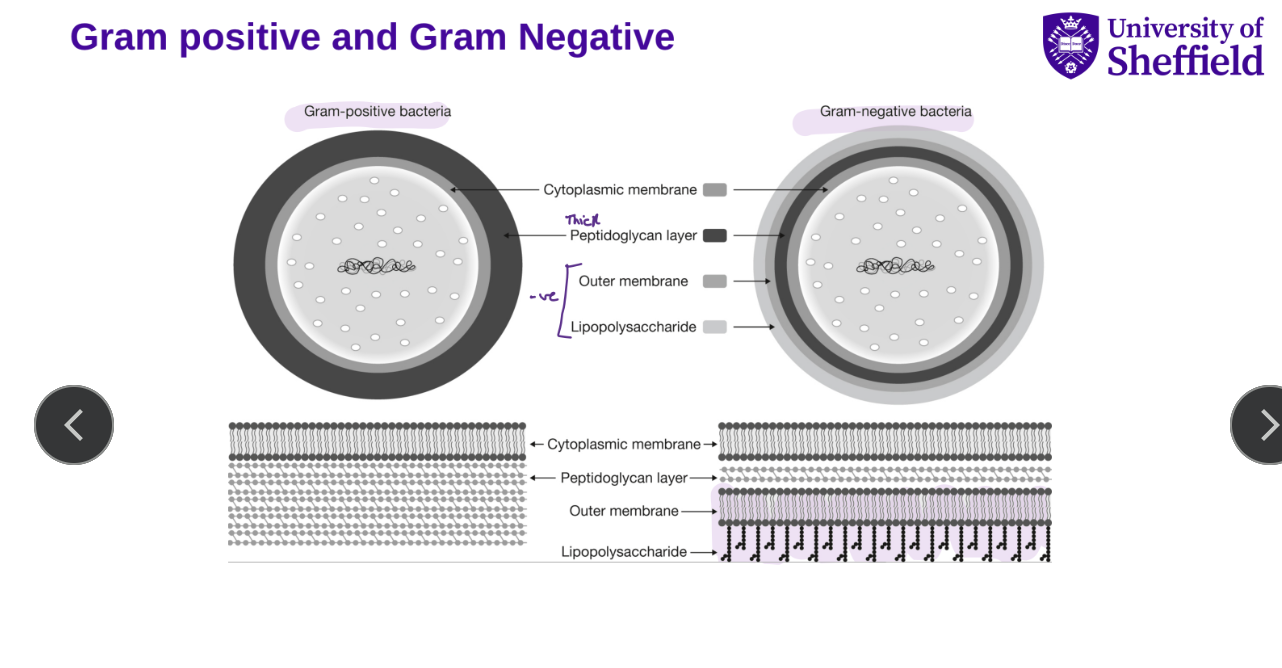
Why are Gram-negative bacteria harder for antibiotics to target ?
The outer membrane acts as an additional protective barrier.
Some drugs must enter through porin channels.
Beta-lactamases in the periplasm can break down susceptible beta-lactam antibiotics.
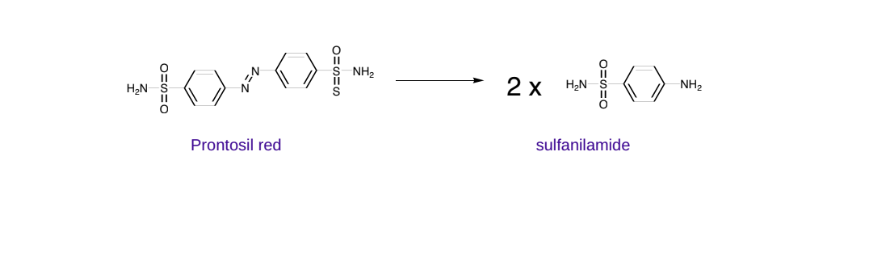
What is Prontosil, and how was it made active?
Early antibacterial drug developed from azo dye
found it was effective in vivo but inactive in vitro
Found that it was metabolised by azoreductase into an active antibiotic ( it has an azo bond which is cleaved and then releases sulfanilamide)
Prontosil acts as a prodrug
Why do bacteria need folate ?
Bacteria require folate to produce tetrahydrofolate (THF).
THF transfers one-carbon units needed for the synthesis of thymidine and other DNA components.
Therefore, folate metabolism is essential for bacterial DNA synthesis and growth.
note: needed for DNA synthesis
What is the folate pathway - describe the steps ?
Pathway that synthesises tetrahydrofolate, which is needed for DNA synthesis
Sulfanilamide inhibits this process
Step 1 – Formation of dihydropteroate
Para-aminobenzoic acid (PABA) combines with dihydropterin pyrophosphate.
The enzyme dihydropteroate synthase (DHPS) catalyses the reaction.
This produces dihydropteroate.
Step 2 – Formation of dihydrofolate
Glutamate is added to dihydropteroate.
This produces dihydrofolate (DHF).
Step 3 – Formation of tetrahydrofolate
Dihydrofolate is reduced to tetrahydrofolate (THF).
The reaction is catalysed by dihydrofolate reductase (DHFR).
NADPH provides the reducing power.
Step 4 – DNA synthesis
Tetrahydrofolate provides one-carbon units needed for thymidine synthesis.
Thymidine is required for DNA synthesis.

How does folate metabolism differ in bacteria and humans?
Bacteria | Humans |
|---|---|
Must synthesise folate. | Obtain folate from the diet. |
Have DHPS. | Do not have DHPS. |
Have DHFR. | Have DHFR. |
Susceptible to sulfonamides targeting DHPS. | Lack the DHPS target of sulfonamides. |
What are sulfonamides, and how do they work?
What are sulfonamides?
Sulfonamides are synthetic, bacteriostatic antibacterial drugs that inhibit bacterial folate synthesis.
How do sulfonamides work?
Sulfonamides have a similar chemical structure to PABA.
They act as competitive inhibitors of dihydropteroate synthase (DHPS).
They compete with PABA for the enzyme's active site.
DHPS may incorporate the sulfonamide instead of PABA, producing a compound that cannot undergo further transformation.
This interrupts the synthesis of dihydrofolate and tetrahydrofolate.
Without sufficient THF, bacteria cannot efficiently synthesise thymidine for DNA.
This inhibits bacterial growth.

Why can sulfonamides bind to DHPS?
Sulfonamides mimic PABA through similar interactions, including:
Hydrogen bonding.
Ionic interactions.
π–π interactions.
These interactions help sulfonamides bind to the enzyme.
Are sulfonamides bacteriostatic or bactericidal?
Bacteriostatic.
They inhibit bacterial growth and multiplication rather than directly killing bacteria.
The host immune system can then eliminate the bacteria.
What structural features are essential for sulfonamide activity - SAR?
Structural feature | Importance |
|---|---|
N4 amino group | Essential for antibacterial activity and must remain unsubstituted in the active drug. |
Para relationship | The amino group must be para to the sulfonamide group to mimic PABA. |
N1 sulfonamide nitrogen | Must retain a hydrogen; may be primary or secondary. |
N1 substituent | Main position for structural modification to improve drug properties.- can be modified to improve activity |
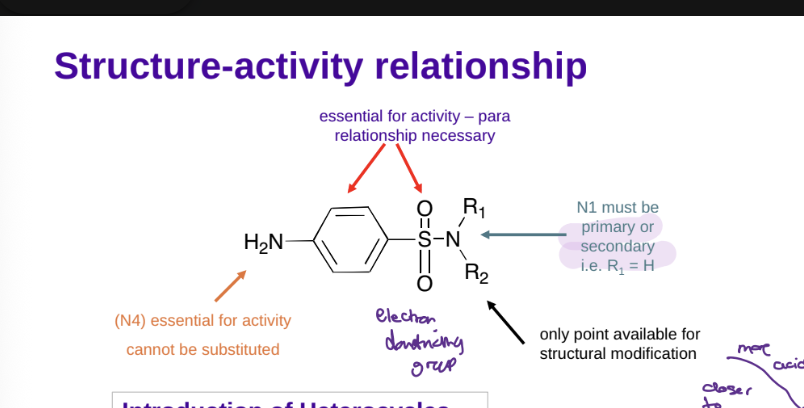
What effects does introducing electron-withdrawing groups on the N1 substituent have on activity?
Electron-withdrawing heterocyclic groups :
Increase the acidity of the sulfur-linked amide ( n-h), lowering the pKa towards PABA ( closest to 4.9 is better for binding )
The pKa affects how much of the drug is ionised at physiological pH - this is increased
Compared to the carboxylic acid in PABA, enhances antimicrobial activity
Enhances water solubility
Higher potency and better solubility in urine
What is another enzyme target in the folate pathway, and how does trimethoprim work?
What is DHFR?
Dihydrofolate reductase (DHFR) is an enzyme that converts dihydrofolate (DHF) into tetrahydrofolate (THF).
THF is essential for DNA synthesis.
Both bacteria and humans have DHFR.
Mechanism of action of trimethoprim
Trimethoprim binds to bacterial DHFR.
It inhibits the reduction of DHF to THF.
This reduces the availability of THF.
Consequently, bacteria cannot produce sufficient thymidine for DNA synthesis.
Bacterial growth is inhibited.

why is trimethoprim selective for bacteria?
Bacterial and human DHFR have slightly different structures.
These differences allow trimethoprim to bind much more strongly to bacterial DHFR.
The lecture states that bacterial DHFR is approximately 100,000 times more susceptible to trimethoprim.
Other drugs that inhibit DHFR
Drug | Main target | Clinical application |
|---|---|---|
Trimethoprim | Bacterial DHFR | Antibacterial treatment |
Methotrexate | Human DHFR | Cancer treatment |
Pyrimethamine | Plasmodial DHFR | Antiprotozoal treatment |
What is sequential blocking?
Sequential blocking occurs when two drugs inhibit different stages of the same metabolic pathway.
Use a combination of the drugs. Co-trimoxazole is a combination of two antibacterial drugs:
Sulfamethoxazole – a sulfonamide.
Trimethoprim – a DHFR inhibitor.

How does co-trimoxazole work ?
Step 1 – Sulfamethoxazole
Competitively inhibits DHPS.
Prevents the normal formation of dihydropteroate.
Reduces the production of dihydrofolate.
Step 2 – Trimethoprim
Inhibits DHFR.
Prevents remaining dihydrofolate from being converted into tetrahydrofolate.
Step 3 – Combined effect
THF production is strongly reduced.
Thymidine and DNA synthesis are impaired.
Bacterial growth is inhibited.
drug summary
rug | Drug class | Target enzyme | Mechanism of action | Main effect |
|---|---|---|---|---|
Sulfonamides | Antimetabolite antibacterials | DHPS | Mimic PABA and competitively inhibit folate synthesis | Bacteriostatic |
Sulfamethoxazole | Sulfonamide | DHPS | Prevents normal dihydropteroate formation | Bacteriostatic |
Trimethoprim | DHFR inhibitor | Bacterial DHFR | Prevents DHF conversion to THF | Bacteriostatic |
Co-trimoxazole | Combination antibacterial | DHPS + DHFR | Sequential inhibition of bacterial folate synthesis | Synergistic; may be bactericidal |
Methotrexate | Antifolate | Human DHFR | Inhibits folate metabolism and DNA synthesis | Anticancer |
Pyrimethamine | Antifolate | Plasmodial DHFR | Inhibits folate metabolism in parasites | Antiprotozoal |
summary - key concepts
Selective toxicity – why certain antibiotics target bacteria rather than human cells.
Gram-positive vs Gram-negative bacteria – structural differences and their effect on drug entry.
Prontosil – why it is a prodrug and how it forms sulfanilamide.
The bacterial folate pathway – the steps from PABA to THF and its role in DNA synthesis.
Sulfonamide mechanism of action – competitive inhibition of DHPS.
Sulfonamide SAR – the importance of N1, N4, the para relationship and pKa.
Trimethoprim mechanism of action – inhibition of bacterial DHFR.
Selective inhibition of DHFR – differences between trimethoprim, methotrexate and pyrimethamine.
Co-trimoxazole – sequential blocking and synergism.
Antibacterial resistance – mutations and overproduction of DHFR