Ch.9 Gene Expression: The Flow of Information from DNA to RNA to Protein
 Call Kai
 Learn
 Practice Test
 Spaced Repetition
 Match
 Flashcards
 Knowt Play
1/31

There's no tags or description
Looks like no tags are added yet.
32 Terms

Central Dogma
DNA →RNA → Protein
Transcription (DNA to RNA)
Translation (RNA to Protein)

Major Chemical Difference btwn RNA + DNA (3)
Ribose instead of deoxyribose
Nitrogenous base uracil instead of thymine (pairs with A)
Most RNA single stranded

Amplification of Gene
(Transcription) single gene is transcribed into many RNA molecules → (Translation) Each RNA molecule is then translated into many protein molecules

Codon
group of 3 nucleotides
EX: 3 nucleotide code = 43 = 64 combinations
Colinear
The sequence of nucleotides in a gene directly matches the sequence of amino acids in the protein

Non-overlapping
Each nucleotide is part of only one codon—the reading frame moves in steps of three without overlapping

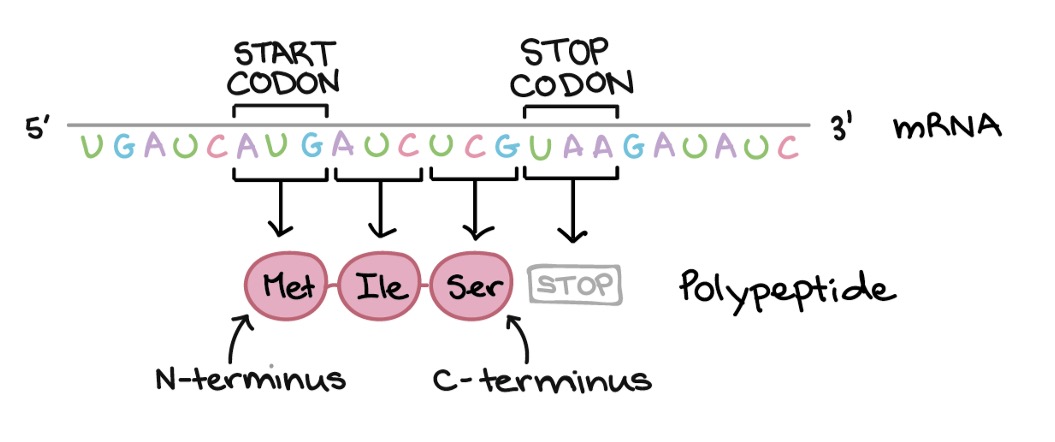
Reading frame
Translation starts at a specific "START" codon and continues in triplet groups, establishing a strict reading frame until it hits a "STOP" codon

Crick + Brenner
Added or deleted 1/2 bases = frameshift + scrambled protein sequence
Added or deleted 3 bases = normal protein
Key Concepts of Genetic Code (6)
Triplets + Nonoverlapping
Stop codon: AUG
Start codon: UAA, UAG, UGA
Degenerate (yet ambiguous)
Mutations: frameshift, missense, nonsense
Almost universal

Transcription
One of the two strands of the DNA double helix serves as a template for a single-stranded RNA transcript
RNA strand formed by complementary base pairing
Promoter
(Transcription in prokaryotes)
DNA sequences that act as a "start" signal, telling RNA polymerase where to bind and begin transcription
RNA polymerase builds 5’-3’
Terminators
RNA sequences that provide the signal to RNA polymerase for stopping transcription
Form hairpin loops (intramolecular H-bond)

Transcription in prokaryotes: Initiation
Region of DNA is unwound to form open promoter complex
Phosphodiester bonds formed between first two nucleotides

Transcription in prokaryotes: Elongation (RNA copy)
Core RNA polymerase loses affinity for promoter, moves in 3’-to-5’ direction on template strand
Within transcription bubble, NTPs added to 3’end of nascent mRNA
Eukaryotic mRNA transcription
transcript must be processed (adding a 5' cap, a 3' poly-A tail, and splicing out introns) before becoming mature mRNA
prokaryotic happens immediately
5' methylated cap
adds a “backward” G to the 1st nucleotide of a primary transcript (not from the DNA template)
Poly-A polymerase.
adds the string of adenine bases to the 3' end of eukaryotic mRNA, creating the poly-A tail
the longer the message; longer the tail

Exons
expressed regions; sequences found in a gene’s DNA and mature mRNA

Introns
intervening regions; sequences found in DNA but not in mRNA
Some eukaryotic genes have many introns
Untranslated Regions (UTRs)
regions of mRNA located at the 5' and 3' ends (outside of the protein-coding region) that are not translated into amino acids
Alternative splicing
process where a single primary RNA transcript is spliced in different ways to produce multiple distinct mRNAs and proteins from the same gene
Charged tRNA
molecule that is covalently coupled to its specific amino acid, ready to deliver it to the ribosome during translation
74-95 nt, anticodon (comp to mRNA codon)
Wobble Position
Some tRNAs recognize more than one codon
genetic code is degenerate (5’ anticodon pairs with various 3’ codon)

Translation: Initiation (Stage 1)
small ribosomal subunit binds to the 5' cap of the mRNA and migrates to the first AUG start codon. An initiator tRNA carrying Methionine (Met) then establishes the starting point for protein synthesis

Translation: Elongation (Stage 2)
Charged tRNAs are ushered into the ribosome's A site, new amino acids are added to the C-terminus of the polypeptide, and the ribosome moves down the mRNA in the 5'-to-3' direction

Translation: Termination (Stage 3)
When the ribosome reaches a stop codon, release factors bind to it. This triggers the release of the ribosomal subunits, mRNA, and completed polypeptide chain

Polyribosome
structure where several ribosomes translate the same mRNA simultaneously
allows cell to rapidly produce many copies of a polypeptide from a single mRNA transcript

Mutations in coding sequences (4)
Silent: do not alter amino acid seq
Missense: replace 1 amino acid with other
Nonsense: changes codon into stop codon (to early)
Frameshift: insertion/deletion of nucleotides
Null mutations
completely block function of a gene product (e.g. deletion of an entire gene)
recessive to wild-types
Hypomorphic mutations
gene product has weak, but detectable, activity
recessive to wild types

Hypermorphic mutations
generate more gene product or the same amount of a more efficient gene product
dominant to wild-types
EX: Achondroplasia (D allele of FGFR3)

Neomorphic mutations
generate gene product with new function or that is expressed at inappropriate time or place
dominant to wild types
EX: Antennapedia (Drosophila) causes ectopic expression = legs where antenna should be