Chapter 2 — Chemistry of Life
 Call Kai
 Learn
Learn Practice Test
 Spaced Repetition
 Match
Match Flashcards
 Knowt Play
1/113

There's no tags or description
Looks like no tags are added yet.
Name | Mastery | Learn | Test | Matching | Spaced | Call with Kai | Chat |
|---|
No analytics yet
Send a link to your students to track their progress
114 Terms
Matter
Physical substance that makes up the material world.
Element
The simplest form of matter with unique properties; an element contains only one type of atom.
Compound
A combination of two or more elements.
How many natural elements are there? How many are required for life?
92 and 20-25%
Major Elements of the Human Body
Oxygen, carbon, hydrogen, nitrogen, calcium, and phosphorus make up about 98.5% of the human body “CHONCaP”.
Lesser Elements
Essential elements that are needed by the body but make up a smaller proportion of the body than the six major elements
S, K, Na, Cl, Mg, Fe
Trace Elements
Essential elements required in very small amounts. 0.7%
Cr, Co, Cu, F, I, Mn
Atom
The smallest unit of an element.
Subatomic Particles
The particles that make up atoms, including protons, neutrons, and electrons.
Proton
A positively charged subatomic particle found in the nucleus of an atom.
Neutron
A subatomic particle with no electrical charge found in the nucleus.
Electron
A negatively charged subatomic particle that moves around the nucleus in orbitals or electron shells.
Nucleus
The central part of an atom containing protons and neutrons.
Electron Shell
A region around the nucleus in which electrons are found.
Quantum Mechanical Model
A very complicated but accurate model used to describe atomic structure and electron behavior.
Bohr Model
A simpler model of atomic structure that is easier to use and is considered close enough for the purposes of the course.
Neutral Atom
An atom in which the number of protons equals the number of electrons.
Ion
An atom or molecule in which the number of protons and electrons are not equal, giving it a net electrical charge.
Negative Ion
An ion with a net negative charge because it has gained electrons.
Positive Ion
An ion with a net positive charge because it has lost electrons.
Atomic Number
The number of protons in an atom; it always determines which element the atom is.
Atomic Mass
Approximately the total number of protons and neutrons in an atom.
Valence Electrons
Electrons in the outermost shell; they are especially important because an atom's reactivity depends on its valence electrons.
Electron Shell Capacity
The first electron shell can hold 2 electrons, while the second can hold 8 and the third is presented in the lecture as holding 8 for the basic model, with 18 possible in the more complete description.
Chemical Bond
An attraction that holds atoms or ions together.
Ionic Bond
A bond formed through the transfer of electrons, producing charged ions that are attracted to one another.
Covalent Bond
A chemical bond in which atoms share electrons.
Nonpolar Covalent Bond
A covalent bond in which electrons are shared equally between atoms.
Polar Covalent Bond
A covalent bond in which electrons are shared unequally between atoms, creating partial positive and negative regions.
Electronegativity
The tendency of an atom to attract shared electrons toward itself; differences in electronegativity contribute to polar covalent bonds.
Hydrogen Bond
A weak attraction between molecules in which a hydrogen associated with an electronegative atom is attracted to another nearby electronegative atom; help hold water together and hold DNA strands together.
Van der Waals Forces
Very weak, temporary attractions between molecules or between nonpolar regions of molecules; associated with molecules containing many C-C and C-H bonds, “hydrophobic interactions”
Free Radical
An atom or molecule with one or more unpaired electrons; free radicals are extremely reactive.
Molecule
2 or more atoms held together by covalent bonds
Cohesion
The attraction between water molecules caused by hydrogen bonding.
Adhesion
The attraction of water molecules to other molecules.
Surface Tension
A property describing how difficult it is to break the surface of a liquid; water's surface tension results from cohesion and hydrogen bonding.
Mixture
A combination of substances that are physically blended together rather than chemically combined.
Solution
A homogeneous mixture in which a substance dissolves and remains evenly distributed; transparent.
Solvent
The substance that does the dissolving in a solution.
Solute
The substance that is dissolved in a solution.
Aqueous Solution
A solution in which water is the solvent.
Colloid
A mixture containing larger particles that remain distributed and scatter light, making the mixture translucent or opaque.

Suspension
A mixture containing the largest particles that are not dissolved and eventually settle out.

Dissociation
The separation of ions when salts or other compounds dissolve in water.
Hydrophilic
Describes a substance that interacts favorably with or dissolves in water; ionic and many polar substances are hydrophilic.
Hydrophobic
Describes a substance that does not interact favorably with water; substances containing many nonpolar covalent bonds are generally hydrophobic.
Amphipathic
Describes a molecule that has both hydrophilic and hydrophobic regions.
Water Dissociation
The occasional and random splitting of water molecules into H+ and OH
Equilibrium
A condition in a reversible reaction in which the rate of the forward reaction equals the rate of the reverse reaction.
pH
A measure related to the concentration of H+ in a solution; the lecture presents a scale from 0 to 14.
Neutral pH
A pH of 7, where the lecture describes H+ and OH
Acidic pH
A pH below 7, associated with a higher concentration of H+, donate H+
Basic pH
A pH above 7, associated with a lower concentration of H+ and more OH, absorb H+
Acidosis
A condition in which blood pH is below 7.35.
Alkalosis
A condition in which blood pH is above 7.45.
Buffer
A set of substances that helps keep pH within a controlled range by absorbing or releasing H+.
Buffer System
A system that helps maintain pH homeostasis by resisting changes in H+ concentration.
Bicarbonate Buffer System
A major buffer system represented by CO2 + H2O ↔ H2CO3 ↔ H+ + HCO3−; the different forms exist at the same time in the blood.
Chemical Reaction
A process involving collisions between molecules in which chemical bonds are broken and/or formed.
Reactant
A starting molecule or substance in a chemical reaction.
Product
A molecule or substance present at the end of a chemical reaction.
Aerobic Respiration
An important chemical reaction in which glucose reacts with oxygen to produce carbon dioxide, water, and ATP; the lecture represents it as C6H12O6 + 6 O2 → 6 CO2 + 6 H2O + about 32 ATP.
Metabolism
All of the chemical reactions that occur in the body.
Synthesis
A reaction that builds a larger molecule from smaller molecules.
Anabolism
The portion of metabolism consisting of all synthesis reactions in the body.
Decomposition
A reaction that breaks molecules down into smaller molecules.
Catabolism
The portion of metabolism consisting of all decomposition reactions in the body.
Reversible Reaction
A chemical reaction that can proceed in both the forward and reverse directions.
Reaction Equilibrium
A state in which the forward and reverse reactions occur at equal rates.
Polymer
A long chain of repeating building blocks called monomers linked by covalent bonds.
hydroxyl functional group

Methyl functional group

Carboxyl functional group
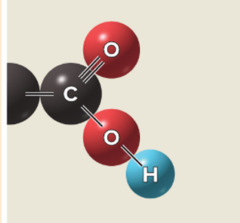
Amino functional group

Phosphate functional group

Isomer
2 or more different molecules with the same kinds of atoms
What is the difference between single bonds and double bonds?
single bonds can rotate and double bonds are rigid
Monomer
A building block used to construct a polymer.
Dehydration Synthesis
A process of joining molecules in which water is removed during the reaction.
Hydrolysis
The breakdown of a molecule or polymer by adding water back into the structure.
Enzyme
A protein that speeds up a chemical reaction without being consumed by the reaction.
Activation Energy
The amount of energy required to get a chemical reaction started; it is the energy barrier that must be overcome.
Catalysis
The process of speeding up a chemical reaction without the catalyst being consumed.
Denaturation
The unfolding or loss of a protein's normal shape, which can occur because of factors such as heat, salt concentration, or pH.
Renaturation
The refolding of a denatured protein back toward its original shape; the lecture notes that this is possible in some cases but not all.
Coenzyme
An organic cofactor that assists an enzyme; many vitamins function as coenzymes.
Carbohydrate
One of the four major classes of molecules in living organisms; carbohydrates include simple sugars and larger sugar polymers.
Monosaccharide
A simple sugar and the basic building block of larger carbohydrates.
Disaccharide
A carbohydrate consisting of two monosaccharides covalently bonded together.
Polysaccharide
A polymer made of many monosaccharides; the lecture describes chains containing hundreds to thousands of simple sugars.
Glycogen
A highly branched polysaccharide used by animals to store glucose, especially in muscle and liver.
Starch
A polysaccharide used by plants to store glucose.
Cellulose
A structural polysaccharide that forms plant cell walls; it consists of straight polymers and cannot be digested by humans.
Carbohydrate Functions
provide energy storage, contribute to structure such as plant cell walls, and contribute to cushioning through structures such as proteoglycans.
Lipid
One of the four major classes of biological molecules; include fats, phospholipids, and steroids and are important for energy storage, membranes, signaling, and protection.
Saturated Fatty Acid
A fatty acid that contains no double bonds, solid at room temperature
Unsaturated Fatty Acid
A fatty acid that contains double bonds, liquid at room temperature
Phospholipid
A lipid containing two fatty acids attached to glycerol, with the remaining hydroxyl associated with phosphate and another small molecule; have a hydrophobic region and a hydrophilic region.
Steroid
A lipid whose carbon skeleton consists of four fused rings; examples include cholesterol, estrogen, and testosterone.