ELD 374 Midterm
 Call Kai
 Learn
 Practice Test
 Spaced Repetition
 Match
 Flashcards
 Knowt Play
1/27

There's no tags or description
Looks like no tags are added yet.
28 Terms
procedural understanding
follow the steps and use the rules to complete the problem, dont know why you do what you
½ + ¼ =
conceptual understanding
being able to solve problems with understadning
number blocks, ten frames, representing 65 + 90 with tens and ones blocks
*give diff ways, focus on this
School principles and standards for mathematics are defined by…
National Council of Teachers of Mathematics (NCTM).
What are the five content standards?
what do you teach
number/operation
algebra
geometry
measurement
prob. + statistics
what are five process standards?
how do you teach
problem solving—26+35, maddie had 35 dollars, sam had 26 dollars how many in total, word problems
representation—-drawings, geo boards, how many times greater is area of square when you double the size, then using drawings
connection— explain how different math concepts connect, bring real life into math,1/2= 0.5=50%,
communication— 2/4, numeration + denominator, fractions are a part and whole
reasoning/proof —explaining why and how, is a sqaure is always a paralleogram, bc opp. sides are congruent and parallel
how do we derive the area of triangle from rectangle?
1/2bh bc its ½ of a trianle
principles of school math
teaching
learning
assesment
cirriculum
tech.
equity
Eight Standards for Mathematical Practices
Make sense of problems and persevere in solving them.
Reason abstractly and quantitatively.
Construct viable arguments and critique the reasoning of others.
Model with mathematics.
Use appropriate tools strategically.
Attend to precision.
Look for and make use of structure.
Look for and express regularity in repeated reasoning.
guide educators on the different types of expertise students should develop, what you should focus on when constructing a lesson
behaviorism
watson
drill + practice, memorization, not focused on conceptual understanding, reward + punishment
learning by repetition
constructivism
learning is active meaning seeking process, learners are not passive consumers of information, focus more on mathematical thinking rather than correct answer, let students discover math concepts
negotiation, explanation, sharing, evaluation
piaget
zpd
Zone of Proximal Development (ZPD) is the sweet spot between what a learner can do all by themselves and what they can do with help
child knows addition, but not multiplication, provide help with multiplication to learn division
CRA approach
concrete (inactive) level—-actions, hands on learning, having students measure the angle, learn by doing, anglex
representation (iconic) level—-visual representation, drawing, having students draw parallegram and two trapezoids to show their relation with area
abstract level (symbolic) —equations—using abstract symbols, 4+4=8, calcuating area using formula, develop math ideas
scaffolding
guidance
sociocultural theory
learning is not isolated from your social cultural environment, they influence your learning
big ideas of geometry
shapes and properties— 4 angles, 4 sides
transformation—move smthing, make smthing bigger or smaller, reflection, rotation, dilation, translation
visualizations—plane and space
location— we can locate objects with some reference, normally on an axis,

plane vs space
plane— 2d, space—3d

polygon vs non polygon
polygon—- closed shape that was formed by joining 3 or more straight lines, multi side
non polygon—a closed figure, shape had curves, intersecting lines,


concave vs convex
convex— all interior angles less than 180 degrees, and at least one diagonal lies inside the polygon, both regular and irregular
concave—at least one interior angle is greater than180 degrees, and at least one diagonal lies outside the polygon, never regular
which ones with these are concave and convex
The polygons that are concave are B, E, H, I, and L. The polygons that are convex are A, C, D, F, and G
irregular vs regular polygons
Regular- when each side and as well as each interior angle are equal, triangle, square, pentagon
Irregular— when angles and sides are not equal, rectangle
Van Level
0: Visualization— what students can see with the naked eye, blue angle
Level 1: Analysis—know triangle has 3 sides, 3 angles, if traingle is presented diff. they may say left angle, know properties
Level 2: Informal deduction—know sqaure is a rectangle
Level 3:Deduction—know proofs and theorems, highschool level
Level 4: Rigor— Develop logical mathematical thinking, college level math
** Provide a description of how students progress through levels of geometry
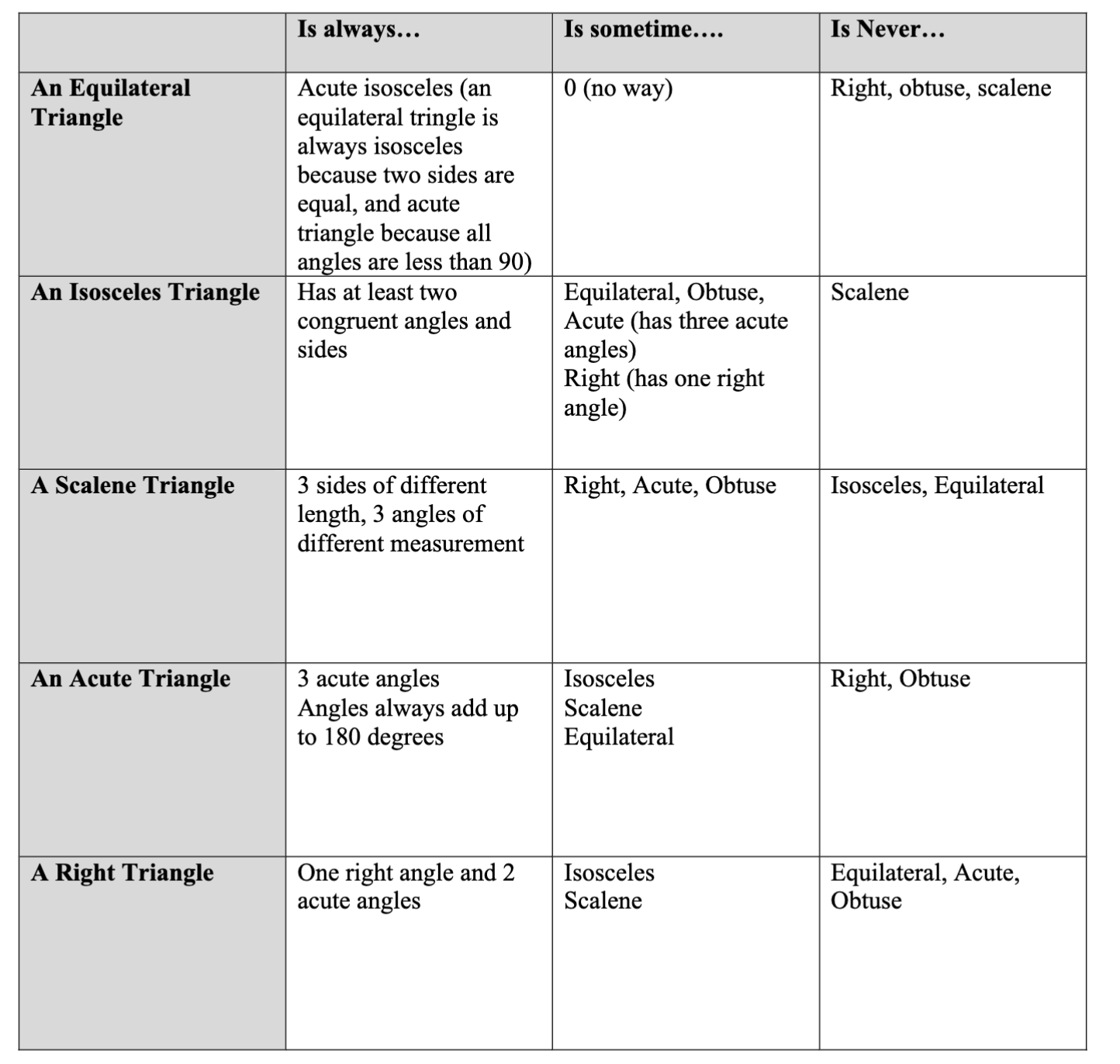
types of triangles
scalene— all sides are not equal
isosceles- at least 2 sides are congruent, equilateral is isos.
equilateral— all sides are congruent,
actue angle— all angles are less than 90
right angle— one is angle is 90
obtuse--only one angle is more than 90

obtuse
obtuse— never acute, right, equilateral
smtimes- isosceles, scalene
quad. and their properties
square— all sides are congruent, all angles are 90 degrees, opp. sides are parallel and congruent
rectangle- opp sides are congruent and parallel to each other, all angles are 90
parallelogram—opp sides are congruent and parallel to each other
rhombus—all sides are congruent, opp sides parallel to each other
trapezoid—one pair of sides are parallel
kite— 2 sides adj. sides same length, equal to each other
**square can be any of these
** at least set of opp. sides are parallel for all!!
** diagonals bisect each other expect for kite/trapezoid
** diagonals congruent/ all right angles only for sqaure,rectangle (or isos. trapezoid)
**diagonals interect at right angles only for rhombus, square, kite
**opp sides not congruent only for trapezoid, kite!!
area for quad.
sqaure, rectangle rhombus, paralleogram— all l x w
trapezoid- 1/2( b1 + b2) H
kite— (d1 x d2)/2
**for rhombus/ kite also ½ of area of rectangle
** for kite, break down into 2 rectangles divide by 2 since they are really triangles, then add the 2
Explain the how does area of rectangle, parallelogram, and rhombus have the same formula to find the area. Explain by using suitable diagrams
The rectangle, parallelogram, and rhombus have the same formula (l x w) to find the area because the rhombus and parallelogram can be rearranged into a standard rectangle without changing their area, and all three formulas are based on multiplying a base by the perpendicular height.
Regarding the parallelogram, you can form a triangle along its perpendicular height and move it to the other side to form a rectangle.
For the rhombus, if you divide it into two triangles and then add the two areas together, you will obtain the total area. Since the area of each triangle is ½ (b x h), adding the two areas results in b x h. Therefore, the area of the rectangle, parallelogram, and rhombus are the same

Explain the how does formula to find the area of parallelogram can be used to derive formula to find the area of trapezoid. Explain by using suitable diagrams
The formula to find the area of the parallelogram can be used to find the area of a trapezoid because two identical trapezoids can be combined to form a parallelogram. The total base of the parallelogram is the sum of the two parallel sides of the trapezoid (base 1 + base 2), and the height remains the same. Since we are only concerned with the area of one trapezoid, we divide that total area of the parallelogram in half, and the formula for a trapezoid becomes 1/2 (base 1 + base 2) x h

sometimes, always, never with quad…
Shape | Rectangle | Square | Parallelogram | Kite | Rhombus | Trapezoid |
|---|
Rectangle | Always | Sometimes | Always | Sometimes | Sometimes | Never |
Square | Always | Always | Always | Always | Always | Never |
Parallelogram | Sometimes | Sometimes | Always | Sometimes | Sometimes | Never |
Kite | Sometimes | Sometimes | Sometimes | Always | Sometimes | Sometimes |
Rhombus | Sometimes | Sometimes | Always | Always | Always | Never |
Trapezoid | Never | Never | Never | Sometimes | Never | Always |
**if trapezoid is at least one pair of parallel sides than all shapes are always a trapezoid,
**trapezoid is smtimes parallelogram, kite