Bio 180 exam 2
 Call Kai
 Learn
 Practice Test
 Spaced Repetition
 Match
 Flashcards
 Knowt Play
1/26

There's no tags or description
Looks like no tags are added yet.
27 Terms
null model for evolution
helps predict genotype freqs expected if evolution is NOT occurring/4 evolutionary processes have NO significant impact on allele freqs at the gene of interest, compare against observed genotype freqs of pop
^allows us to test if evolution is occurring at a specific gene (Hardy-Weinberg Principle)
^observed genotypes look like null model, can conclude that evolution is not occurring at this gene/time/pop
Basic model of Hardy-Weinberg principle
2 diff alleles L and S
frequency of L is p and frequency of S is q, so p+q=1 (alleles don’t have to have equal freqs but must add up to 1!)
no new mutations/alleles
large pop so no genetic drift
individuals mate w/ each other at random
mating is random w/ respect to the gene, mate/reproduce the same #
no natural selection, all have same fitness w/ respect to their genotype
no gene flow (no indiv leave/enter)
Follow Hardy-Weinberg Equilibrium
pop follows Hardy-Weinberg Principle and has genotype freqs p2, 2pq, q2 (p and q are the freqs of 2 alleles of the gene)
*allele freqs will not change from 1 gen to the next
^if don't match, then allele freqs are changing (one of the 4 evolutionary processes is occurring but don’t know which) OR mating is not random
Non-random mating
changes genotype frequencies but NOT allele frequencies
+violates Hardy-Weinberg by incr freq of homozygous genotypes
-inbreeding (most extreme) and assortative mating
^related indivs tend to have same alleles at many genes (inherited them from same ancestor)
assortative mating
indiv choose mates on basis of having same or diff phenotype as themselves (tends to be more homozygous)
inbreeding
mating among relatives
*ex: self-pollinating plants - self-fertilization is most extreme form of inbreeding
4 sources of genetic variation
mutation
enzymes make random mistakes in DNA replication (change of base sequences) creating new alleles (←only mutation does this!!)
independent assortment
alleles of diff unlinked genes assort themselves independently of each other during metaphase I AKA homologous chromosomes move to metaphase plate and line up randomly
maternal vs paternal
variation in gamete genotypes
crossing over/recombination
non-sister chromatids of homologous chromosomes cross over, swap alleles/sections of genes in prophase I to be unique
makes new genotypes but not always bc could be homozygous w/ same alleles
outcrossing
fusion/mix of sperm and egg (fertilization), diff combos of chromosomes so offspring have new combos
combine new/diff haploid gametes to have diploid offspring
Why have sexual reproduction to have genetically diff offspring?
Purifying selection (in a few generations w/ intense environment, gets rid of deleterious alleles)
Changing environment produces high-fitness phenotypes (like bet hedging – genetic variety, if virus/disease or change in environment, most likely won’t kill entire pop and some indiv w/ beneficial trait will survive/reproduce and species survives)
directional selection
natural selection favors an extreme phenotype bc it has higher fitness
^avg of the trait changes (incr or decr)
^amt of overall variation decr bc alleles associated w/ 1 extreme are being eliminated (allele freqs change)
*due to diff reproductive success

stabilizing selection
natural selection that favors the avg phenotype in the pop and acts against extreme phenotypes
^avg trait value doesn't change bc indiv w/ intermediate values have the highest fitness (both extremes have lower fitness)
^amt of overall variation decr bc alleles associated w/ both extremes r being eliminated (changes allele freqs)

natural selection vs. artificial selection
the process that changes allele frequencies when certain heritable traits r associated w diff levels of reproductive success
^decr genetic var over many gens
^nonrandom (produces certain pattern/type of change)
^caused by differences in fitness, resulting in adaptation
vs.
when humans actively/consciously select which indiv will be the parents of the next generation

!!!
disruptive selection
opposite of stabilizing selection, avg/middle have lowest fitness, better to be one extreme or the other
^incr overall trait variation (can lead to speciation)

frequency dependent selection
what is beneficial depends on the rest of the population's trait (ex: beneficial to have rare trait; beneficial to have common trait – depends on the frequency/what everyone else is!)
^the trait being selected for is how common or rare the trait is

Environment not changing very much over time -> most likely see?
environment changing dramatically over time -> most likely see?
stabilizing selection
directional selection
How evolution (change of allele freqs) can happen
(opposite of hardy-Weinberg)
have:
mutation
gene flow
genetic drift
non-random mating! (contributes bc changes genotype freqs)
selection
genetic drift
any change in allele freqs due to chance/at random (w/ respect to fitness) (drift up/down over time)
^can result in random fixation (freq=100%) or loss (freq=0%) of allele
^decr/keep same genetic variation over many gens (doesn't create or introduce new alleles to a pop, so can't incr genetic var)
^higher impact on allele freqs of small pops than large pops
^random process (unpredictable outcome) - fitness can incr/decr/stay the same
gene flow
allele freqs change when individuals and their alleles move from one pop to join another existing pop
^caused by movement of individuals into or out of a pop, resulting in allele freqs of source and recipient pops becoming more similar (homogenization)
^incr genetic variation in recipient pop (can incr/no change in genetic var over many gens)
^can incr/decr/not affect fitness of recipient pop (depends on the selective environment)
^random (unpredictable outcome)
founder event
when a relatively small number of indivs go to a new habitat and start a completely new pop (1 type of genetic drift)
^(likely) decr genetic variation of the new pop
^at least some of the alleles present in the og pop not represented, so new pop has lower genetic var
Effects of mutations
deleterious - reduces fitness (lowk most bc pop already well-adapted to environments they’ve been exposed to in the past, mutations are random, extremely unlikely that the resulting phenotypes from mutations work better (fitness wise) than existing phenotypes)
neutral - no impact on fitness
beneficial - incr fitness
4 evolutionary processes
natural selection
mutation
gene flow
genetic drift
inbreeding depression
lowered avg fitness of individuals in a pop due to incr prevalence of homozygous recessive genotypes w/ deleterious effects
genetic rescue
bring individuals of same species that were bred in captivity or collected from healthy pops and introduce them into the small isolated pop that is showing signs of entering the extinction vortex
^introduce new alleles -> can incr genetic diversity (introduce high fitness alleles, struggling pop may become more fit)
^pro: new alleles can incr genetic diversity/variation and lessen the impact of inbreeding depression and genetic drift (+incr avg fitness in the threatened pop)
^con: alleles from diff pops can be maladapted to the environment of the threatened pop, making things even worse
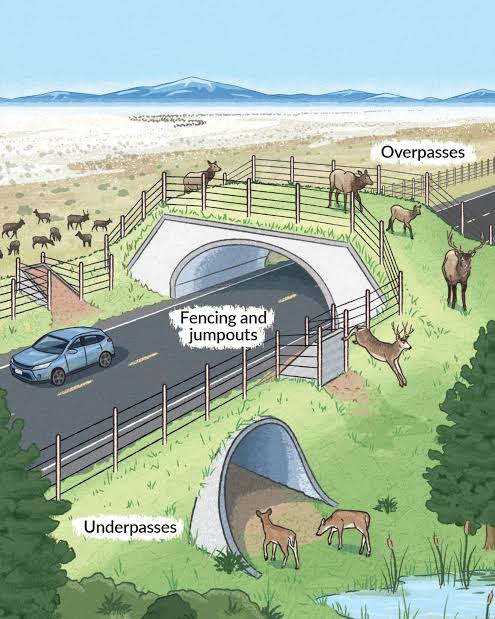
wildlife corridors
physically connect 2 areas of habitat, allow plants/animals/other organisms to move from 1 habitat fragment to another (overpass, underpass) (affects gene flow most directly)
genetic bottleneck
when a species undergoes a large/rapid decr in pop size due to a disease epidemic/catastrophic storm/other major change (1 type of genetic drift)
^(likely) decr genetic variation in affected pop
How to find observed genotype frequencies? Observed frequencies of M and N alleles?
put # of each genotype over total individuals (ex: 18 of MM, 100 total humans, 18/100=0.18)
for observed freq of M allele, do ((MM individuals)*2 + (MN indivs))/(total indiv*2)
MM * 2 bc MM individuals give 2 M alleles each while MN individuals only give 1 allele each. Total individuals times 2 is total number of alleles!
if given observed genotype freqs only: do same but w/ genotype freqs and divide the entire thing by 2 (ex: (0.2*2 + 0.4)/2
How to get expected genotype frequencies? What is the last step?
follow p2 + 2pq + q2 = 1. so, M2 + 2MN + N2 = 1. To get MM, do freq of M squared. To get MN, do 2 times the freq of M times the freq of N. to get NN, do freq of N squared.
Compare expected genotype freq to observed genotype freq
observed matches expected → evolution not happening, pop under hardy-weinberg equilibrium. observed different from expected → evolution is happening, pop not under hardy-weinberg equilibrium
would use chi-squared test