metabolism- oxidation of pyruvate and tricarboxylic acid cycle
 Call Kai
 Learn
 Practice Test
 Spaced Repetition
 Match
 Flashcards
 Knowt Play
1/10

There's no tags or description
Looks like no tags are added yet.
11 Terms
where does the oxidation of pyruvate and the tricarboxylic acid cycle occur
it happens in the mitochondria matrix as this is where the enzymes needed are and the membrane involved for the electron transport system
what is the function of pyruvate dehydrogenase
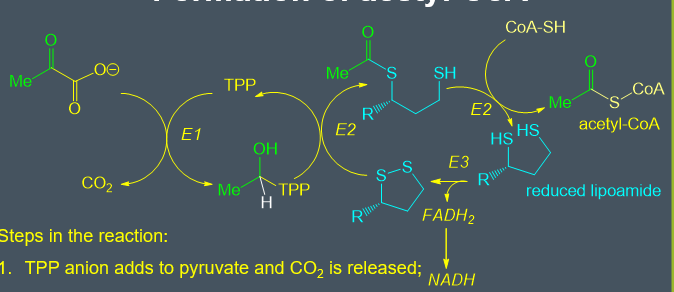
it is the complex that contol the entry of pyruvate into the TCA cycle, it has 3 subunits:
pyruvate dehydrogenase E1- decarboxylates pyruvate ( has a requirement of thiamine pyrophosphate )
dihydrolioyl transfease E2- makes coA ( needs lipoamide )
dihydrolipoyl dehydrogenase E3- converts reduced lipoamide into disulphide which is required for FAD
explain the steps involved in the formation of acetyl-coA
Thiamine pyrophosphate is added to pyruvate and CO2 is released
lipoamide disulphide is added to acetyl group and a redox reaction occurs
disulphide exchange occurs to form acetyl coA and reduced lipoamide
reduced lipoamide is oxidised to disulphide using FAD
FADH2 is oxidised by NADH which is fed into the electron transport system
what type of reactions fdoes the tricarboxylic acid cycle use
catabolic and anabolic reactions
what are the 4 stages of the tricarboxylic acid cycle
condensation and rearrangement
decarboxylation
formation of GTP
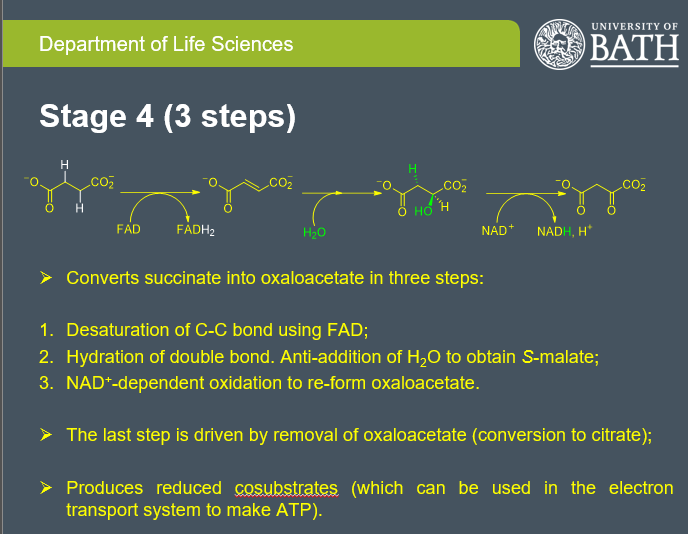
conversion to succinate to oxaloacetate
what are the net products of the tricarboxylic acid cycle
3NADH, H+ , 1FADH2 ,1GTP
WHT CAN THE TRICARBOXYLIC ACID CYCLE ONLY WORK IN AEROBIC CONDITIONS
the oxygens role is to deoxidise the reduced cofactors ( NADh, FADh) by the electron transport system. this allow the cycle to continue
explain stage 1 of the TCA cycle- condensation and rearrangement
citrate synthase catalyses a condensation of acetyl-coA and oxaloacetate
hydrolysis of coA ester makes the reaction irreversible
citrate undergoes a rearrangement to form isocitrate- this prepares for stage 2
explain stage 2 of the TCA cycle- decarboxylation
isocitrate is converted into beta-ketoacid using NAD+
beta-ketoacid loses a co2
2-oxoglutarate is converted into succinyl-coa by a multi-enzyme complex
this reaction is analogous to the reaction carried out by the pyruvate dehydrogenase ( TPP, lipoamide, coA-SH )
explain stage 3 of the TCA cycle- formation of GTP
coA is displaced by inorganic phosphate to produce a mixed acid anhydride
phosphate is transferred to an active site
the transfer of the phosphate group onto the GDP forms GTP ( which can be used to form ATP )
explain what happens in the TCA cycle in stage 4- formation of oxaloacetate