OMSI- CRS II
 Call Kai
 Learn
 Practice Test
 Spaced Repetition
 Match
 Flashcards
 Knowt Play
1/111

There's no tags or description
Looks like no tags are added yet.
112 Terms
lung US procedure
linear best for pleural line
curvilear or phased array for other aspects
probe marker to pt head (should show 2 ribs)
13 cm deep

when would point of care lung us be used
chronic heart failure
pneumoia
pneumonia
restrictive dieases
reflective artifact us
interface of a smooth surface and air, such as the pleural line
A-line us
a reverberation reflection of the pleural line on lung us.
indicates the probe is deep enough
submental scan
geniohyoid- attaches to both mandable and hyoid bone

thyroid region scan- jugular region

thyroid region scan- anterior
platysma muscle (py)
sternocleidomastoid muscle (scm)
sternohyoid muscle (sh)
sternothyroid (sth)
thyroid (thy)
esophagus (eo)
common carotid artery (CA)
internal jugular veins (IJV)
omohyoid muscle (om)

vertebral artery us

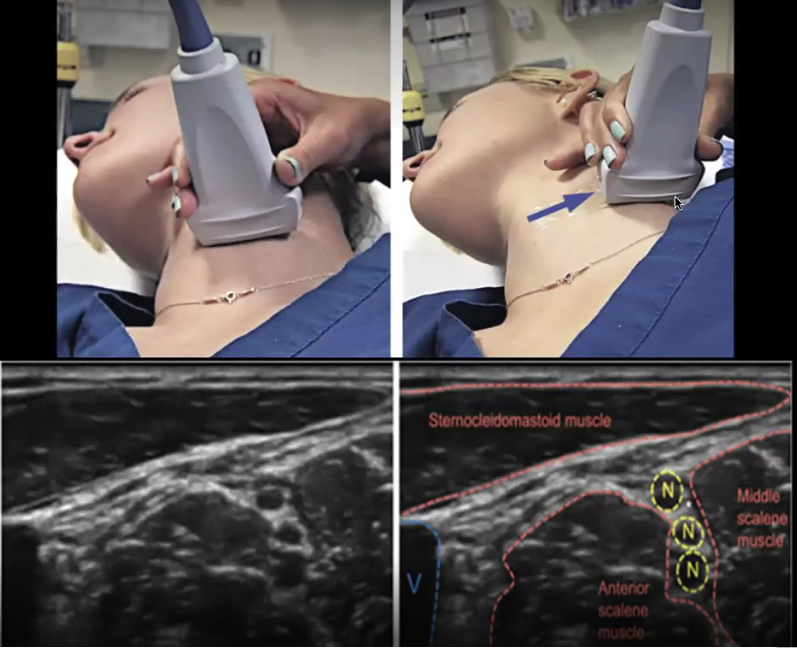
interscalene brachial plexus
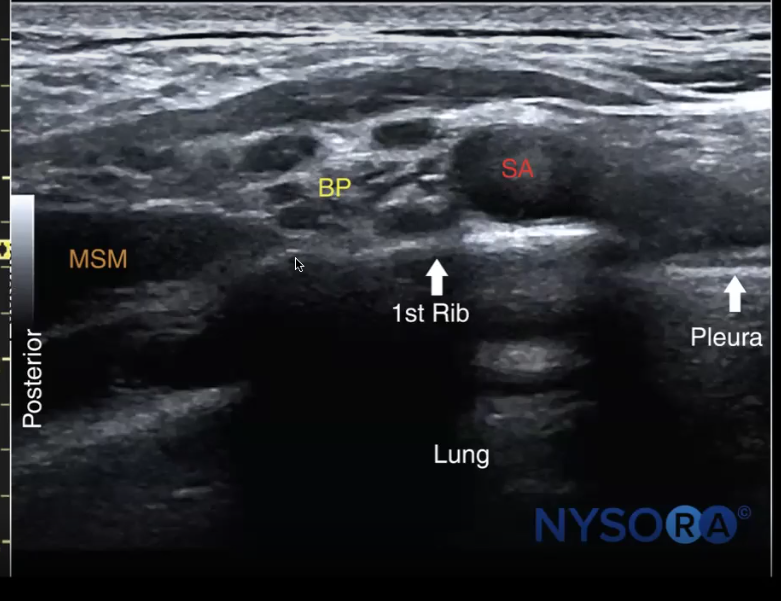
supraclavicular brachial plexus us
cardiac muscle cells features
high levels of mitocondira for constant ATP recycling
many energy sources, typically fatty acids (60%) and carbohydrates/lactate (35%). Rest are amino acids and ketones
98% of cardiac ATP is generated through aerobic metabolism. Although in low oxygen it can do glycolysis only (will run out in around a minute)
cardiac fuel stores
low glycogen storage. Has insulin response GLUT4 transporters to get glucose from blood sugar
stores triacylglycerols, but still only limited amounts in NORMAL conditions. Excess is pathological
has the highest levels of lipoprotein lipase
creatine
lipoprotein lipase (LPL)
is needed to cleave fatty acids in chylomicrons to make them usable
chylomicron surface lipoprotein APO C-II will interact with cell surface LPL
triggers cleavage, fatty acids can enter cell at this point while glycerol goes back into circulation
in cardiac muscles, LPL activity is inversely related to insulin levels
hormone sensitive lipase (HSL)
Within adipose tissue, stimulated by epinephrine and inactivated by insulin.
regulated mobilization of free fatty acids in the blood that can be used by cardiac muscle
what happens in hypoxic conditions
electron transport chain is stopped
buildups of electron carriers stops TCA cycle
entirely dependent of anaerobic glycolysis
local acidity increases to regernate NADH
reperfusion after cardiac hypoxia
reintroducing oxygen after hypoxic conditions. can cause an increase of reactive oxygen species, but cells can avoid this
during hypoxia, hypoxia-inducable transcription factors are stabilized. increased levels of CD39 and CD73 on cell surface
inflamatory cells migrate to cardiac muscle, releases ATP and ADP into blood
these proteins will convert ATP/ADP in the blood to adenosine
adenosine will bind to A1AR surface cardiac cell receptors => cardio protection for ischemic-reporfusion.
ATP cytoplasmic maintinance
cardiac myocytes have a lot of cytosolic ATP
This makes it hard for ATP/ADP antiporter to shuttle ATP out of mitocondrial matrix
phosphocreatine shuttle fixes this
phosphocreatine shuttle
in mitocondira inter-membrane space, ATP’s phosphate is transfered to creatine through creatine kinase 1
creatine can leave outer membrane as creatine-P
in cytosol, CKg will immidiately transfer any ATP phosphates to creatine to generate ADP and creatine-P
CKc maintains equilibrium between all 4
CKa generates ATP from cytosolic creatine-P, active during muscle contraction
metabolic reporgramming in a failing heart
cardiac metabolism is reverted back to something similar to the fetal heart
increased glycolysis untilization and decreased expression of beta oxidation genes. this is due to failing hearts being oxygen deprived
these genes are coexpressed with regenerative potential
using mainly glycolysis will reduce oxidative stress on heart
fetal heart
relies on maternal glucose for energy
after birth, glycolysis genes are down-regulated while genes for fatty acid b oxidarion is upregulated
glucose metabolism is crucial to maintain proliferative potential
cardiac metabolism in type 2 diabetes
leading cause of death in type 2 diabetes is cardiovascular complications. Due to altered metabolism
T2D increases both glucose and fatty acids in blood, cells response to insulin dulls
heart cells use more fatty acid utilization, and twice as much fat accumulates in cardiomyocytes. (could cause limited proliferation)
glycolysis decreases
long chain fatty acyl coA allosterically inhibits hexokinase (ezyme that initially phosphorylates glucose let in through glut4)
cardiac metabolism in obesity
increases risk of coronary artery disease and heart failure
similar mechanism to T2D
obesity increases fatty acids in the blood and hepatocytes. Higher in women, women are at a higher risk
cardiometabolic disease
the result of long term changes in metabolism caused by obesity or insulin resistance
insulin resistant state will increase inflammation and oxidative stress. can lead to metabolic syndrome, prediabetes, and non-alcoholic fatty liver disease
this can progress into cardiometabolic disease
A1c
glycation is the non-enzymatic addition of sugars to proteins and lipids
hemoglobin A1c is glycated hemoglobin
alters normal activity of proteins and lipids
levels correspond to chronic high blood glucose, major risk factor
contributes to atherosclerosis development
advanged glycation end products
aka AGE
AGE can interact with receptors called RAGE. found on endothelial cells, smooth muscle, platelets
binding will lead to endothelial injury, and changes in platelets or smooth muscle
AGE can crosslink structural proteins and result in reduced elasticity
cardiolipin
a diphosphosphatidylglycerol lipid that constitutes 20% of lipids in inner mitocontrial membrane and only in there
has 4 long chain alkyl groups
complex I, II, IV and V bind to cardiolipin. nessicary for funtion.
can create a unique structure in membrane that traps protons. helps to maintain proton gradient and function as a buffer
barth syndrome
rare X-linked, loss of function of taffazzin enzyme
causes dilated cardiomyopathy, skeletal myopathy, neutropenia, and short stature. usually incompatable with life
tafazzin is an acytltransferase needed to form cardiolipin
oxidative stress in the heart
causes a ton of issues
can be produced in vascular cells through upregulated NADPH oxidase (NADPH => NADP+)
inactivation of endothelium derived nitric oxide, causes reactive nitrogen species
cardiac disease biomarkers
cell lysis can release proteins that diffuse into blood. presence is affected by:
bigger ones diffuse slower
half life of the protein. cardiac myoglobin can be used, but has a very short half life (about a day)
specificity of the protein in tissues. For cardiac, cardiac troponins (cTnT and cTnI) are pertinent positive.
asprin and heart attack/stroke
can be used in people with a history of heart attack or stroke to prevent it
prevents clotting by inhibiting COX1 and COX2 on platelets. Ultimately, this inhibits thromboxane A2
also produces lipoxin that has anti-inflamatory capabilities
nasal cavity epithelium
very similar to other respiratory epithelia, has specialized olfactory epithelia
sensory cells, bipolar neurons with sensory cillia. will interpret signals and transduction to brain
also has supporting cells for structural and nutritional support
basal cells (stem cells) can differentiate into both cell types
cells in the trachea and bronchi
cilliated cells- move mucus/debris/pathogens from passages. attach to basement membrane
goblet cells- produce mucus
basal cells- clustered around basement membrane
brush cells- chemosensation and absorbtion, microvili increase surface area
neuroendocrine cells- secrete hormones
pulmonary ionocytes
speciealized cells that start to appear in bronchi
regulate ion balance of cells
promotes osmosis for water to leave cells and keep mucus layer hydrated
less than 1% of cells
high levels of Cystic Fibrosis Transmembrane Conductance Regulator (CFTR), which conducts Cl across apical membranes.
cells in the bronchioles
ciliated cells, goblet cells, and basal cells become less numerous
brush cells- air quality sensors
neuroendocrine cells
pulmonary ionocytes
club cells- secreate surface-avtive agent (similar to surfactants)
cells in respiratory bronchiles
aka branch off branchioles
fewer cilliated cells
club cells
cells in alveoli
type 1
type 2
dust cells- alveolar macrophages
intramural cells: capillary endothelial, fibroblasts, smooth muscle (sometimes), ionocytes
goblet cells on light mirocgraph
large amount of lipids in muscus means they will stain very light or not at all.
non-cilliated
connect with basal lamina and apical site
more numerous during chronic irritation
mucus is composed of glycoproteins MUC5AC and MUC5B
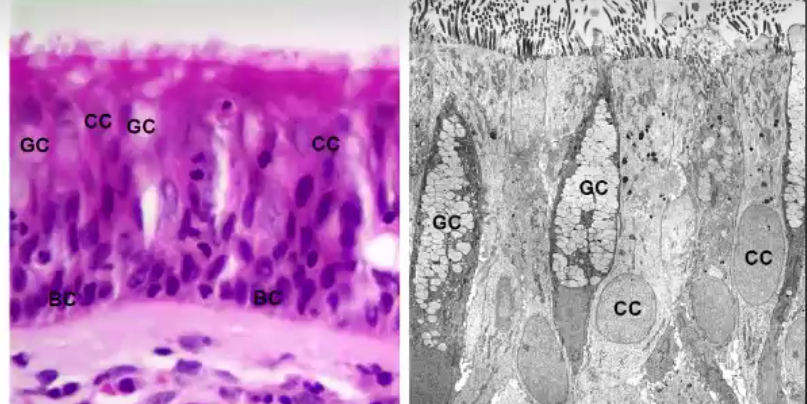
club cells
secrete surface active agents that acts as a surfactant, prevents airway collapse
non cilliated, but can differentiate into cilliated cells to protect epithelium
can also differentiate into alveolar cells (alveolar bronchiolization)
found in terminal bronchioles
how does cyclic fibrosis affect pulmonary ionocytes
normal ionocyte has CFTR (Cl- leave cell) and ENaC (allows sodium to get inside cell).
CFTR plays a regulatory role for ENaC to balance
in cystic fibrosis, CFTR doesn’t work. Cloride cannot leave cell, ENac does not let sodium into cell.
water does not flow into ECM, mucus get’s thick
what drives airway smooth muscle contraction
MLCK (myosin light chain kinase) promotes contraction- promoted by calcium and calmodulin
MLCP (myosin light chain phosphatase) promotes relatation- activated by PKA that inhibits the IP3 pathway (release of calcium)
sympathetic (B2-AR) and parasympathetic (M3 receptor)
alveolar type 1 cells
simple squamous allows for gas exchange
communicated with type 2 alveolar cells, senses more surfactant need by stretch mechanosensors
communicates through paracrine factors like ATP

alveolar type 2 cells
plump, polygonal shape
progenitor cells for type 1 cells
produce surfactant, stored in lamellar bodies (vesicals). looks stringy

true sufactant proteins
4 types: A and D are hydrophilic and B and C are hydrophobic
composed of lipoproteins, phospholipids, colesterol
SP-A modulates surfactant turnover
hydrophobic proteins have structural roles
SP-B allows lamellar bodies to form
SP-A and surfactant homeostasis
SP-A feedback regulator
surfactant synthesis
fusion of lamellar bodies with plasma membrane
purinergic receptors
on alveolar type 2 cells
activated by nucleotides/nucleosides
includes P1, P2Y, P2X
surfactant production in alveolar type 2 cells
P2Y2 receptors are activated by nucelotides secreted by type 1 cells
This GPCR activates Gq, activates PKC through phospholipase C
PKC stimulates exocytosis of lamellar bodies
respiratory system components
ventilation mechanism- ribs. diaphragm, intrensic muscles
conducting portion- transports air but to gas exchange
respiratory region- where gas exchange occures
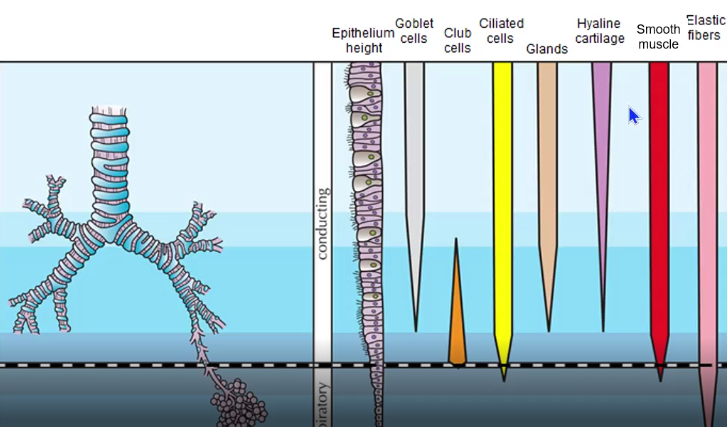
respiratory epithelia
cilliated
columnar
pseudostratified
conducting airways characteristics
gets progressively thinner as it get’s deeper in lung
respiratory epithelia
glands in lamina propria
smooth muscle
elastic fibers
cartilage
nasal cavity
3 regions
vestibular- opening of nasal cavity
respiratory- main body of nasal cavity
olfactory- at the top of nasal cavity
vestibular area of nose
lined with stratified squamous epithelium
typical skin- keratinized and hair follicalse
slowly transition to respiratory epithelia
respiratory area of nose
respiratory epithelium with thick basement membrane
nasal chonanae (grooves in cavity)
layer of CT below basement membrane is called lamina propria- mixed glands, plexus of thin veins, merges with periosteum of underlying bone
olfactory area of nose
olfactory epithelia
pseudostratified columnar with cillia, no goblet cells
3 cell types: olfactory, sustentacular cells (supporting cells), basal cells
below basement membrane is lamina propria, glands with serous secretions
pharynx divisons
nasopharnx- posterior to nasal cavity, air passageway
oropharynx- behind oral cavity, has the palatine tonsils. food and air passage. superior boundary is uvula
laryngopharynx- behind epiglottis, above esophagus. seperate food to esophagus and air to trachea
eustation tube
connect middle ear to nasopharynx
opens during swallowing/yawning
equalizes pressure
in children, this tube is more horizontal than in adults. raises risk of ear infections
uvula
most posterior extension of soft palet, separates nasopharynx and oropharynx
numberous mucus glands
cross-striated muscle
nonkeritinized, statified squamous epitheium
oropharynx
lined by not keratinized statified epithelia
Pantene tonsils (superior) and lingual tonsils (inferior)
submucosa has glands, and the muscles of pharyngeal wall
laryngopharynx
starts at epiglottis, both trachea and esophagus
epithelium can varies. treacheal aspect is respiratory epithelium and esophageal is statified squamous, non-keritinized epithelum
larynx
epiglottis
false vocal fold- aka vestibular fold, includes mucus glands in the lamina propria
true vocal fold- aka vocal fold, actual skeletal muscle in lamina propria and affect voice generation.
both folds have epithelium is stratified squamous, nonkeritinized

epiglottis
lid of larynx
elastic cartilage backbone
anterior surface is lined by digestive-like epitheial that transitions to respiratory as it wraps around
trachea wall
contains respiratory epithelia with goblet cells.
composed of 16-20 overlapping rings

broncus to bronchioles
bronchioles do not have cartilage in them
much more branching into terminal bronchi- have low columnar or cuboidal epithelia with no goblet cells
is considered a respiratory bronchiole when alveoli start to appear. no cillia
respiratory region of lung contains
respiratory bronchioles
alveolar ducts- 2 or 3 elongated branches off respiratory bronchiole
atrium- mildly expanded area between sacs and ducts
alveolar sacs- 2 to 3 branch off atrium
alveolus- a single pouch

alveolar pores
small openings between adjacent alveoli, helps to equilize pressure to avoid a collapsed lung.
one alveoli cannot crush another
although can be a path for infection
smooth muscle in alveolus
at the the “knobs”
found with increased elastic and collagen fibers
bronchial veins
join with the pulmonary veins returning oxygenated blood to heart, very short.
arteries and veins run with bronchial tree. can be differentiated from pulmonary veins because they will be in the parenchyma
intercalated discs
longitidinal site- cell sides, communication (gap junctions) and adhesions (desmosomes)
transverse site- cell ends, firmer adhesions (desmosomes and fascia adherens) and force transmission.
plakophilic-2 (PKP2) mutations
a linker molecules for intermediate filaments to desmosomes in cardiomyocytes and skin. mutations can:
weaken desmosomes adhesions
cardiomyocytes detach (will die)
associated with arrhythmogenic right ventricular cardiomyopathy (ARVC) because of impaired conduction
exacerbated by exercise, when athletes suddenly collapse
histological changes are seen- irregular nuclei and cell arrangement
cardiomyocyte dyad
composed of T-tubule membrane (L-type Ca channels) and junctional SR (ryanodine receptor 2) seperate by a narrow state.
L-type channel lets calcium enter
will activate ryanodine 2 to make SR release more calcium
cardiac excitation coupling
L type Ca channels open and allow calcium into cell
ryanodine 2 receptor is activated, more calcium is relased in SR called a “calcium spark”
triggers cross bridge
afterwards calcium is sequestered back into SR by type 2 SR Ca/ATPase (SERCA2), inhibited by phospholamban
regulation of RyR2 receptors
PKA phosphorylates receptor, stimulating it
low calcium stimulates by binding to high affinity site, while high cytosolic Ca inhibits by binding to low affinity site. Helps end contractions.
on lumen side is a calcium sensor
calsequestrin inhibits RyR2
calsequestrin
binds to calcium in SR lumen to act as a ion buffer. Helps SR store a lot of calcium in SR.
2 isoforms: 1 is in skeletal muscle, 2 in cardiac
interacts with junctin/triadin to regulate RyR. When lumen SR is high, CSQ is busy binding calcium. when lumen calcium is low, CSQ is free to interact with junctin/triadin to inhibit RyR2
phospholamban
phosphorylated by sympathetic pathway to promote relaxation
dephosphorylated: stimulated, in turn inhibits SERCA2
phosphorylated: inhibited, dissasociate from SERCA2 so it can work
adrenergic receptor
GPCR, activated by catecholamines
B1- Gs, PKA pathway. increased heart rate and output
B2- bronchodilation and vasodilation
cholinergic (muscarinic)- Gi, inhibits PKA
beta andrenergic receptors
sympathetic stimulation on heart
Gs => adylyl cyclase => cAMP => PKA
stimulated calcium influx
stimulates RyR2 receptors for SR calcium efflux
inhibits phospholamban, SERCA2 is more active
cholinergic (muscarinic) receptor
parasympathetic stimulation of heart
GI => inactivated adenylyl cyclase. Turns PKA off
decreases heart rate
calmodulin
small calcium binding protein. Will be pre-bound to whatever protein it interacts with, such as ion channels or transcription factors
activated Ca2+/calmodulin dependent protein kinases
structure is similar to troponin C
calmodulin dependent protein Kinase 2
activated by calmondulin triggered by effux through L-type calcium channels. that calmondulin will soon deactivate L-type calcium channel
CamK2 will help activate RyR2 and phosphorylate phospholamban
vascular smooth muscle cells
line walls of various organs and blood vessels
endothelial cells can respond to signals and release factors that will affect smooth muscles cells.
main regulation is cytosolic calcium- no troponin is used and contraction is activated by Ca- associated calmondulin (Ca2+/CaM)
Ca2+/CaM activates myosin light chain kinase (MLCK)
MLCK will phosphorylate subunits on myosin. triggers cross bridge.
MLCP (myosin light chase phosphatase) will trigger relaxation
vasocontricion modulators
angiotensin 2, thrombin, vasopressin, endothelin will affect endothelial cells that will release factors to smooth muscle
triggers Gq to release calcium from SR
vasodilation modulators
epinephrine, acetylcholine, bradykinin, mechanical stress
trigger Gq in endothelial cells, activates calmodulin
CaM activates endothelial nitric oxide synthase. NO is sent to smooth muscle
NO activates gyanylyl cyclase, PKG will activate myosin light chain phosphatase
how is cholesterol trasnported
due to insolubility, it is transported in plasma by lipoprotein particals
will be up taken by tissues that need them, excess is sent to liver to excretion
lipoproteins particals
how cholesterols are transported
a hydrophobic lipid core
outer shell of polar lipids and apolipoproteins
include chylomicrons, VLDL LDL, and HDL
chylomicrons initially take up lipids from intestines, will be metabolized down into VLDL,LDL, and HDL as it goes through body
4:10
how are lipoproteins analyzed
not easily adapted for clinical lab setting
agarose gel electrophoresis- seperate on size and charge
ultracentrifugation- separates on density
lipoproteins can be seperated by endothelial cells by flushing system with heparin since the bind to heparin sulfate receptors
apolipoproteins
provide a scaffolding for lipoprotein seembly
enzyme cofactors
act as ligands on lipoprotein surface
facilitate lipid transfer
Apo A-1
found in HDL
needed for HDL formaopm
activated LCAT
Apo B-48
found in chylomicrons
mediates synthesis and secretion of chylomicrons
Apo B-100
found on IDL, LDL, VLDL
mediates VLDL synthesis and secretions
binds LDL receptor and mediates LDL endocytosis
Apo C-2
found in chylomicrons, HDL, IDL, VLDL
binds and activates LPL
Apo E
found in chylomicrons, HDL, IDL, VLDL
mediates endocytosis of remnants
forward lipid transport pathways
2 of them, exogenous source and endogenous
exogenous are from diet, will be transported by chylomicrons. will be processes by LPL by tissues that need them.
endogenous are from liver production of VLDL. will be process by LPL in tissues, and any remnants will be sent to liver as HDL
Type one hyperlipodemia: chylomicrons can presist in blood if apo C-2 (LPL cofactor) is missing or LPL
exogenous transport pathway
lipid uptake by small intestines, packaged by chylomicrons with apo B48 and transported through lymph
will mature and acquire Apo C-2 and Apo E
LPL in capillaries and tissues releases free fatty acids for uptake. glycerol will be phosphorylated and packaged in VLDL.
CM remnants are processed by liver
endogenous transport pathway
liver releases mature VLDL containing Apo: C-2, B-100, E
LPL will release free fatty acids, will turn into a IDL and
scitzo!!
Apo C-3
along with apo A-2, will inhibit LPL activity
type one hyperlipidemia
an inability to metabolize chylomicrons due to missing or non-functional apo C-2 (LPL cofactor), LPL, increase LPL inhibiter in blood, mutation in protein anchoring LPL to indothelial cells
will see a foamy, milky top layer in a blood cample
start to form xanthomas (yellowish growths on skin)
chylomicron retention disease
when chylomicrons are retained inside intestinal cells. crypt cells will be engorged but blood plasma will be low.
low ApoB-48
apo B-48 vs B-100
from same gene, B-48 is post transcriptionally modified to change a cytosine to a uracil. this causes transcription to stop early
type 2 hyperlipodema
does not have active LDL receptor
autosomal dominant
causes elevated serum cholesterol levels and normal triglyceride levels
Class 1: no LDLR
Class 2: transport issues, protein is retained in ER
Class 3: LDLR cannot interact with Apo B-100
Class 4: endocytosis issue
Class 5: endocytosed cholesterol cannot be recycled
type 3 hyerlipidemia
when VLDL remnants accumulate in circulation and become cholesterol enriched.
particals will have a high cholesterol/TG ratio and cholesterol/ApoB ratio
abnormal electrophoretic properties
caused by mutation in APO-E, a single substitution (E-2)
mutations of apoB gene
when lipoproteins cannot be assembled. Low triglycerides and low cholesterol