Facial Markings and Forms of the Head and Facial Structure
 Call Kai
 Learn
Learn Practice Test
 Spaced Repetition
 Match
Match Flashcards
 Knowt Play
1/69

There's no tags or description
Looks like no tags are added yet.
Name | Mastery | Learn | Test | Matching | Spaced | Call with Kai | Chat |
|---|
No analytics yet
Send a link to your students to track their progress
70 Terms
Facial markings
Physical appearance of one's face is affected in part by these; Examples: Wrinkles, Depressions, projections; Help give each of us an individual look; Can be natural or acquired
Natural
born with these markings
acquired
due to aging, environment, lifestyle
Factors responsible for facial markings
Heredity, age, environmental, muscle striation and action, position of the body, condition of the body
Heredity
genetic make-up; due to this, we share similarities with family members
Age
facial markings increase with age. This can be due to loss of muscle mass, stretching of the skin, and how our skin was cared for throughout our life
environmental
exposure to the sun is huge factor. Those who are exposed to excessive amounts of sun throughout life will tend to have a darker complexion with more lines and firmer, less soft skin texture
Muscle striation and action
the more a muscle is worked, the firmer it becomes. The reserve is true if muscles are not worked. They can soften and sag.
Position of the body
objects fall or sag downward in the direction of the earth. Erect position: body parts fall inferior/down. Supine position: body parts sag posterior and lateral
Condition of the body
the state that the decreased body is in when the embalmer receives it can affect facial markings. Sudden weight loss prior to death = more wrinkles and facial sagging; gained weight before death =fewer markings because the stretched skin; disfigured due to accident or disease
Furrow/sulcus/wrinkle
a crevice in the skin bordered by adjacent elevations
Groove
an elongated depression on a relatively level plane or surface
Fold
an elongated prominence adjoining a surface
natural facial markings
- consist of markings present at birth; philtrum, nasolabial fold, nasal sulcus, oblique palpebral sulcus, angulus oris eminence, angulus oris sulcus, labiomental sulcus, submental sulcus, dimples
Philtrum
Natural facial marking; the vertical groove located medially on the upper lip located between the columna nasi and the medial lobe of the mucous membrane of the upper lip
Nasolabial fold
Natural facial marking; the eminence or projection on the cheek adjacent to the corners of the mouth. Extends from the superior part of the posterior margin of the wing of the nose to the side of the mouth
nasal sulcus
Natural facial marking; the angular area between the posterior margins of the wing and the nose of the nasolabial fold
Oblique palpebral sulcus
Natural facial marking; the shallow curving groove inferior to the medial corner of the eyelids, moving laterally downward
angulus oris sulcus
Natural facial marking; the groove at each end of the line of closure of the mouth
Labiolmental sulcus
Natural facial marking; the junction of the lower integumentary lip and the superior border of the chin, which may appear as a furrow
Submental sulcus
Natural facial marking; the junction of the base of the chin and the submandibular area, which may appear as a furrow
Dimples
Natural facial marking; shallow depressions located o the cheek or chin, either rounded or vertical
Acquired facial markings
those markings that developed throughout life as a result of repetitious use of certain muscles; nasolabial sulcus, traverse frontal sulci, interciliary sulci, optic facial sulci, superior palpebral sulci, inferior palpebral sulcus, bucco-facial sulcus, mandibular sulcus, labial sulci, platysmal sulci, cords of the neck
Nasolabial sulcus
Acquired facial marking; the furrow originating at the superior border of the wing of the nose and extending to the side of the mouth
transverse frontal sulci
Acquired facial marking; the furrows that cross the forehead, caused by the actions of the occipitofrontalis muscle
Interciliary sulci
Acquired facial marking; the vertical or transverse furrows between the eyebrows
Optic facial sulci
Acquired facial marking; (crow's feet) the furrows radiating from the lateral corners of the eyes
Superior palpebral sulci
Acquired facial marking; the furrows of the superior borders of the upper eyelid
Inferior palpebral sulcus
Acquired facial marking; the furrow of the lower attached border of the inferior palpebra
Bucco-facial sulcus
Acquired facial marking; the vertical furrow of the cheek
Mandibular sulcus
Acquired facial marking; the furrow beneath the jaw line, which rises vertically on the cheek.
Labial sulci
Acquired facial marking; the vertical furrows of the lips extending from within the mucous membranes into the integumentary lips
Platysmal sulci
Acquired facial marking; the transverse dipping furrows of the neck
Cords of the neck
Acquired facial marking; vertical prominence's of the neck; may be long or short.
What causes loss of form of the head?
1. injury or trauma
2. disease
3. post mortem tissue changes (embalming, swelling, restoration)
How many basic linear profile forms are there?
3
How many variations of the basic linear profile forms are there?
6
convex profile
1. most common type
2. forehead recedes from eyebrows to hairline
3. chin recedes from projection of upper lip

concave profile
1. least common type
2. forehead protrudes from eyebrow to hairline
3. chin protrudes farther than upper lip

vertical profile
forehead, upper lip, and chin project to an imaginary vertical line
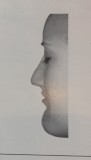
convex - concave profile
forehead recedes; chin protrudes

concave - convex profile
forehead protrudes, chin recedes

vertical - convex profile
forehead vertical, chin recedes

vertical - concave profile
forehead vertical, chin protrudes
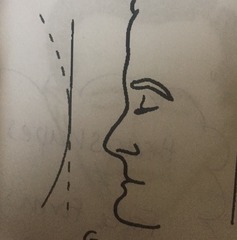
convex - vertical profile
forehead recedes, chin vertical

concave - vertical profile
forehead protrudes, chin vertical

head form, frontal view
suggestive of a geometric shape
How many head shapes (frontal view) are there?
7
oval (frontal view)
most common, classic egg shape

round (frontal view)
aka infantine; face is full and convex
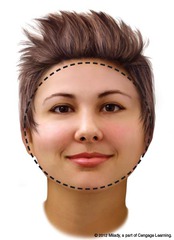
square (frontal view)
broad with little curvature; forehead and jaws are wide; described as "strong" type

oblong (frontal view)
long and narrow

triangular (frontal view)
least common form; wider between the angles of the jaw than across the forehead

inverted triangle (frontal view)
wide forehead and narrow jaws

diamond (frontal view)
wide cheekbones, narrows at forehead and jaws

bilateral forms of the head
curvature of the face from side to side
What two views show the bilateral forms of the head?
1. inferior position (looking upward from chin, as seen when approaching the casket)
2. superior position (looking downward from head, most accessible position for making a restoration)
surfaces that have a similar bilateral curvature
cheeks, forehead, upper lip, chin
Which surfaces are the key to the bilateral forms?
Cheeks; cheekbones mark the change from the front plane of the face to the side of the face, and all structures seem to radiate from the cheekbones
What role does the nose play in determining bilateral forms?
none
oval bilateral form
most common; gentle curvature from frontal to lateral planes
angular bilateral form
frontal plane is narrow, cheekbones prominent and lateral planes flattened
round bilateral form
broad frontal plane, full curving cheeks
square bilateral form
frontal plane relatively broad, very little curvature; lateral planes also have little curvature
forehead
extends from eyebrows to frontal eminences
crown
area above frontal eminences; location of normal hairline
lateral margins of forehead
created by temples
central forehead plane
gently convex, directly superior to nose and medial ends of eyebrows, extends to frontal eminences
lateral forehead planes
gently convex, narrower than central plane, recede from central plane to lines of temples
Angulus Oris Eminence
the small convex prominence lateral to the end of the line of lip closure of the mouth