History of science
 Call Kai
 Learn
Learn Practice Test
 Spaced Repetition
 Match
Match Flashcards
 Knowt Play
1/13

Earn XP
Description and Tags
Important people for the history of science
Name | Mastery | Learn | Test | Matching | Spaced | Call with Kai | Chat |
|---|
No analytics yet
Send a link to your students to track their progress
14 Terms

He was an early proponent of science and tried to observe and explain different aspects of the universe, with a particular interest in its origins, claiming that nature is ruled by laws, just like human societies, and anything that disturbs the balance of nature does not last long.
He is the first philosopher known to have written down his studies
In astronomy, he tried to describe the mechanics of celestial bodies in relation to the Earth. In physics, his postulation that the indefinite (or apeiron) was the source of all things led Greek philosophy to a new level of conceptual abstraction.
Anaximander from Miletus, Born 610 BC

Renaissance mathematician and astronomer who formulated a model of the universe that placed the Sun rather than the Earth at the center of the universe. The publication of this model in his book De revolutionibus orbium coelestium (On the Revolutions of the Celestial Spheres) just before his death in 1543 is considered a major event in the history of science.
Nicolas Copernicus (Mikołaj Kopernik in Polish) born 1473

Austrian-Swedish physicist who worked on radioactivity and nuclear physics
First to discover nuclear fission of uranium when it absorbed an extra neutron
Did not receive the Nobel prize in 1944
Chemical element 109 named after her
Lise Meitner, Born 1878 in Vienna

His contributions to astronomy were enormous. He not only designed and built instruments, he also calibrated them and checked their accuracy periodically. He thus revolutionized astronomical instrumentation.
Whereas earlier astronomers had been content to observe the positions of planets and the Moon at certain important points of their orbits (e.g., opposition, quadrature, station), He and his cast of assistants observed these bodies throughout their orbits. Without these complete series of observations of unprecedented accuracy, ?? could not have discovered that planets move in elliptical orbits.
Tyge Brahe, born 1546

Educated in Sorbonne Paris
Her brilliant researches led to the isolation of polonium, named after the country of her birth, and radium.
Nobel Prize both in Physics and Chemistry
Maria Skłodowska-Curie Born 1867
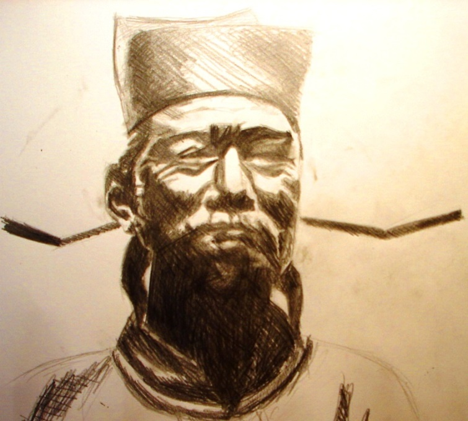
1088 he was the first to describe the magnetic needle compass, which would be used for navigation (first described in Europe by Alexander Neckam in 1187)
Excelling in many fields of study and statecraft, he was a mathematician, astronomer, meteorologist, geologist, zoologist, botanist, pharmacologist, agronomist, archaeologist, ethnographer, cartographer, encyclopedist, general, diplomat, hydraulic engineer, inventor, academy chancellor, finance minister, governmental state inspector, poet, and musician.
Shen Kuo (Chinese: 沈括); 1031–1095

An American astronomer who discovered the relation between the luminosity and the period of Cepheid variable stars.
It was her discovery that first allowed astronomers to measure the distance between the Earth and faraway galaxies.
"A straight line can be readily drawn among each of the two series of points corresponding to maxima and minima, thus showing that there is a simple relation between the brightness of the Cepheid variables and their periods
Henrietta Swan Leavitt Born 1868
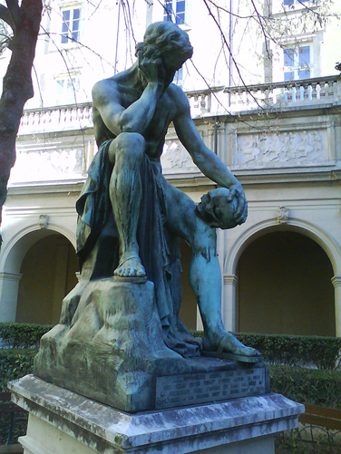
His proposal on atoms bears a passing and partial resemblance to the nineteenth-century understanding of atomic structure
Many consider him to be the "father of modern science".
His theory held that everything is composed of "atoms", which are physically, but not geometrically, indivisible; that between atoms, there lies empty space; that atoms are indestructible; have always been, and always will be, in motion; that there are an infinite number of atoms, and kinds of atoms, which differ in shape, and size.
Democritus, born around 460 BC

A Persian scholar in the House of Wisdom in Baghdad who produced works in mathematics, astronomy, and geography during the Abbasid Caliphate.
His major works introduced Hindu-Arabic numerals and the concepts of algebra into European mathematics.
Latinized versions of his name and of his most famous book title live on in the terms algorithm and algebra.
Al-Khwārizmī (780—850)

A German mathematician, astronomer, and astrologer. A key figure in the 17th century scientific revolution, he is best known for his laws of planetary motion.
Two days after ?? unexpected death on October 24, 1601, Her was appointed his successor as imperial mathematician in Prague with the responsibility to complete his unfinished work. The next 11 years as imperial mathematician would be the most productive of his life. He took ?? observation logs after ?? death.
Johannes Kepler born 1571

Private student of Karl Weierstrass obtained doctorate 1874
Sweden's first female professor (Stockholm Högskola (non government)) and the first female professor in Mathematics in the world
Worked with partial differential equations
Sofia Kovalevskaja Born 1850

He was an Italian polymath and a central figure in the transition from natural philosophy to modern science and in the transformation of the scientific Renaissance into a scientific revolution.
He was championing heliocentrism and Copernicanism, and was thus controversial during his lifetime, when most subscribed to either geocentrism or the Tychonic system. He was tried by the Inquisition, found "vehemently suspect of heresy", and forced to recant. He spent the rest of his life under house arrest
He studied speed and velocity, gravity and free fall, the principle of relativity, inertia, projectile motion and also worked in applied science and technology.
Galileo Galilei Born 1564

Was an Italian-American physicist and the creator of the world's first nuclear reactor, the Chicago Pile-1.
He was one of the very few physicists in history to excel both theoretically and experimentally.
Was awarded the 1938 Nobel Prize in Physics for his work on induced radioactivity by neutron bombardment and the discovery of transuranic elements.
He made significant contributions to the development of quantum theory, nuclear and particle physics, and statistical mechanics.
He is one of the 16 scientists who have elements named after them
? paradox
Enrico Fermi Born 1901
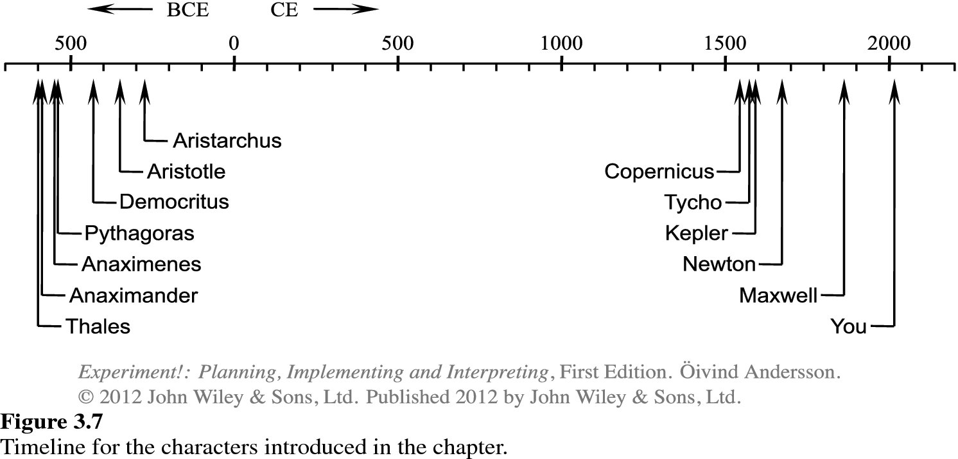
Anledning till hoppet mellan Aristarchus och Copernicus?
Varför är det inga kvinnor med?
övriga årtal:
1477 Uppsala University is established
1678 Elana Cornaro Piscopia first female doktor of Science worldwide (University of Padua)
1827 KTH is established (Chalmers 1829)
1872 Betty Petterson starts to study at Uppsala University (First female regular student)
1921 Brita Snellman first regular female student admitted to KTH
1956 Katarina Kraft Sweden’s first female Doctor of Technology graduates from KTH
ALT 1. The timeline shown in Figure 3.7 shows a very large time gap between
Aristotle and Copernicus. The reason for this time gap was because the church
had banned scientific research. Every person during that time had to be forced
to accept the theories. This is evident from the work of Galileo Galilei. He spent
the last years of his life in house arrest simply for going against the
understanding of the church. Therefore, it was dangerous and hard to conduct
research.
ALT 2. After Aristarchus the church opposed any one that stated
anything different than the writing of Aristotle. Females were not allowed to
study or be teachers at the universities for a long time. 1477 Uppsala University
is established 1678 Elana Cornaro Piscopia first female doktor of Science
worldwide (University of Padua) 1827 KTH is established 1872 Betty Petterson
starts to study at Uppsala University (First female regular student) 1921 Brita
Snellman first regular female student admitted to KTH 1956 Katarina Kraft
Sweden’s first female Doctor of Technology graduates from KTH