MICRO Exam 2: Microbial growth and nutrition
 Call Kai
 Learn
 Practice Test
 Spaced Repetition
 Match
 Flashcards
 Knowt Play
1/53

There's no tags or description
Looks like no tags are added yet.
54 Terms
What are the two types of metabolic reactions
Catabolism and anabolism
What is catabolism
Breaking down of complex nutrients into building blocks and releases energy
What is anabolism
Building of complex molecules from simpler ones, requires energy
Why are metabolic reactions needed
For cells to grow and replicate
What are helpful microbes
Good ones like; medicine, vitamins, and probiotics
What do optimicrobial compounds/treatments do
Prevent microbes from causing disease, spoiling food, contaminating water. As well as manipulating them to make beneficial products like foods, medicines, vitamins, and probiotics
how is the growth of all life related?
they all require the same core elements to grow but get them in different forms and amounts
what are the building blocks for fundamental organic molecules
proteins, nucleic acids, carbohydrates, and lipids
what does microbial growth mean?
an increase in the number of cells aka replication
how does cell division begin?
mother or parent cell duplicates its chromosomes and other contents and doubles in size, it then divides into 2 daughter cells
how does most bacteria reproduce?
binary fission
how many cells does binary fission begin with?
one cell that divides into 2
what is the process of binary fission
the cell duplicates its DNA and other components and divides into two cells, the daughter cells then become independent when a septum grows between them and they separate
where does budding mainly occur
yeast
how does budding work
small new cell develops on surface of existing cell and separates to form daughter cells (small cell grows off of parent cell)
what are the detailed steps of binary fission?
dividing cells replicate their single bacterial chromosome shortly before division; chromosome is attached to the cell membrane (grows and separates the replicated chromosome); cell temporarily may have 2 (or more) chromosomes (if bacterial cell is replicating quickly); cells may not completely separate (diplo, strepto, staphylo, and other cell morphologies)
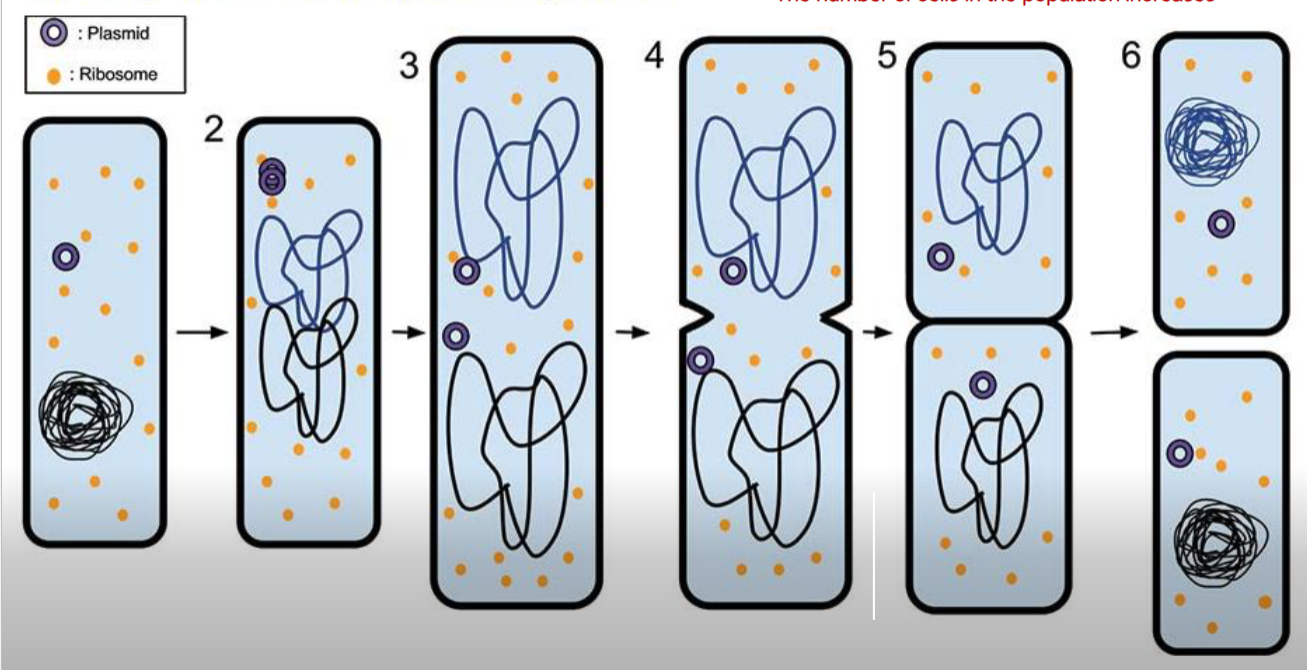
what does this image represent?
binary fission in prokaryotes
what material is required when culturing bacteria?
culture media with all nutrients necessary for growth
what circumstances is bacteria cultured under
proper environmental conditions including temperature, pH, aeration, solute concentration/osmolarity (varies for different bacterial species)
what is used to estimate viable bacteria in the original sample
colony count and dilution factor
what are the steps to performing a growth curve?
inoculate sterile liquid media in a flask with small number of bacterial cells from a pure culture → incubate cells at optimal conditions → at evenly spaced time intervals, remove small aliquot of sample and plate cells on solid nutrient media → incubate and count bacterial colonies → assume that all cells in a single colony are derived from a single cell → to determine total number of cells, multiply the number of colonies by the dilution factor
how is countable viable/living bacteria expressed?
Colony Forming Units (CFUs) per ml

what does #1 represent with the logarithm of viable cells
it is increasing

what does #2 represent for the logarithm of viable cells
it is constant or not changing

what does #3 represent with the logarithm of viable cells
what is the lag phase
adjustment to the environment; bacteria do not increase in number, but are still metabolically active and adjusting to new culture conditions, cells increase their contents and prepare to divide
what is the exponential (log) phase
once bacteria have adapted to culture conditions, population growth is exponential or logarithmic (2-4-6-8-16-32 cells… etc) cells dividing at their most rapid rate, cells dividing at a constant rate
what is generation time
doubling time; the time it takes to double the population, bacteria can very from 20 minutes to days, many bacteria that are commonly studied replicate in < 1 hour
what is the stationary phase
as growth increases exponentially, nutrients are used up, metabolic waste products accumulate, growth levels off, cell number stays constant (cells exhibit maximum stress resistance to environmental stressors)
what is the death phase
conditions worsen, number of live cells decreases at a logarithmic rate, cells assume unusual shapes (difficult to identify), cells really decrease, generally best not to use old cultures for staining as results can be misleading - best to use young log phase growth cells as they best represent the natural size, morphology, and Gram stain
what can growth curves help determine
infection and disease, food microbiology, industrial microbiology, water treatment, and genetic engineering
what do plate counts measure
serial dilutions
what do hemocytometers measure
direct microscopic counts
what do spectrophotometers measure
measurement of turbidity
what can using heat cells to remove water help measure?
dry weight
what are plate counts
performance of serial dilutions of a microbial sample and plate on nutrient agar
what is the countable CFU range
30-300
what does it mean if something is viable
alive and able to replicate
what can hemocytometers be used in combination with to distinguish between live and dead cells
trypan blue stains
what is a hemocytometer
a glass microscope slide that has a counting chamber that has a grid of squares and perpendicular lines that holds liquids in a suspension
what does turbidity measure
optical density (OD600); measure amount of light transferred through liquid, microbial cells present will scatter light and reduce amount transferred through solution, FAST
what are some problems with measuring turbidity
can’t tell if cells are alive or dead; size of cells change during growth cycle, other variables like dead cell debris affect reading
what is a polymerase chain reaction
sequencing approach that quantifies bacteria and other microbes in environmental and tissue samples without isolating and culturing them
what is a colony
a group of growth of an original cell
how do colonies form
from a single cells, spore, or from a group of the same microorganisms attached to one another in clumps or chains (usually have a distinctive shape, color, surface, etc)
what is defined media
made from ingredients with KNOWN chemical composition; often used when exact nutritional needs of an organism are known
what is complex media
contains ingredients with UNKNOWN chemical compositions; often used for general cultivation of microbes (including those whose nutritional requirements are not known) as it is rich in nutrients
what is general purpose media
media that supports the growht of mant general (non-fastidous/not picky) microbes; complex media that contains a mixture of ingredients/nutrients that support a wide variety of microbial life (ex. nutrient agar, broth, brain-heart infusion, and trypticase soy agar)
what is enriched media
contains complex organic substances (blood, serum, hemoglobin, or special growth factors) that fastidious (picky) bacteria require for growth
what are some growth factors in enriched media
specific vitamins or amino acids
what is selective media
allows only specific types of microbes to grow; contains one or more agents (dyes, antibiotics, acids, high salt concentrations) that inhibit the growth of unwanted organisms
what is differential media
allows you to distinguish between different types of microorganisms that grow based on their appearance; contains agents like fermentable carbohydrates and pH indicators that cause color changes to show different characteristics of microbes that grow