RESEARCH METHODS
 Call Kai
 Learn
Learn Practice Test
 Spaced Repetition
 Match
Match Flashcards
 Knowt Play
1/220

There's no tags or description
Looks like no tags are added yet.
Name | Mastery | Learn | Test | Matching | Spaced | Call with Kai | Chat |
|---|
No analytics yet
Send a link to your students to track their progress
221 Terms
What are the 5 Methods of Acquiring knowledge?
Rationalism (relying on sound premises + conclusions)
Authority (relying on authority figures)
Intuition (relying on guts)
Scientific method
Empiricism (getting knowledge thru observation + experience)
(RAISE)
Why can Intuition be wrong sometimes?
Because it is driven by biases rather than logical reasoning or scientific evidence
Why can relying on Authority be wrong sometimes?
Cuz the authority figure may:
Be wrong
Be using their intuition
Have their own reasons to mislead
Why can Rationalism be wrong sometimes?
Cuz if premises are wrongs or have an error in logic, then the conclusion will also be invalid
Why can Empiricism be wrong sometimes?
and what is empiricism the heart of?
Cuz we’re limited in what we experience and observe + our senses can deceive us
The Scientific method
What are the 7 steps of the Scientific method?
1) Make an observation
2) Ask a question
3) Develop a hypothesis or prediction
4) Test the prediction
5) Analyze results
6) Record the results against the hypothesis
7) Make a conclusion
What is Science?
The systematic study of the structure + behavior of the physical + natural world thru observation + experience
What are the 3 Features of Science?
Systematic empiricism
Empirical questions
Public knowledge
(SEP)
What is Systematic empiricism?
Learning by carefully:
Planning,
Recording,
Analyzing,
Making observations.
What are Empirical questions?
and how can they be answered?
Questions about the way the world actually is
by systematical observation
When do Scientists typically publish their work?
After:
Asking empirical questions,
Making systematic observations,
Drawing conclusions
What are the 2 reasons Publication is an essential feature of science?
Science is a social process, a large scale collaboration
Publication allows science to be self-correcting
What are Open access journals?
Journals whose articles are freely available to all
What are the 5 Benefits of Open access?
More access (authors can address more w/o the readers paying)
Increased citations + impact
Increased visibility (readers know them more + institutions host them)
Drives Research innovation
Faster availability + searchability
What is the Self-correcting replication crisis in psychology?
It’s why psych is under criticism because a number of research finding don’t replicate
What is the ‘Many labs replication project’?
An effort by psychological scientists around the world to attempt to replicate findings from 13 classic + contemporary studies
What are the 3 reasons Pseudoscience matters?
It highlights the fundamental features of science
Because a lot of pseudoscientific beliefs are widely held in society
Because many pseudosciences try to explain aspects of human behavior + mental processes → Pseudo psych
What are the 3 Goals of science?
Describe → Making careful observations
Predict → Use the observations to predict wether an event or behavior will occur in a certain situation
Explain → Determine the causes of behavior
What does Basic research do?
it examines how the mind works
What does Applied research do?
and is it different from basic research?
It examines how to use basic research to solve real-world problems
yes, but the distinction isn’t always clear-cut
What is Folk psychology?
Intuitive beliefs about peoples behavior, thoughts, and feelings
What are 3 examples of Common sense myths?
“Ppl use only 10% of their brain power”
“Most ppl experience a midlife crisis in their 40s or 50s”
“Students learn best when teaching style is matched to their learning style”
What are Heuristics?
Mental shortcuts in forming + maintaining our beliefs

What are the 5 steps of the Simple model of Scientfic research?
Researchers formulate a research question,
Conduct an empirical study designed to answer the question
Analyze the resulting data
Draw conclusions about the answer to the question,
Publish the results so that they become part of the research literature (i.e., all the published research in that field) - which is the primary source of new research questions.
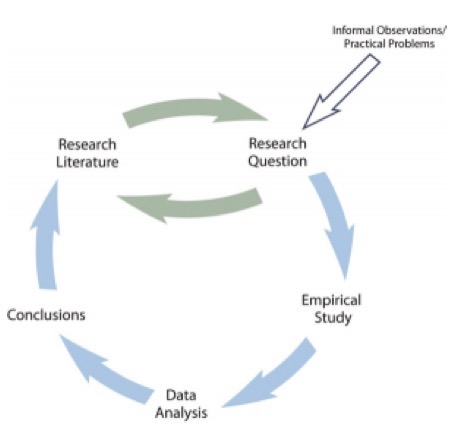
What are 2 examples of Research based on the Simple model?
Are women really more talkative than men? (Mehl et al, 2007)
Passenger + cell-phone conversations in simulated driving/Do phones have a negative impact on driving? (Drews et al, 2004)
What must finding a Research topic start with?
A good research question (which often begin as more general research ideas)
What 3 things make a Research topic good?
Interests author
Creative (New topic/less covered)
Not too broad
What are the 3 Most common sources for Finding inspiration for a research topic?
Informal observations
Practical problems
Previous research (most most common)
What are Informal observations?
Direct observations of behavior + Secondhand observations from non-Scientfic sources (like books, movies, etc)
What are Practical problems?
Observations involving real situations + events
How do people find inspiration from Previous research?
By Reading + Evaluating other work + Conducting new studies to build on it
What is Reviewing research literature?
Finding, reading, and summarizing the published research relevant to your topic of interest.
What is Research literature?
All the published research in that field
What are the 4 reasons Reviewing previous literature is important?
Cuz it helps:
Identify if a research question has already been answered
Evaluate the interestingness of a research question
Give ideas for how to conduct a study
Show how a study fits into the research literature
What are the 2 sources for Reviewing research literature?
Articles in professional journals
Scholarly books
What are Professional journals?
and what are the 2 types of it?
Periodicals that publish original research articles
Empirical research reports + Reviews articles
What are Empirical research reports?
Reports that describe new empirical studies conducted by authors thru introducing a research question, reviewing prev research, describing methods + results, and drawing conclusions
What are Review articles?
and what are the 2 types of it?
Articles that summarize previously published research + present new ways to organize/explain the results
Theoretical articles + Meta-analysis
What are Theoretical articles?
An article devoted primarily to presenting a new theory
What is a Meta-analysis?
An articles that provides a statistical summary of all of the previous results (so an analysis of an analysis)
What are the 3 Peer review methods?
Double-blind peer review
Single-blind peer review
Open peer review
What is a Double-blind peer review?
When the reviewers of a research article don’t know the identity of the researcher(s) and vice versa.
+(Researchers who want to publish their work in the journal submit a manuscript to the editor—a researcher too—who then sends it to 2/3 experts on the topic. Each reviewer reads the manuscript, writes a review, and sends it back to the editor along with recommendations about whether the manuscript should be published or not. The editor then decides whether to accept the article for publication, ask the authors to make changes and resubmit it for further consideration, or reject it outright. But the editor will always forward the reviewers’ written comments to the researchers so that they can revise their manuscript accordingly.)+
What is a Single-blind peer review?
When only the reviewer’s identity is known
What is an Open peer review?
When the identities of the reviewers are published alongside the journal article.
What are Scholarly books?
and what are the 2 types of it?
Books written by researchers + practitioners for use by other researchers/practitioners
Monographs + Edited volumes
What is a Monograph?
An extended review article written by a single author or a small group of authors
What are Edited volumes?
Books that are collections of chapters written by different authors on different aspects of the same topic, and overseen by one or more editors
What kind of peer review process do Scholarly books undergo?
a similar one to professional journals
What does the primary method used to search the research literature involve?
Electronic databases, like:
Academic Search Premier,
JSTOR,
ProQuest for all academic disciplines,
ERIC for education,
PubMed for medicine + related fields.
What are the 4 most common Literature search databases?
PsycINFO
Web of science
Google scholar
ResearchRabbit
What is PsycINFO?
A comprehensive electronic database covering thousands of professional journals + scholarly books produced by the American Psychological Association (APA)
When you do a literature review, you have to be…?
Selective
What are the 4 ways to be Selective when doing a Literature review?
Focus on recent research + Look thru the reference list
Look for review articles on your topic
Look for empirical research reports addressing your question
Look for sources that provide information that can help you “sell” your research question
You should focus on sources that help you do what 4 basic things?
Refine your research question,
Identify appropriate research methods,
Place your research in the context of previous research,
Write an effective research report.
What is the Average number of sources cited per article?
About 50 → (Adair + Vohra, 2003)
What are Empirically Testable Research Questions?
Questions expressed in terms of a single variable or the relationship between variables
What are the 3 ways to Generate Empirically Testable Research Questions?
Look at Discussion sections of recent articles (The last big section of the article)
Come up with your own research questions
Reassess previous research questions
What 3 things do Discussion sections include?
Summary of the results + their interpretation in the context of past research
New directions are suggested for fixture research
Researcher suggestions for future research (Which take the form of research questions)
How do you come up with your own Research ideas?
By conceptualize a particular behavior as a variable + ask her frequent/intense it is → if science answered that then consider a relationship between a behavior + some other variable
How can you Reassess Previous research?
By seeing if the research questions can be refined, via asking yourself more general questions about the relationship
(Like → Are there other ways to define and measure the variables? Are there types of people for whom the relationship might be stronger or weaker? Etc,)
What are the 2 Criteria for Evaluating Research questions?
Interestingness = How attention grabbing/Engaging smthn is
Feasibility = How likely is the research question going to be
successfully answered
What 3 things must the Interestingness Criteria consider?
Is the answer in doubt?
Does it fill a gap in research literature?
Does it have important practical implications?
What 3 things must the Feasibility Criteria consider?
Time
Money
Equipment + materials
Technical knowledge + skill
Access to research participants
What’s a Theory?
An explanation or interpretation of one or more phenomena
Whats a thing that all Theories have in common?
They go beyond the phenomena, explain by including → Variables, structures, processes, functions, or organizing principles that have not been observed directly
What’s a Hypothesis?
A specific prediction about a new phenomenon that should be observed if a particular theory is accurate + relies on a few key concepts
What are the 2 types of Hypothesis?
Null
Alternative
What’s a Null hypothesis?
A hypothesis that always predicts no effect/relationship between variables
What’s an Alternative hypothesis?
Your research prediction of an effect/relationship between variables
Whats the Primary way that Scientfic researchers test Theories?
the Hypothetico-Deductive method

Whats the Hypothetico-Deductive method?
the method where based on the conclusion of a theory we reassess it + see if it lines up

What does the Hypothetico-Deductive method combined with the General model of Scientfic research in psychology form?
A model of theoretically motivated research
What are the 3 characteristics of a Good Hypothesis?
Testable + Falsifiable
Logical
Positive
What does a Testable + Falsifiable hypotheses mean?
That the hypotheses must be testable using the methods of science + it must be possible to gather evidence that will disconfirm the hypothesis if it is false
What does it mean for a Hypothesis to be Logical?
That it should be informed by previous theories/observations + logical reasoning
What are the 2 kinds of Logical Reasoning?
Deductive
Inductive
What does Deductive Reasoning begin with?
A broad + general theory to generate a more specific hypothesis
What does Inductive Reasoning use?
Specific observations to form a general hypothesis
What does it mean for a Hypothesis to be Positive?
That it should make a positive statement about the existence of
a relationship/effect, rather than one that doesnt
What is the File drawer effect (Rosenthal,1979)?
In science many results remain unpublished, especially negative ones → which produces a publication bias.
(So there so much unpublished ones proving a none relationship but we just cant see it)
What’s a Variable?
a Quantity or Quality that varies across people or situations
What are the 2 types of Variables?
Quantitative variable
Categorical variable
What’s a Quantitative variable?
A quantity that is typically measured by assigning a number to each individual
(Eg,??)
What’s a Categorical variable?
A variable that represents a characteristic + is measured by assigning each response to one of several categories (they don’t have to have a number associated)
What’s an Operational definition?
A definition of the variable in terms of precisely how it is to be measured + what the variable is
(No right or wrong answer)
What’s a Population?
and what’s a part of a population?
A large group of people that researchers are interested in drawing conclusions about
Sample
What’s a Sample?
And what are the 2 parts of it?
A smaller portion of the population of interest
Simple random sampling + Convenience sampling
What’s Simple random sampling?
A type of sampling where every member of the population has an equal chance of being selected
What’s Convenience sampling?
A type of sampling that consists of individuals who happen to be nearby + willing to participate — but is unequal in who gets picked
What are the 2 types of Validity?
Internal validity
External validity
What’s Internal validity?
The degree to which we can confidently infer a causal relationship between variables
(So the extent in which we’re measuring what we intend to measure, often associated with high levels of control within our experiment)
What’s External validity?
The degree to which we can generalize the findings to other circumstances, like the real-world
Whats the relationship between Internal + External validity?
A give and take one
What 4 things does Experimental research include?
Independent variables (IV)
Dependent variables (DV)
Extraneous variables
Confounds
Whats an Independent variable (IV)?
the Variable the experimenter manipulates (the cause)
(Eg, whether someone takes a drug or not)
Whats a Dependent variable (DV)?
The variable the experimenter measures (the effect)
(Eg, the test scores of the drug used)
What are Extraneous variables?
are they a problem?
Any variable other than the dependent + independent variable
No, not automatically if theyre held constant/don’t change during an experiment
What is the result of Extraneous variables becoming a problem?
Confounds
What are Confounds?
A type of Extraneous variable that systematically varies along with the variables under investigation, so provides an alternative explanation for the results.
Why are Confounds a problem?
Because they confuse the data cuz they intertwine with any effect of the independent variables, so we cant tell if the change we’re seeing is due to manipulation or the confound itself