AP Biology Unit 2 Review
 Call Kai
 Learn
 Practice Test
 Spaced Repetition
 Match
 Flashcards
 Knowt Play
1/99

There's no tags or description
Looks like no tags are added yet.
100 Terms
Prokaryote
Single celled organisms, such as bacteria and archea

Eukaryote
Cells with membrane bound organelles. Found in animals, plants, and fungi.

Similarities between Eukaryotic and Prokaryotic Cells
-Ribosomes, Cytoplasm, Cytoskeleton, Plasma Membrane
-DNA and RNA for cellular replication
Differences between Prokaryotes and Eukaryotes
-Ribosomes float freely in Cytoplasm in prokaryotes, not eukaryotes
-Prokaryotes don’t have a nucleus, unlike eukaryotes
-No membrane bound organelles in prokaryotes, unlike eukaryotes
-Singular circular DNA in nucleoid for prokaryotes, unlike eukaryote's many and linear DNA in nucleus and nucleolus
-Prokaryotes generate energy across outer plasma membrane, eukaryotes generate energy with mitochondria/chloroplast
Organelles
Structure bound in their membrane in eukaryotes
Endomembrane Organelles
Nuclear Envelope, ER, Golgi Complex, Lysosomes, Vesicules, Plasma membrane
Energy Organells
Mitochondria and Chiroplasts
Compartmentalization
Creates separate environments for separate organelles
What does compartmentalization do?
Increases surface area for reactions to occur; prevents interfering reactions in the same place
Which organelles are unique to plants?
Chloroplast, Central Vacuole, Cell Wall, and plasmadesmasta
Which organelles are unique to animals?
Lysosomes, Centrioles/Centrosones, Cilia/Flagella, and Cytoskeleton
Nucleus
Has chromosomes, enclosed by 2x membrane, pores

Nucleolus
Dense region of nucleus where ribosonal RNA (rRNA) which build ribosomes

Ribosomes
Synthesize proteins

Where can ribosomes be found?
In the cytosol, called "free ribosomes" or in the ER, where they can leave it through transport vesicles
Endoplasmatic Reticulum
Synthesizes membranes, separates proteins formed in Rough ER from ribosomes (enzymes)
What are the types of ER?
Rough and Smooth ER
What does the Rough ER do?
Contains ribosomes bonded to it, houses proteins to late be transported

What does Smooth ER do?
NO ribosomes, synthesizes lipids, detoxifies the cell, and breaks down carbohydrates in useful parts
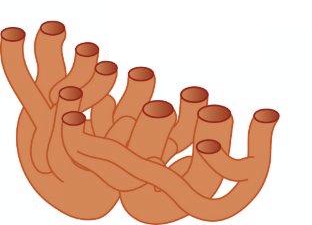
Describe the composition of the golgi body
Flattened separated membranous sacs called cistemane. Cis face at the front receiving vesicles from rough ER. Trans face at the end which sends vesicles into cytosol or plasma membrane for secretion

What is secretion?
Cells release their "goods" that are useful for the body and have a specific function, like proteins secreting enzymes
What are the functions of the Golgi apparatus?
Receives transport from Rough ER, modifies them and sorts them, adds molecular tags, and packages them in transport vesicles to exit the membrane via exocytosis
Lysosomes
-Only in animals. Contains hydrolytic enzymes which hydrolize macromolecules, break down fats, and recycle molecules' goods for the body
-Autophagy= Recycle their own cell's organic materials

Peroxisomes
Break down H2O2 into water

Types of Vacuoles
Food vacuoles, contractile vacuole (maintains water level), and central vacuoles only in plants that have water and is key to turgor pressure

What does the endosymbiont theory state?
A once small prokaryotic cell was engulfed by a large eukaryotic cell, becoming mitochondria/chloroplast and endosymbient, used to explain similarities of mithocondria and chloroplast compared to a prokaryote
Evidence for Endosymbiont Theory
double membrane, ribosomes, circular DNA, capable of functioning on their own
Mitochondria
Double membrane: outer smooth, inner has folds called cristae dividing it into internal compartments which increases SA, and intermembrane which separates outer and inner membrane

Functions of mitochondria
powerhouse of the cell; generates ATP through cellular respiration
Cells with high metabolic activity will have________________
more mitochondria
Chloroplast
Site of photosynthesis; contains chlorophyll

Structure of chloroplasts
Thylakoids, membranous sacs, that stacked are called grana, stroma in the fluid around thylakoids that has chloroplasts DNA, ribosomes and enzymes
Cytoskeleton
Networks of fibers through cytoplasm

Functions of cytoskeleton
-Structural and mechanical support
-Anchors organells
-Movement of vesicles, organelles and entire cells
Cytoskeleston's Microtubules
Rod-like structure made of tubulin, provide structural support for organelle movement, assists in sepsration of chromosomes, and help cell movement through cilia or flagella

Cytoskeleton Microfilaments
Thin solid rods made of actin. Maintains shape in contractions and mobility, division of animal cells
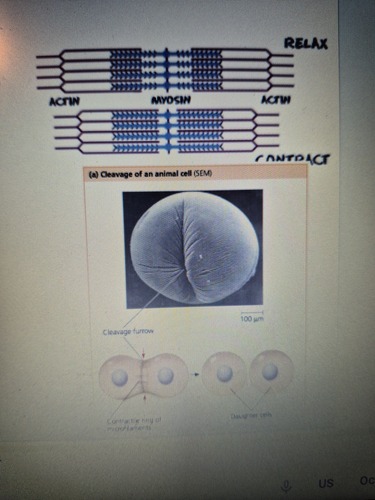
Cytoskeleton: Intermediate Filaments
Fiberous protein made of many subunits. Maintains cell shape, anchors nucleus and organelles, lines nuclear envelope.

Size of a cell will dictate_________________
The cell's function
Cells need a high________ to _________ exchange of materials through the plasma membrane
SA to Volume ration; efficiently

Which organelle is this?
It's the Nucleus

Which organelle is this
It's the Nucleolus

Which organelle is this
It's the Ribosomes
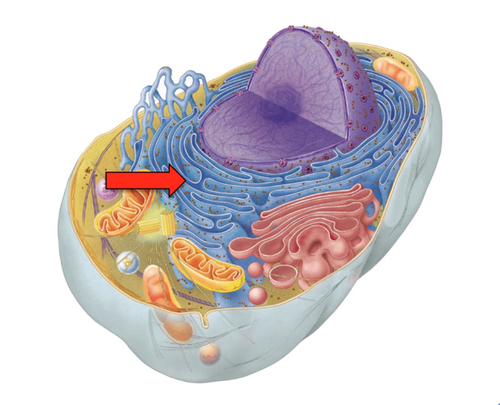
Which organelle is this
It's the Rough ER

Which organelle is this
It's the Smooth ER
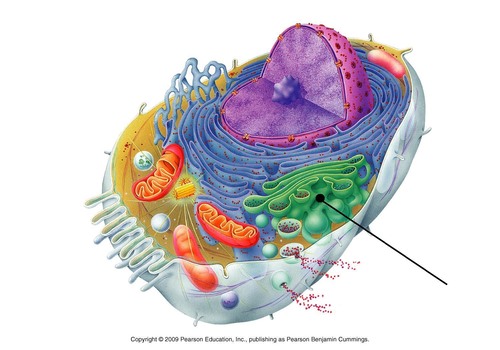
Which organelle is this
It's the Golgi Body

Which organelle is this
It's the Lysosomes

Which organelle is this
It's the Peroxisomes

Which organelle is this
It's the Vacuole

Which organelle is this
It's the Mitochondria

Which organelle is this
It's the Chloroplast

Which organelle is this
It's the Cytoskeleton
Formulas for cuboidal cells
Surface Area= length × width × number of sides
Volume= length × width × height
SA to V Ratio= Surface Area/Volume
Formulas for spherical cells
Surface Area= 4𝝅r²
Volume= 4/3 × 𝝅r³
Surface Area to Volume Ratio= Surface Area/Volume
Selective Permeability
The ability of biological membranes to regulate the specific substances that enter and exit the cell.
Plasma (cell) Membrane
Separates internal cell environment from external environment
Amphipathic
A property of molecules, such as phospholipids, having both hydrophilic (water-loving) and hydrophobic (water-fearing) regions.
Fluid Mosaic Model
A structural model describing cell membranes as fluid structures held together by weak hydrophobic interactions, containing a mosaic of proteins, lipids, and carbohydrates.
Cholesterol (in cell membranes)
A membrane steroid that reduces phospholipid movement at high temperatures to prevent excessive fluidity, and hinders close packing of phospholipids at low temperatures to prevent solidification.
Integral Proteins
Proteins embedded directly into the lipid bilayer that typically contain both hydrophilic and hydrophobic regions, often serving as transmembrane proteins.
Peripheral Proteins
Proteins that are not fully embedded in the lipid bilayer but are loosely bound to the membrane surface, without interacting directly with the hydrophobic fatty acid tails.
Glycolipids
Carbohydrates covalently bonded to lipids on the outer membrane surface, functioning in cell-to-cell recognition.
Glycoproteins
Carbohydrates covalently bonded to proteins, representing the most abundant membrane surface markers used for cell-to-cell recognition.
Plasmodesmata
Hole-like channels in plant cell walls filled with cytosol that connect the cytoplasm of adjacent plant cells.
Passive Transport
The transport of a substance across a biological membrane down its concentration or electrochemical gradient without the expenditure of cellular energy to achieve equilibrium.
Diffusion
The spontaneous net movement of a substance down its concentration gradient from an area of high concentration to an area of low concentration.
Osmosis
The diffusion of water across a selectively permeable membrane down its concentration gradient, or toward the area of higher solute concentration.
Facilitated Diffusion
Passive transmembrane transport of polar molecules or ions down their concentration gradient assisted by specific channel or carrier proteins.
Aquaporins
Specialized transmembrane channel proteins that facilitate the rapid passage of water molecules through the plasma membrane.
Carrier Proteins
Membrane transport proteins that undergo conformational shape changes to translocate specific solutes across the cell membrane.
Active Transport
The movement of a substance across a membrane against its concentration gradient, requiring energy input typically in the form of ATP to achieve equilibrium.
What does ATP do in Active Transport
ATP transfers its terminal phosphate group to the transport protein, which undergoes conformational change to better move the substance.
Membrane Potential
The difference in electrical charge across a cell membrane created by unequal distributions of ions, rendering the cytoplasm relatively negative compared to the extracellular fluid.
Electrogenic Pumps
Transport proteins that generate a voltage across a membrane by translocating net charge, which can be stored and used as an energy source for cellular processes.
Sodium-Potassium Pump
An electrogenic pump in animal cells that exports 3 Na+ ions and imports 2 K+ ions per cycle, resulting in a net +1 charge transferred to the extracellular fluid.
Proton Pump
An integral membrane protein found in plants, fungi, and bacteria that actively transports H+ out of the cell, generating a proton gradient across the membrane.
Cotransport
A mechanism coupling the favorable downhill diffusion of one substance with the unfavorable uphill transport of a second substance against its concentration gradient.
Example of Cotransport
Sucrose-H+ cotransport.
Sucrose can travel into a plant cell against its concentration gradient ONLY coupled with H+ which goes down its electrochemical gradient.
Exocytosis
The cellular process of exporting bulk materials where intracellular vesicles fuse with the plasma membrane to release their contents into the extracellular fluid.
Endocytosis
The cellular uptake of biological molecules and particulate matter via the inward budding and pinching off of vesicles from the plasma membrane.
Types of Endocytosis
-Phagocytosis
-Pinocytosis
-Receptor Mediated Endocytosis
Phagocytosis
A type of endocytosis ('cell eating') in which a cell wraps pseudopodia around large particles, packaging them into a food vacuole that fuses with a lysosome for digestion.
Pinocytosis
A nonspecific form of endocytosis ('cell drinking') where a cell gulps droplets of extracellular fluid containing dissolved molecules inside protein-coated vesicles.
Receptor-Mediated Endocytosis
A selective endocytic mechanism in which specific solutes bind to membrane receptors, clustering together to enter the cell in coated vesicles.
Tonicity
The ability of an extracellular solution to cause a cell to gain or lose water, dependent on the relative concentration of nonpenetrating solutes.
Osmoregulation
The biological process by which organisms regulate solute concentrations and balance water gain and loss.
Isotonic Solutions
-No net change movement of water
-Equal solution concentration outside and inside
-Water enters and exits the cell at the same rate
Hypertonic Solution
-Cells lose water to their surroundings
-Solute concentration is higher outside than inside
-Cells will shrivel and die
-Plasmolysis in plant cells
Hypotonic Solution
-Cells gain water from their surroundings
-Solute concentration is higher inside than outside
-Cells will gain water
-Animal cells swell and lyse, Plant cells will work optimally
Plasmolysis
The shrinkage of a plant cell's central vacuole and pulling away of the plasma membrane from the cell wall when placed in a hypertonic environment.
Cytolysis
The swelling and bursting (lysis) of an animal cell placed in a hypotonic environment caused by an excessive influx of water.
Water Potential (Ψ)
The physical property that predicts the direction in which water will flow, calculated using Ψ=Ψs+Ψp and measured in megapascals (MPa) or bars, where 1 MPa=10 bars.
Water will from where from which areas?
High Water Potential——> Low Water Potential
Low Solute Concentration——> High Solute Concentration
High Pressure——> Low Pressure
Solute Potential (Ψs)
-A component of water potential calculated by Ψs=−iCRT, where i is the ionization constant, C is molar concentration, R is the pressure constant, and T is temperature in Kelvin (273+∘C).
-More Solute, Less Free Water
Ψs=−iCRT, what i the ionization constant, C the molar concentration, R the pressure constant, and T the temperature.$T
i - 1 in sucrose, 2 in NaCl
C - Moles (M) of solution concentration
R - 0.0831 if bars, 0.00831 if MPa
T -273+∘C in Kelvin (K)
What is Ψp (Pressure Potential) in an open beaker
0MPa
Dialyzer
An artificial kidney machine using counter-current flow of blood and dialysis fluid separated by a semi-permeable membrane to eliminate toxins and excess water via diffusion and osmosis.
Macrophage
An immune cell that captures and destroys pathogens or viruses while surveying for antigens.
Killer T-cell
An immune cell that acts as a soldier to identify and destroy the body's own infected cells.
Dendritic Cell
An antigen-presenting immune cell that alerts other immune cells to the presence of an infection.
B-cell
An immune cell that produces antibodies to fight specific foreign antigens.