Lecture 15: Acute Abdominal Pain_ Mesenteric Ischemia and Small Bowel Obstruction
 Call Kai
 Learn
 Practice Test
 Spaced Repetition
 Match
 Flashcards
 Knowt Play
1/71

There's no tags or description
Looks like no tags are added yet.
72 Terms
Acute Abdominal Pain
Describes a symptom that can be caused by a long differential diagnosis
Acute Abdomen
-peritoneal signs that require immediate surgical intervention rather than waiting on laboratory results and diagnostic imaging
Small Bowel Obstruction (SBO)
-mechanical or functional bloackage of the intestine preventing the normal transit of products of digestion
-15% of admissions to the hospital for acute abdominal pain
Mechanical SBO (simple)
obstruction occurs at a single point
Mechanical SBO (Closed Loop)
• Obstructed at 2 locations
• Creates a segment of bowel with both proximal and distal blood flow compromise
• Can cause intestinal infarction and necrosis much quicker than simple obstruction
• Mortality rate double
Functional SBO
• Occurs as a result of disruption of the normal coordinated peristaltic activity of the gastrointestinal tract in the absence of a physical blockage within the intestinal lumen
• Most commonly known as an adynamic ileus
Pseudo-Obstructions
• Usually due to chronic diseases
• Disruption of nerves/innervations to peristaltic muscles
• Ex. Hirschsprung's Disease
• Postoperative adhesions (60%)
• Hernias
• Volvulus
• Compressing masses
-Mechanical Causes of sbo's/ileus
• External to Intestinal Wall
• Primary neoplasms
• Inflammatory
• Infectious causes
• Intussusception
• Traumatic
-Mechanical Causes of sbo's/ileus
• Intrinsic to Intestinal Wall
• Bezoars
• Foreign bodies
• Gallstones
• Ascaris infestation
-Mechanical Causes of sbo's/ileus
• Intraluminal
Adhesions
#1 SBO mechanical Cause
Adhesions
-Develop as a result of a process involving the interaction among numerous types of cells, cytokines, and coagulation factors caused by damage to peritoneal surfaces
-those that undergo intestinal or pelvis surgeries are at greater risk
Neoplasms
#2 SBO mechanical Cause
Gynecologic Cancer (ovarian)
what neoplasms are an especially common cause of SBO?
External Hernias
-cause of SBO
-involves the abdominal wall
-inguinal, femoral, or incisional
Internal Hernias
-cause of SBO
-involves mesenteric defects from prior surgery
Gallstone Ileus
when gallstone erodes through GB wall into the
small bowel and lodges distally
Small Bowel Volvulus
• Abnormal twisting of loop of bowel around the axis of its own mesentery
-much more common in colon
-small bowel is rare
Intussusception
• Telescoping of the bowel resulting in obstruction and ischemia
• Most frequently seen in pts under 2 years of age
• Rare in adults
Bowel proximal to obstruction first becomes mildly dilated by the accumulation of partially digested food and normal intestinal secretions (succus)
What is the first thing that happens in SBO?
Succus entericus
-normal intestinal secretions
-secreted by cells lining the intestinal wall in response to mechanical stimulation
Increased intestinal dilation
in SBO:
_________________________________ causes increase in peristalsis and triggers frequent and loose bowel movements and n/v (early in obstruction)
Bacterial Overgrowth
in SBO, what is a consequence of loss of normal intestinal motility?
E. Coli, Strep Faecalis & Klebsiella
Bacteria that commonly cause problems in SBO
Proximal
If the obstruction is _______________ in location, continued bouts of emesis can lead to electrolyte abnormalities, metabolic alkalosis, and severe hypovolemia and shock.
Small Bowel Obstruction (SBO)
-hyperactive bowel sound with rushes and high pitched " tinkles", hypoactive absent BS are a late finding
-Percussion - may elicit tympani
-Palpation - diffuse tenderness to palpation commonRebound, guarding, rigidity, distention
-Digital rectal exam: fecal blood, impaction, etc.
-Previous Surgery
-Hx of constipation
-Age over 50
-Vomiting
-Abdominal distension and Increased bowel sounds
Prospective study factors that indicate a high probability of SBO
Small Bowel Obstruction (SBO)
• Distended loops of bowel, normally greater than 3 cm in diameter
• Air-fluid levels
• "String of pearls" or "string of beads" sign
• Trapped gas between intraluminal fluid
• Transition point of strangulation
• Aggressive fluid resuscitation (IV NS)
• Control N/V/pain
• Reduce hernias if possible
• Bowel decompression with a NG tube
• Timely surgical consultation
SBO treatment
NG Tube
• Its effect in decreasing the duration of SBO has scant support in the medical literature
• Because it is such a noxious procedure, if the pt's N/V can be controlled with medication, it may be reasonable to delay NG insertion
• Trauma literature has shown little current value in treatment
• Hypovolemia, oliguria, renal failure
• Intestinal ischemia and infarction
• Peritonitis and sepsis
Complications of SBO
-Hemorrhage
-Wound infection
-Abscess formation
-Short bowel syndrome
SBO Surgical complicaitons
Manual Pressure
how to reduce a reducible hernia?
Surgery (emergency)
how to reduce a strangulated hernia
1. Place patient in Trendelenburg position
2. Administer pain meds/muscle relaxant
3. Apply steady pressure to contents
4. Apply ice to area once reduction complete
steps on how to reduce a hernia
Colorectal CA/Malignancies
majority of LBO is caused by what?
Large Bowel Obstruction (LBO)
-prevalence increases with age due to increased prevalence of colon cancer and diverticulitis
-Sepsis and death common!
-ischemia can lead to perforation and fecal soilage of the peritoneal cavity
Large Bowel Obstruction (LBO)
• Look for extremely dilated loops of bowel, typically
following the periphery:
• >6cm typical
• >12cm high risk of perforation
• Haustra typically do not connect across diameter of bowel and spaced far apart,
Diverticulitis
-common cause of LBO
-inflammation of diverticular tissue
-painful
-symptoms develop when it becomes obstructed with stool
-inflammation sets in and micro-perforations of the sac develop
Diverticulosis
denotes the presence of diverticula in the colon. Most patients with this condition are asymptomatic.
Uncomplicated Diverticulitis
• Only the peri colonic fat is inflamed
• With time, a phlegmon, abscess, or gross perforation may develop
Complicated Diverticulitis
• The involved colonic segment may fistulize to any adjacent organ, most commonly the bladder
• Adjacent bowel may become obstructed by mass effect from an abscess or may incur an inflammatory ileus
• Recurrent episodes of can lead to strictures in the colon with subsequent colonic obstruction.
Volvulus
-cause of LBO
-cecal or sigmoid
-twist may compromise/cut off the vascular supply to the loop of colon
-Older adults are affected most often
-Resection w/o primary anastomosis
or
-Resection w/ primary anastomosis and intraoperative lavage
-Endoscopically placed metal stents (to relieve LBO)
treatment of colon cancer causing LBO: Left Colon
-Palliative colorectal stents (if poor surgical candidate)
-Right Colectomy and Primary anastomosis
or
-Colostomay and Hartmann's Pouch
treatment of colon cancer causing LBO: Right Colon
-IVF
-IV Antibiotics
-N/V/Pain control
-Bowel rest
-Surgical resection if persistent obstruction
LBO Treatment: Diverticulitis
-Sigmoidoscopy with Volvulus reduction
or
-Sigmoid Colectomy (with Hartman's)
LBO treatment: sigmoid volvulus
-Surgical Cecostomy
or
-Colonscopy (high risk of colonic perforation, so not preferred)
LBO treatment: cecal volvulus
Acute Mesenteric Ischemia
-caused by reduction in intestinal blood flow
-commonly arising from occlusion, vasospasm, and/or hyopperfusion of mesenteric vasculature
-pts older than 50 esp w/ cardiovascular disease
1. Arterial embolus (most common)
2. Arterial thrombosis
3. Non occlusive (arterial) mesenteric ischemia (NOMI) Intestinal angina
4. Mesenteric venous thrombosis
4 distinct categories of acute mesenteric ischemia
• Celiac artery
• Superior mesenteric artery (SMA)
• Inferior mesenteric artery (IMA)
main blood supply of intestines
Mesenteric arterial embolism
-SMA most susceptible due to large caliber and narrow angle of origin to aorta
-lodges 3-10 cm distal to origin in tapered segment distal to take off of middle colic artery
-Middle segment of jejunum most often ischemic b/c most distal from collateral circulation
Mesenteric Arterial Thrombosis
w-in pts with chronic intestinal ischemia from progressive stenosis due to atherosclerotic plaque
-celiac or SMA artery at origin
Non occlusive mesenteric ischemia (NOMI) (intestinal angina)
• Splanchnic hypoperfusion and vasoconstriction, tends to occur inpatients with atherosclerotic plaque
• Typical patient older with cardiovascular disease who sustained life threatening event, CHF, MI, treated with drugs that reduce perfusion- diuretics
• Medications - digoxin, alpha adrenergic agonist
Mesenteric Venous Thrombosis
-type of Acute Mesenteric Ischemia that occurs in younger pts
Mesenteric Arterial Embolism
Factors assoc with __________________________________:
• Coronary Artery Disease: post-MI, CHF
• Valvular Disease: Rheumatic mitral valve disease, non-bacterial endocarditis
• Dysrhythmias: chronic atrial fibrillation
• Aortic Aneurysm and Dissections
Mesenteric Arterial Thrombosis
Factors assoc with __________________________________:
-patients with chronic, severe visceral atherosclerosis
-give a history of "abdominal angina," or abdominal pain after meals (postprandial)
-• Older age
• Diffuse atherosclerosis (coronary, cerebral, or peripheral vascular disease)
• Hypertension
Nonocculusive Mesenteric Ischemia (NOMI)
Factors assoc with __________________________________:
Cardiovascular low flow states:
• CHF
• Dysrhythmia
• Cardiogenic shock
• Post cardiopulmonary bypass
-Sepsis
Drug induced splanchnic vasoconstriction:
• Digoxin
• Vasopressors (epinephrine, norepinephrine, dopamine)
• Cocaine
• Methamphetamines
Mesenteric Venous Thrombosis
Factors assoc with __________________________________:
-Hypercoagulable states: Polycythemia vera, sickle cell, antithrombin III def., protein C& S def., malignancy, myeloproliferative disorders, estrogen therapy/OCP, pregnancy
-Inflammatory Conditions: Pancreatitis, diverticulitis, appendicitis, cholangitis
-Trauma: Post-operative, post-splenectomy
-Misc: CHF, renal failure, Decompression Sickness, portal hypertension
Acute Mesenteric Ischemia
1. Sudden onset of poorly localized abdominal pain
2. Gastric emptying (vomiting or diarrhea) in acute setting
3. Patient with cardiac disease or arrhythmia
Acute Mesenteric Ischemia
-pts usually have hx of embolic event
-pain out of proportion to exam
-writhin in pain byt soft abdomen w/o guarding
• Heme+ stools
• Rebound/guarding/rigidity
• Hypotension/tachycardia/shock
Acute Mesenteric Ischemia
• Leukocytosis > 15,000 mm3
• Elevated serum lactate is 90% sensitive
-"thumb printing" on plain films
-adynamic ileus, distended loops of small bowel with airfluid
levels
-Pneumatosis intestinalis (air in bowel wall)
Acute Mesenteric Ischemia
Typical findings:
• Arterial or venous thrombosis (arterial cut off)
• Intramural gas (pneumatosis intestinalis)—very ominous!!
• Portal venous gas
• Focal lack of bowel-wall enhancement (infarcted tissue)
Mesenteric Angiography
-gold standard for diagnosis of acute mesenteric ischemia
• Can diagnose and possibly treat at the same time
CTA
bc many hospitals dont have angiography servies rapidly available, what is the best next option for diagnosis of acute mesenteric ischemia?
Pneumatosis intestinalis

• Restore intestinal blood flow ASAP
• Aggressive hemodynamic monitoring
• IV fluid support
• Correction of metabolic acidosis
• Broad spectrum antibiotics
• NG tube
• Systemic anticoagulation with Heparin or LMWH
• Surgery
• Arteriography
Small Bowel Obstruction (SBO)
assoc with: adhesions, neoplasms, and hernias
Large Bowel Obstructions (LBO)
assoc with: neoplasms, diverticular dz, and volvulus
D (indicates an acute abdomen)
A 60-year-old woman presents with diffuse colicky abdominal pain, nausea and vomiting. The patient's past medical history is significant for hypertension and perforated appendicitis at age 25 that was managed surgically. Her physical exam reveals hyperactive bowel sounds, diffuse abdominal tenderness and distention. An abdominal x-ray is shown below. Which of the following additional features would result in the patient being managed surgically?
A. The patient has not passed gas
B. The patient has a reducible ventral hernia
C. The patient is volume depleted
D. The patient has rebound tenderness
E. The patient is a diabetic

D (high likelyhood of adhesions)
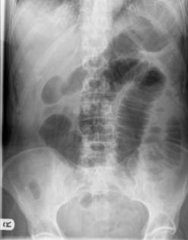
A 47-year-old gentleman presents to the emergency department with a 3-4-day history of cramping abdominal pain, nausea, and vomiting. Physical examination reveals a normal cardiovascular assessment, but his abdomen is found to be distended, tender to palpation, and with high-pitched bowel sounds. An abdominal radiograph is shown in Figure A. Upon further questioning, what is most likely to be found in this patient's past history?
• A:Psychological derangements
• B:Gastroesophageal reflux disease
• C:Irritable bowel syndrome
• D:Previous abdominal surgeries
• E:Intermittent appendicitis
D (portal venous gas and pneumatosis intestinalis on CT)
A 60-year-old male is brought to the ED by EMS complaining of severe abdominal pain that began suddenly 6 hours ago. His BP is 145/75, HR is 105 and irregular. On examination, your note mild abdominal distention and diffuse tenderness without guarding. Stool is heme+, lab results reveal WBC 12,500, Hct 48, lactate 4.2. ECG shows atrial fibrillation, rate 110. A CT scan is show below. Which of the following is the most likely dx?
A. AAA
B. Crohn's disease
C. Diverticulitis
D. Mesenteric ischemia
E. SBO
