Wildlife Physio Exam 3
 Call Kai
 Learn
 Practice Test
 Spaced Repetition
 Match
 Flashcards
 Knowt Play
 Podcast
1/116

There's no tags or description
Looks like no tags are added yet.
117 Terms
Non-shivering thermogenesis helps _______________________ animals warm up.
Non-shivering thermogenesis helps hibernating animals warm up.

Non-shivering thermogenesis helps hibernating animals warm up by metabolizing _____________________.
Non-shivering thermogenesis helps hibernating animals warm up by metabolizing Brown Adipose Tissue (BAT).
True or False:
A Hairless Dog has a larger boundary layer than a Shitzu.
False.
A Hairless Dog has a smaller boundary layer than a Shitzu.
True or False
Heat Shock Proteins block protein denaturation in hot situations.
False
Heat Shock Proteins bind to proteins during extreme heat to keep them from refolding incorrectly. When it cools down, they let go and let the protein fold correctly.

True or False
In Camels, countercurrent heat exchange occurs in the nasal turbinate.
False.
In Camels, countercurrent heat exchange occurs in the rete mirabile.
Evaporative cooling happens in the Nasal Turbinate of camels (wet nose).
Countercurrents can be utilized to retain heat (like in Ungulate legs) or be bypassed to lose heat (duck legs in cold temps). It is also used in cooling the brain of camels by running hot blood next to cold blood.

True or False
Evaporation causes greater heat loss through Convection
False.
Convection causes greater heat loss through Conduction
Why does convection accelerate the heat transfer (loss)? - It pushes the hot air away and cools the area and bc heat transfer is increased when there is a larger temperature differential (when there is cold air touching the hot air)

Convection causes greater heat loss through ________________ .
Convection causes greater heat loss through Conduction.
True or False
Poikilotherms are more likley to have multiple isozymes for an enzyme than homeotherms.
True
Poikilotherms are more likley to have multiple isozymes for an enzyme than homeotherms.
This is because Poikilotherms vary more than Homeotherms
Explain how the Rete Mirabile Allows a Camel to Save up to 5L of water a day...
The rete mirabile helps camels brains keep cool by using cool blood (which is cooled in the nose) and running it next to warm blood heading towards the brain, ultimately cooling the brain. With cooled brain temperatures, the camel does not have to produce a lot of sweat (which would cause it to loose water).
Additionally, evaporative cooling that occurs in the nose of camels happens when the air they exhale is condensated into water droplets on their nose (preventing water loss).

Explain what similarity between snowshoe hares and pied flycatchers make them both vulnerable to climate change?
Snowshoe hares and Pied Flycatchers both rely on daylength for cues. But as climates change, and their environment advances along with it, daylength stays the same.
Pied Flycatchers rely on daylength to know when to migrate to their breeding grounds, but climate change advances the phenology of their breeding sites, so birds arrive at the breeding grounds later than would be optimal for raising young.
Snoeshoe hares rely on daylength to know when to begin to change the color of their fur. But as climate change changes their environment before daylength tells them to change color, they are left sticking out. They become an easy target fro prey.
(In reference to the paper) Why are long distance migrants more vulnerable to climate change than non-migratory species?
Long distance migrants use daylength as the primary cue to time Spring migration towards the breeding grounds. Climate change is advancing the phenology of the breeding site, but there is no corresponding change in daylength, so birds are arriving at the breeding grounds later than would be optimal for raising young.

What is the overall question in the paper?
Can a long-distance migrant respond to increasing temperatures with adjustments in egg lay and arrival?

Draw the graph that represents the date of egg lay period of flycatchers at their breeding grounds:
Remember that as years went on, the mean egg laying date became earlier in the year (hence the decrease in the egg laying date)

Draw the graph that represents the date of arrival date of flycatchers at their breeding grounds:
Remember that the pied flycatchers did not change/advance their arrival date.

How did Figure 2 reflect the overall paper?
Pied flycatchers are using daylength to time departure for spring migration. This means that they cannot arrive sooner when conditions are advanced at the breeding site. However they can advance lay date once they've arrived.

Explain Figure 2:
Question:
Does temperature at the breeding site predict date of egg lay and arrival dates?
Explanation: It appears that pied flycatchers cannot advance the date of arrival given local conditions at the breeding site; however, once there, females can advance the date of egg lay to more closely match environmental conditions. (answers for 3d, 3e and 4 may overlap a bit, that's fine)

Explain Figure 1:
The Question: How has the selection differential changed over the 20 years of data analysis? (or, is there a change in the effect of lay date on recruitment of young into the breeding population the next year?)
Explanation:
As years progress, there is greater and greater benefit to laying eggs earlier in the year, in that a greater proportion of earlier laid young recruited into the next years' population.

Define the term Heat:
The amount of energy present.
Define the term Temperature:
The measure of the intensity of the heat present.
______________ is the amount of energy present.
Heat is the amount of energy present.
_________________ is the measure of the intensity of the heat present.
Temperature is the measure of the intensity of the heat present.
Name the three rules of heat transfer:
1. Heat flows from warmer to cooler places
2. The greater the difference in temperature (temp gradient), the greater the transfer of heat (flux)
3. Physical Properties Matter (animals with a lot of blubber lose less heat)
Write out what PUFA stands for:
PUFA = Polly-Unsaturated Fatty Acid
Would a desert animal choose a diet higher or lower in Poly-unsaturated fatty acids (PUFA)?
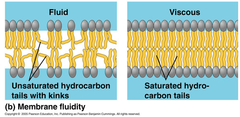
A desert animal would choose a diet that is lower in Poly-unsaturated fatty acids. This is because in hot temperatures, animals need more saturated fatty acids to reduce the fluidity of their membranes.
If an animal were to instead have more (PUFA) in a hot enviornment, their membrane would be too fluid.
What is a Poikilotherm?
Poikilotherms body temperatures vary with the environment.
Opposite of Homeotherm
What is a Homeotherm?
Homeotherms body temperatures are kept constant (do not vary with the environment).
Opposite of Poikilotherm
What is a Endotherm?
Endotherms' body temperatures depend on internally generated metabolic heat (they produce their own heat).
Opposite of Ectotherm

What is an Ectotherm
Ectotherms' body temperatures depend on external heat sources.
Opposite of Endotherms

Name animals that are a...
Poikilothermic Endotherm:
Small Birds and Small Mammals:
- Hummingbird (enters torpor)
- Hamster (enters torpor)

Name animals that are a...
Homeothermic Endotherm:
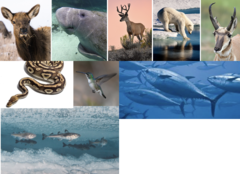
Most Birds and Mammals:
- Deer
- Dog
- Cat
- Brooding Python

Name animals that are a...
Poikilothermic Ectotherm:
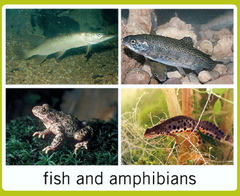
Most Amphibians and Reptiles:
- Lizards
- Freshwater fish (goldfish)

Name animals that are a...
Homeothermic Ectotherm:
Most Marine Fish:
- Polar Marine Fish

Explain why Cataglyphic Ants can hunt in the Saharan Desert at the hottest time of the day:
Cataglyphic Ants can hunt in such hot temperatures because they use heat shock proteins. They also have silver hairs which reflect the light from the sun.
Before going to the surface, they go in the tunnel of the nest which is pretty warm (45C) but not as warm as the surface (50C). They wait in the tunnel for 10-15 min to make heat-shock proteins. The heat shock proteins bind onto the denatured proteins and prevent them from refolding incorrectly while the ants experience hot temperatures, such as when they go up to the surface (50C).
Heat shock proteins allow animals to survive a longer period of heat shock.

Draw all the forms of heat loss and gain from this penguin (the ground is hotter than the penguin, the air is cooler)

Define Colligative Antifreezes:
Colligative Antifreeze:
- Uses solutes to decrease the freezing point within cells. It makes the concentration of solutes within the cells higher so that the freezing point is lower.

Define Non-Colligative Antifreezes:
Non-colligative Antifreeze uses proteins to lower the temperature at which ice crystals form.
Specifically, Glycoproteins which bind to ice crystals and lower the temperature in which ice crystals grow.

Are Colligative Antifreezes or Non-Colligative Antifreezes more effective at lowering the freezing point in animals?
Non-Colligative Antifreezes are more effective at lowering the freezing point than Colligative Antifreezes but are more costly.
Non-Colligative Antifreeze: block ice formation
Colligative Antifreeze: increase solutes

List and explain the four areas of research Williams proposed (Vulnerability of Species/Populations):
1. Exposure
2. Sensitivity
3. Resilience
4. Adapt

List and explain the four areas of research Williams proposed, to frame how vulnerable populations are to climate change...
1. Exposure
- What is the Regional Climate Change?
- What is the availability of the Microhabitat?
2. Sensitivity
- What is their Physiological Tolerance to climate change?
- How much Placitity do they have?
3. Resilience
- How resilient are they to climate change?
- What is their life history?
- Can they disperse/colonize new places?
- How susceptible are they to inbreeding?
4. Adapt
- Is there genetic variability in the trait they have that is sensitive to climate change?

Summarize the main point of the Lizard/Climate Change Studies:
Draw the graphs that support these studies:
The studies found that there were more Generalists Near the Poles, because there is more variation in temperature there.
The studies found that there are more Specialists near the Equator because they experience more constant temperatures.
The studies found that as latitude increases, the tolerance zone increases (dot graph).
Generalists have more of a broad performance curve (broad range of temperatures)...When temperatures change (graph d) there are not many changes in their fitness
Specialists have a narrow performance curve (narrow range of temperatures)...When temperatures change (graph c), there is a huge change in their fitness. At their optimal temps, they will have the highest fitness.

Of the four areas of research proposed by Williams, which one does the Lizard work fall into?
The Lizard study falls into Sensitivity because it discusses their Physiological Tolerance to Climate Change.
Specifically, how species that live near the equator have a narrow range of temperatures at which they can survive at (they are specialist) and are therefore more physiologically sensitive to climate change.
Whereas species that live near the poles have a wider range of temperatures that they can survive at (generalists) and are therefore less physiologically sensitive to climate change.

What causes Death at Extremely Cold Temperatures?
Extreme Cold causes...
1) Intracellular Ice Formation (ice formation in the cells breaks the membranes vc the volume of the ice is larger)
2) Chemical reaction rates drop (Low Enzymatic Reactions)
- Chemical reaction rates drop becasue there is not enough kinetic energy (less reactions happen)
3) Central Nervous System (CNS) integration is reduced (neurons cannot fire/interact correctly)
What are Avoidance Strategies that can be used in Extremely Cold Temperatures?
Hibernation and Migration:
Hibernation example: Woodchucks can bring their body temps down for long periods of time. They significantly lower their Tb.
Migration example: Migration of birds north and south
What are Tolerance Strategies at Extremely Cold Temperatures?
Cold Tolerance Strategies:
1) Behavioral
- Change Conduction, Convection, Evaporation, or Radiation
2) Physiological
- Countercurrent Heat Exchangers (Rete Mirable)
- Shivering Thermogenesis (ectotherms)
- Non-shivering Thermogenesis (mammals)
3) Extreme Cold Adaptations:
- Colligative Antifreeze
- Non-colligative antifreeze
- Promoting Extracellular Ice Formation
What are (Behavioral) Tolerance Strategies at Extremely Cold Temperatures?
Behavioral Tolerance Strategies at Extremely Cold Temperatures:
Change in Conduction, Convection, Evaporation and Radiation (heat transfer)
Examples:
Ex: Lizard laying on rock (increases conduction and radiation (flattening))
Ex: Bird Fluffed up (increases boundary layer in order to reduce convection in the individual)
Ex: Pinguins huddled up (increases boundary in order to reduce convection in groups)
Ex: Polar bear (increases Surface Area to get more heat from Radiation and have hollow fur)
Ex: Butterly increases SA
How does this involve Behavioral Tolerance Strategies?
Lizard Laying on rock increases ____________ and _____________ by flattening its body.
Lizard Laying on rock increases Conduction and Radiation by flattening its body.
How does this involve Behavioral Tolerance Strategies?
Bird Fluffed up increases ______________ in order to reduce ______________.
Bird Fluffed up increases the Boundary Layer in order to reduce Convection.
How does this involve Behavioral Tolerance Strategies?
Pinguins huddled up increases ______________ in order to reduce ______________.
Pinguins huddled up increases the Boundary Layer in order to reduce Convection.
How does this involve Behavioral Tolerance Strategies?
Polar bears increase _____________________ to get more heat from __________________.
Polar bears increase Surface Area to get more heat from Radiation.
They also have hollow fur?
Butterflies increase _____________________ to get more heat from __________________.
Butterflies increase Surface Area to get more heat from Radiation.
What are the (Physiological) Tolerance Strategies at Extremely Cold Temperatures?
Physiological Tolerance Strategies:
1) Countercurrent Heat Exchangers
2) Shivering Thermogenesis
3) Non-shivering Thermogenesis (mammals)
What is Countercurrent heat exchange?
(Physiological Cold Tolerance Strategy)
Countercurrents can be utilized to retain heat (like in Ungulate legs) or be bypassed to lose heat.
Types of Countercurrent Heat Exchange:
- Rete Mirable
- Vasodilation (Ungulate legs and Duck legs/feet)
In order to retain heat (when the countercurrent is being used), there is a shunt of blood (vein) that takes the blood and runs it next to hot blood (artery) and then brings it down to the feet (in the dilated A-V anastomosis) to keep them warm.
In order to lose heat (countercurrent bypassed) the animal does not use the shunt of blood (has constricted core vein and constricted A-V anastomosis) and instead brings blood to the outside of the foot in order to lose/release heat.
Anything that is italicized in this slide, you do not need to know the name of, it is just for reference in the photo.
In Ducks, what happens in their feet during extremely cold temperatures (below 0)?
Ducks retain heat in their feet (via countercurrent) until below 0 degrees, because below 0 they must send occasional pulses of blood into their feet to keep them warm (to prevent tissue damage). By doing this they bypass the countercurrent exchange and therefore lose heat through their feet.
On the left side of the graph, you can see that as the temperatures get lower, the heat loss from feet increases, in addition to the metabolic heat being produced (the increase in metabolic heat is due to the increased pumping of blood to the feet).
Therefore, you could say that...As Temperatures get colder, Heat Loss from Feet and Metabolic Heat Production Increases.
What is Shivering Thermogenesis?
(Physiological Cold Tolerance Strategy)
Shivering Thermogenesis:
Shivering allows the body to keep temperature elevated up to 5 degrees C.
Although, it is costly...in causes nearly 9x the increase in Metabolic Rate.
ex. shivering in snakes warms up their eggs and keeps them warm
ex. shivering in moths/butterflies warms up flight muscles and their thorax.
What is Non-shivering Thermogenesis?
hint: What is metabolized?
(Physiological Cold Tolerance Strategy)
Non-shivering Thermogenesis often happens in Mammals.
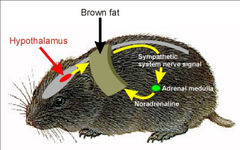
They use Brown Adipose Tissue (BAT) as a way to heat the body back up...Metabolizing (BAT) produces heat, but not ATP.
Brown Adipose Tissue (BAT) is found in...
- Neonatal animals
- Some cold-acclimated animals
- Hibernators during arousal
(BAT) is highly vascularized and has abundant mitochondria.
For reference in the photo "Brown Fat" refers to Brown Adipose Tissue (BAT) because adipose tissue is used for fat stores.
Brown Adipose Tissue (BAT) is found in what animals?
Mammals:
- Neonatal animals
- Some cold-acclimated animals
- Hibernators during arousal
Metabolizing Brown Adipose Tissue (BAT) produces _________ , but not _________ .
Metabolizing Brown Adipose Tissue (BAT) produces Heat, but not ATP.
Metabolising (BAT) produces heat for the animal to heat its body back up.
What are the Extreme Cold Adaptations?
(They have three options - what are they?)
1. Colligative Antifreeze
2. Non-colligative antifreeze
3. Promoting Extracellular Ice Formation
Colligative Antifreeze:
(Extreme Cold Adaptation)
Colligative Antifreeze lowers the freezing point by increasing the amount of solutes in the animal.
Colligative Antifreeze is an Adaptation (not a form of Acclimation)
Non-colligative Antifreeze:
(Extreme Cold Adaptation)
Non-colligative Antifreeze uses proteins to lower the temperature at which ice crystals form.
Glycoproteins (which have polar groups) bind to ice crystals and prevent their growth.
Glycoproteins prevent the growth of ice crystals by lowering the temperature at which the ice crystals enlarge.
Non-colligative Antifreezes increase ___________________ .
Non-colligative Antifreezes increase Seasonally.
Expression of genes for antifreeze protein (glycoproteins) increase seasonally…and freezing point decreases seasonally in winter flounder.
Expression of genes for antifreeze protein (glycoprotein) ________________ seasonally, and freezing point _______________ seasonally in winter flounder.
Expression of genes for antifreeze protein (glycoprotein) Increases seasonally, and freezing point Decreases seasonally in winter flounder.
Are Colligative Antifreezes or Non-Colligative Antifreezes more effective at lowering the freezing point in animals?
Non-Colligative Antifreezes are more effective at lowering the freezing point than Colligative Antifreezes.
Non-Colligative Antifreeze: block ice formation
Colligative Antifreeze: increase solutes
What is Super Cooling?
Supercooling:
- If something is cooled gradually then a liquid may remain unfrozen well below its freezing point (water bottle in freezer)
- In the absence of ice nucleating agents
- Lowers the temp at which ice crystals initially form
Promoting Extracellular Ice Formation:
(Extreme Cold Adaptation)
Ice nucleating agents promote freezing outside of the cell (Extracellular Ice Formation (ECF))
Why it is done...
- As water outside the cell freezes (due to ECF)...water is drawn out of the cell.
- Therefore, when the water is drawn out and formed into ice, it lowers the freezing point on the inside of the cell.
Example of this: Wood Frogs are Freeze Tolerant
Wood Frogs Freeze from outside in, but Thaw evenly. Why? Does it have to do with supercooling?
Wood frogs survive freezing temperatures through a process called freeze tolerance. They supercool, lowering their body temperature without freezing by producing antifreeze-like substances. Ice forms in their body cavity, but their cells don't freeze. When they thaw, it's gradual, starting from the inside out. This controlled process prevents damage from ice crystal formation, allowing them to survive freezing conditions.
Wood frogs thaw evenly from the inside out because, during thawing, ice in their body cavity melts first, rehydrating their cells and preventing ice crystal damage
What causes Death in very HOT conditions?
1) Disruption of Membrane Integrity
2) Exceeding Optimal Temp of Enzyme Function
3) Protein Denaturation
What are the (Avoidance) strategies for HOT conditions?
Estivation
or
Migration
What are the (Tolerance) strategies for HOT conditions?
(hint: 3 categories)
Hot Tolerance strategies:
1) Behavioral
- Locate Appropriate Microclimate
- Change Foraging Strategy
- Change Color
- Change Effective Surface Area
2) Physiological
- Vasodilation
- Rete Mirabile
Extreme Heat Adaptations:
- Saving Water (camels and kangaroo rats)
What are the Behavioral HOT Tolerance Strategies?
Behavioral Tolerance Strategies:
1) Locate Appropriate Microclimate
- Find shade (burrow) or Hang out in Water
2) Change Foraging Strategy
- Ants spend less time on the surface
3) Change Color
4) Change Surface Area (spread out body)
What are the Physiological HOT Tolerance Strategies?
Physiological Tolerance Strategies:
1) Vasodilation
- Get more blood closer to where it can leave the skin
- Countercurrent heat exchange
2) Evaporative Heat Loss
- Increased water loss for evaporative cooling
- ex. Camels nose
- ex. Cicadas Sweat
2) Rete Mirabile
- Ungulates, Dogs, Rabbits, Primates, Sheep, Cats
Vasodilation:
Widening blood vessels that are closer to where heat can leave the skin.
Type of Countercurrent Heat Exchange
Evaporative Cooling:
Sweating and Panting = evaporates water
Camels collect this water on their nose
Without rest, this rabbit will die of heat exhaustion, but the dog can keep running. Why is this? What does it have to do with the Rete Mirabile?
Rabbits, lacking the Rete Mirabile, do not have an effective heat exchange system. As a result, they can quickly overheat when running and are more prone to heat exhaustion. Dogs, with their Rete Mirabile, can continue running for longer periods without suffering from heat exhaustion because they can dissipate heat more efficiently.
What is the difference in how Generalists and Specialists deal with temperatures?
*I made this question up bc I had no notes on these graphs*

Temperature Outline:

What are the (4 types) of Heat transfer between animals and environment?
1) Conduction
2) Convection
3) Radiation
4) Evaporation
What are the 3 rules for heat transfer between animals and environment?
1. Heat flows from warmer to cooler places
2. The greater the difference in temperature (temp gradient), the greater the transfer of heat (flux)
3. Physical Properties matter (animals with a lot of blubber lose less heat)
What is Conduction?
(one of the 4 types of heat transfer)
Conduction is heat transfer via in direct physical contact.
It depends on...
1) Temperature differential
- if large temp diff, more heat moves
2) Area of contact
- if lizard wants to get more heat it will touch more of the rock (it will flatten itself out)
3) Conductivity of materials
- some conduct more energy than others
- fluffy dog vs. not fluffy dog

What is Conduction + Convection?
(one of the 4 types of heat transfer)
Convection is the bulk movement of fluid.
In Conduction, a hot object heats the area around it, but Convection moves that hot air away.
Convection accelerates heat transfer between solids and fluids (convection increases the heat lost through conduction).
Why does convection accelerate the heat transfer? - bc heat transfer is increased when there is a larger temperature differential (when there is cold air touching the hot air)

What is a Boundary Layer?
Boundary Layer: The thicker the boundary layer, the less heat is lost through conduction (a non-fluffy dog has a smaller boundary layer which makes it lose more heat).
Convection only works outside of the boundary layer.
Size of the boundary layer is influenced by - the size and shape of animal surface roughness fluid speed (air, h2O)

What is Radiation?
(one of the 4 types of heat transfer)
Radiation is the transfer of heat between objects WITHOUT contact.
1) Photons/Electromagnetic Waves
- The sun is primary source of radiation (sun gives of short waves and high density of photons) - but evey object gives off radiaiton - Above absolute zero, ALL objects emit and recive radiation
- The surface temp is important - the intensity of T^4
- The hotter the surface, the shorter the wavelengths (ex. sun)
- Cold surface gives long eavelengths (ex. frog)
- The area of the radiative surface is important too...more surface area = more radiation

What is Evaporation?
(one of the 4 types of heat transfer)
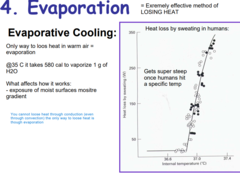
Evaporation is an extremally effective method of LOSING HEAT.
Evaporative Cooling:
When humans hit a specific temperature they begin to produce sweat (sweat is heat lost via evaporation)
@35 C it takes 580 cal to vaporize 1 g of H2O
Only way to lose heat in warm air = evaporation
You cannot loose heat through conduction (even through convection) the only way to loose heat is though evaporation
What does it mean to say "Heat flux from different sources is additive"?
If you add the (heat in) and subtract the (heat out) it will equal the heat stored in the lizard (body temp).
+ Heat in - Heat out = Heat Stored (Body Temp)

What is the main example (animal) of Heat Transfer that was discussed in class?
Camels!
They can live in Ta (air temp) that can exceed 50ºC (138 F)
How do they cope with this?
1) Body Heat Regulation
2) Water
3) Brain Function

How do Camels live in such extreme conditions? How do they cope?
1) Body Heat Regulation
2) Water
3) Brain Function

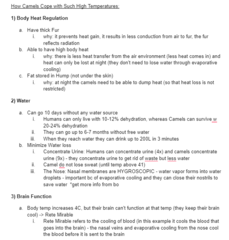
Body Heat Regulation:
(one of the ways camels cope with heat)
Body Heat Regulation:
1) Have Thick Fur
2) They are able to have high body heat (body heat can increase above 37C)
3) Fat Stored in Hump (instead of under the skin)
Why do Camels have thick fur?
(form of body heat regulation)
Camels have thick fur bc it prevents heat gain
It results in less conduction from air to fur
The fur reflects radiation
Prevents Evaporation
Look at Photo...
Shaved camel lost more water through evaporation than the unshaved camel

Why do Camels increase their body temp?
(form of body heat regulation)
Camels increase their body temperatures because there is less heat transfer from the air environment (less heat comes in)
Heat can be lost at night, they don't need to lose water through evaporative cooling

Evaporative Cooling:
As a liquid evaporates, its remaining surface cools.
Evaporative cooling examples:
- Sweating
- Panting in dogs
- Wet noses in some animals

Why do Camels Store Fat in their Hump?
(form of body heat regulation)
At night the camels need to be able to dump heat (so that heat loss is not restricted).

Water:
(one of the ways camels cope with heat)
Camels can go 10 days without any water source:
- Camels can go up to 6-7 months without free water
- Humans can only live with 10-12% dehydration, whereas Camels can survive w 20-24% dehydration
They minimize water loss:
- Concentrate Urine (they concentrate urine to get rid of waste but less water)
- Camels do not lose sweat until temp above 41
Camels Noses:
- Nasal membranes are HYGROSCOPIC (water vapor forms into water droplets - important bc of evaporative cooling, and they can close their nostrils to save water.
(Ava remember to get other notes from Bo if he has any)

Brain Function:
(one of the ways camels cope with heat)
Body temp increases 4C, but their brain can't function at that temp (they keep their brain cool) -> Rete Mirable (the cooling of blood in the brain)

What is "Rete mirabile"?
(form of brain function/coping with heat)
Rete mirabile = Counter Current Exchange
It refers to the cooling of blood (in this example it cools the blood that goes into the brain)
The blood goes into nasal veins and evaporative cooling from the nose cools the blood...the blood then travels up into the brain and therefore the brain doesn't get too hot.

Animals that have a Rete mirabile often have a _________________ brain temperature.
Animals that have a Rete mirabile often have a cooler brain temperature.
*look at graph*

What are the Physiological/Thermal Strategies?
(hint: different types of animals)
1) Ectotherms - body temp dependent on extremal heat sources
2) Endotherms - body temp dependent on internally generates metabolic heat
3) Homeotherms - body temp constant
4) Poikilotherms - body temp varies/changes

What does Tb and Ta stand for?
Ta = air temp
Tb = body temp

Thermal Tolerance:
Thermal Tolerance can be Biochemical:
1) Membrane Dynamics
2) Enzymes (isozymes)
3) Heat Shock Proteins
Thermal Preformance Curves:
Each animal has their preferec body temp (thermal preformance curve).
But, when there is an enviornmental temperature shift, the thermal preformance curve (and preferred body temp) changes too.
If the enviornmental shift creates colder temperatures (shifts to the left) the animals preferred temp will be at a colder temperature as well.
and they will eat more foods with higher percentages of unsaturated fats (PUFA) *we will get to this soon*

Membrane Dynamics:
(type of Thermal Tolerance/Acclimation)
The cell membrane made of Lipid Bilayer
Things that Effect Cell Membrane Fluidity:
1) Temperature
2) Unsaturated/Saturated Fats
Unsaturated = More Fluid (has more kinks/double bonds)
Saturated = Less fluid (more stiff)
