Cell Bio Exam 4
 Call Kai
 Learn
 Practice Test
 Spaced Repetition
 Match
 Flashcards
 Knowt Play
1/99

There's no tags or description
Looks like no tags are added yet.
100 Terms
Which of the following signaling pathways would be likely to trigger the most rapid cell response?
Acetylcholine binds to anion-channel-coupled receptor that allows Na+ to flow down its electrochemical gradient, triggering contraction of a skeletal muscle cell.
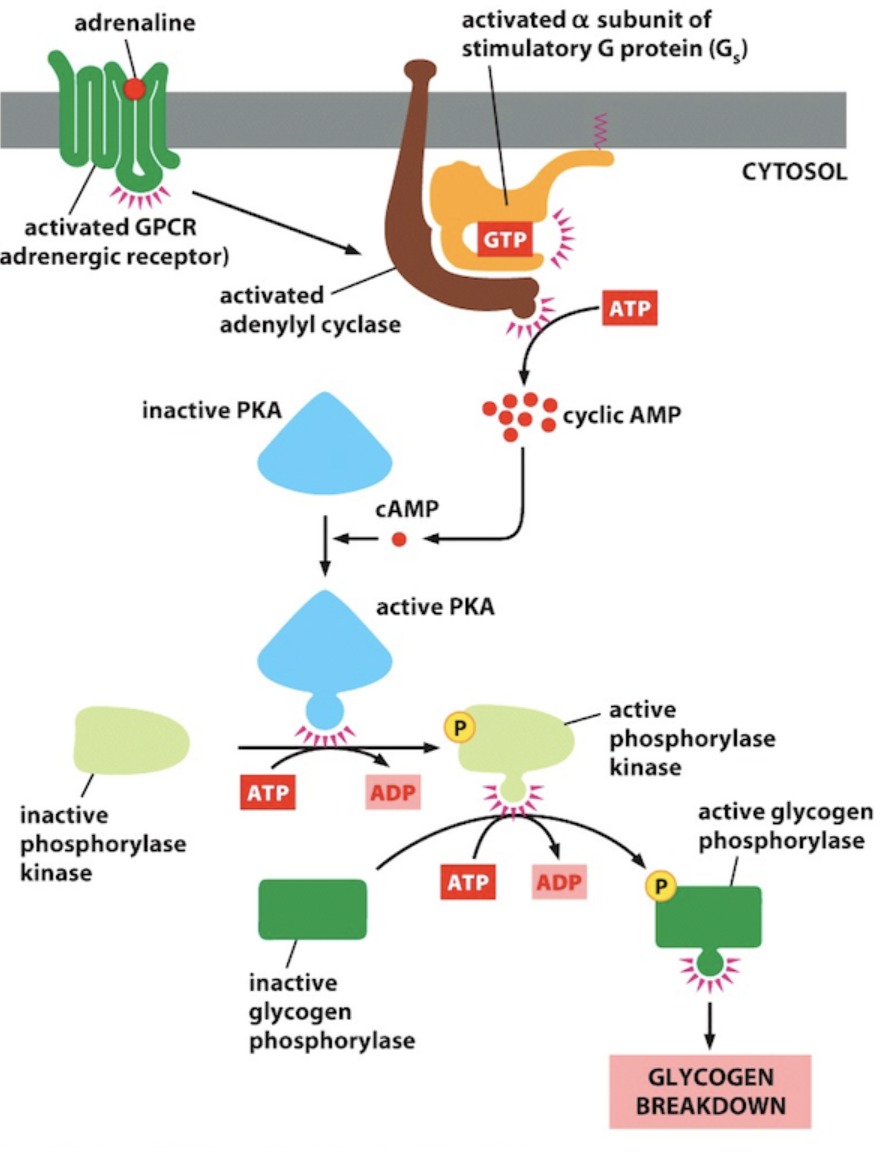
In skeletal muscle cells, epinephrine (adrenaline) stimulates the breakdown of glycogen by activating a GPCR. In the signaling pathway shown here, which step does not amplify the original signal?
activation of adenylyl cyclase by an activated G protein
Some signaling molecules can activate more than one receptor leading to differing outcomes in different cell types depending on the receptors present in each cell. Acetylcholine can activate muscarinic G-protein-coupled receptors and nicotinic receptor ion channels. Some snakes like cobras and mambas produce venom that functions as an antagonist of nicotinic receptor ion channels. Which of the following biological effects would you predict to occur after a cobra or mamba snake bite?
Skeletal muscle contraction decreases
How can you determine whether a signaling pathway increases or decreases gene expression?
Count the inhibitory interactions (⊣). An even number of inhibitions increases gene expression, while an odd number decreases it.
Which of the following steps are required in the activation of the G-protein signaling pathway?
Gα exchanges GDP for GTP, Ligand binds to the G-protein-coupled receptor, Activated Gα influences target proteins.
Which changes to GPCR signaling increase or decrease growth hormone (GH) release?
GH decreases when ligand binding or Gα activation is blocked, or GRK phosphorylation is increased. GH increases when GTP hydrolysis or arrestin binding is blocked.
Cholera toxin prevents Gαs from hydrolyzing GTP, keeping it active. This increases cAMP → PKA → CFTR activation → Cl⁻ and water secretion, causing severe diarrhea. Inhibiting adenylyl cyclase or PKA could reduce these effects.
Treatment of the cells with a drug that inhibits adenylyl cyclase activity and Treatment of the cells with a drug that inhibits PKA activity
What is required for PKC activation?
binding to DAG and continuing presence of Ca2+
IP3 signaling helps regulate sweating, which is important for regulating body temperature. Anhidrosis, the inability to sweat normally, can be caused by genetic and environmental factors. A rare mutation has been identified in a family with several children suffering from anhidrosis. The mutation inactivates the protein that IP3 binds on the ER membrane. Suppose cells were isolated from affected family members and exposed to different treatments. Which of the following treatments would be able to repair the signaling defect in cells isolated from these patients?
addition of high amounts of Ca2+ in the cytosol
How do the 5-HT7A and 5-HT2B serotonin receptors differ in their signaling pathways?
5-HT7A activates Gs → adenylyl cyclase → cAMP → PKA. 5-HT2B activates Gq → PLC → IP₃/DAG → increased Ca²⁺ and PKC activation.
How does melatonin activate Gi signaling to promote sleepiness, and what changes increase wakefulness?
Melatonin activates MT₁ → Gi → inhibits adenylyl cyclase → decreases cAMP/PKA → sleepiness. Blocking melatonin binding or activating adenylyl cyclase increases wakefulness.
How does Ca²⁺ activate calmodulin (CaM) to regulate target proteins?
Ca²⁺ binds to calmodulin's globular regions, causing a conformational change in its central helix. Calmodulin wraps around its target protein to regulate its activity.
Why would blocking EGF binding be ineffective against glioblastoma caused by overexpressed EGFR?
Overexpressed EGFR can promote cell division without EGF binding. Effective strategies instead block EGFR kinase activity, adaptor protein binding, or receptor abundance.
Targeted chemotherapies can also alter the intracellular signaling pathway at steps after or downstream of the EGFR. Which of the following potential treatments could be effective for treating tumors like glioblastoma caused by overactivation of EGFR?
Addition of a drug that inhibits Ras GEF function, Addition of a drug that blocks the phosphorylation sites on AKT, and Addition of a drug that inhibits serine and threonine kinase activity
How can tyrosine-to-alanine mutations identify docking sites in RTK signaling?
Replacing tyrosine with alanine prevents phosphorylation. The protein that no longer binds identifies the docking site (e.g., Tyr2 → Ala prevents PKX binding).
What is the major advantage of forming large signaling complexes around activated RTKs?
They allow the receptor to activate multiple downstream signaling pathways simultaneously by recruiting different signaling proteins.
Which androgen receptor defects cause androgen insensitivity, and which would NOT?
Failure to activate transcription, bind DNA, or enter the nucleus can cause androgen insensitivity. Tight binding to low testosterone concentrations would NOT explain it.
Which components are active or inactive when ethylene is present in plants?
Active: transcription regulator and ethylene-responsive gene transcription. Inactive: ethylene receptor's inhibitory signaling and receptor-associated protein kinase (CTR1).
The drug Viagra promotes blood vessel dilation by prolonging signaling through nitric oxide (NO). How does Viagra boost NO?
It blocks the enzyme that degrades cyclic GMP
What molecule does Gleevec (imatinib) mimic to inhibit Bcr-Abl kinase in chronic myeloid leukemia (CML)?
ATP. Gleevec occupies the ATP-binding site of Bcr-Abl, preventing phosphorylation and inhibiting cancer cell growth.
Which of the following alterations to the signaling pathway would lead to increased transcription by the CREB protein?
inhibition of GTP hydrolysis and inhibition of cAMP breakdown
Which of the following would increase phosphorylation of CREB by PKA?
blocking binding of the regulatory subunits to the catalytic subunits of PKA
What does a target cell require to respond to an extracellular signal molecule?
appropriate intracellular signaling pathways, effector molecules that alter cell behavior in response to the signal molecule, access to the signal molecule, a receptor that recognizes the signal molecule
Many of the extracellular signal molecules that regulate inflammation are released locally at the site of infection. What form of cell–cell signaling is being used?
paracrine
When cells respond to an extracellular signal, they most often convert the information carried by this molecule from one form to another. What is this process called?
signal transduction
What makes it possible for a combination of signal molecules to evoke a response that differs from the sum of the effects that each signal could trigger on its own?
the ability of different intracellular relay systems to interact
Under what condition will a target cell always respond quickly to an extracellular signal?
The response does not require changes in gene expression.
Which of the following statements is false?
Serine/threonine kinases are opposed by the action of tyrosine kinases.
Which type of receptors do steroid hormones generally employ?
nuclear receptors
Why does nitric oxide (NO) act as a paracrine signal that affects only neighboring cells?
It is rapidly converted to nitrates and nitrites in the extracellular fluid.
Signaling via a GPCR ceases when which condition occurs?
The α subunit hydrolyzes its bound GTP.
When activated phospholipase C cleaves an inositol phospholipid, what happens to the small signaling molecules the enzyme produces?
Inositol 1,4,5-trisphosphate (IP3) is released into the cytosol, while diacylglycerol is retained in the membrane.
What are small intracellular signaling molecules often called?
second messengers
The enzyme cyclic AMP phosphodiesterase helps terminate a response mediated by an increase in cyclic AMP by doing what?
converting cyclic AMP to AMP
Because cyclic AMP diffuses quickly through the cytosol and a cyclic AMP phosphodiesterase rapidly converts cyclic AMP to AMP, what is the consequence?
The cytosolic concentration of cyclic AMP can change rapidly.
The concentration of free Ca2+ in the cytosol of an unstimulated cell is kept low compared with its concentration in both the extracellular fluid and the endoplasmic reticulum. Which of the following help to maintain this difference?
Ca2+ pumps in the ER membrane and in the plasma membrane
When activated by the binding of Ca2+, calmodulin relays the Ca2+ signal onward by doing what action?
binding to Ca2+/calmodulin-dependent protein kinases
Which of the following statements are consistent with the structure and function of intermediate filaments?
Eight strands of staggered tetramers; provide tensile strength and anchor to desmosomes.
What mutations can disrupt desmin intermediate filaments?
Mutations that prevent dimer formation, tetramer formation, or end-to-end assembly. Intermediate filaments are nonpolar.
Which of the following would be a consequence of mutations that disrupt the interaction between cross-linking, stabilizing proteins and keratin filaments?
corneal damage caused by cell rupture from mechanical trauma
What events occur in the leading and trailing heads of kinesin?
Leading: ADP release, ATP binding, neck linker zippering. Trailing: ATP hydrolysis and Pᵢ release.
An experiment was performed to determine the role that ATP plays in kinesin movement along microtubules. Kinesin and microtubules were incubated together in a test tube, but instead of ATP, a non-hydrolyzable analog of ATP was added to the tube. What impact on kinesin function do you expect to observe in the presence of this ATP analog?
The kinesin would bind tightly to microtubules and not release.
Nocodazole is a microtubule-specific drug that binds free tubulin dimers and blocks microtubule polymerization. Adding nocodazole to cells causes multiple effects. Which of the following would occur after nocodazole is added to cells growing in culture?
The cell cycle arrests in mitosis and the Golgi apparatus fails to organize at the normal site near the nucleus.
Motor neuron degeneration occurs in several diseases and leads to loss of muscle control. One form of motor neuron degeneration was found to have defects in retrograde transport (backward transport to cell body, in blue below) that were caused by mutations in a gene that codes for a particular protein. What protein, when mutated, would inhibit backward, but not outward, transport along axon microtubules?
dynein
End-binding proteins are found bound to the GTP tubulin in the GTP cap of microtubules. Where would the end-binding protein EB3 be found if added to the microtubules assembled from the E254A mutant tubulin?
All along the microtubules
Which motor protein transports components to the growing tip of a flagellum?
Kinesin (specifically kinesin-2), which moves toward the plus (+) end of microtubules.
An actin-binding protein called cofilin binds preferentially to ADP-containing actin filaments rather than ATP-containing actin filaments. Based on this preference, which is true?
Cofilin binds to older actin filaments.
How does Yersinia pestis inhibit macrophage phagocytosis through YopT?
Block organization of the actin filaments required for phagocytosis of the pathogen by the host macrophage.
What is the correct order of events during muscle contraction?
Neuron stimulates muscle cell.
Action potential opens Ca²⁺-release channels.
Ca²⁺ is released from the sarcoplasmic reticulum.
Troponin moves tropomyosin.
Myosin binds to actin, causing contraction
Which of the following would increase the level of muscle contraction?
blockage of the Ca2+ pump and addition of a leaky Ca2+ channel to the sarcoplasmic reticulum
How does troponin's Ca²⁺ sensitivity relate to cardiomyopathy?
Increased sensitivity: Hypertrophic cardiomyopathy (stiff heart). Decreased sensitivity: Dilated cardiomyopathy (weakened contraction).
During actin treadmilling, which actin monomers are added and removed?
ATP-actin is added at the plus (+) end, while ADP-actin is removed from the minus (−) end.
What cytoskeletal proteins are associated with sperm motility, muscle contraction, skin strength, and axonal transport?
Dynein = sperm motility; Tropomyosin = muscle contraction regulation; Keratin = skin strength; Kinesin = transport toward axon terminals.
GTP hydrolysis and whether GTP or GDP is bound to tubulin is an important mechanism to control the dynamic instability of microtubules. Certain aspects of dynamic instability can be viewed using GFP-EB1. Which process(es) is it useful for visualizing and why?
growing microtubules, because EB1 binds to the GTP-tubulin cap on microtubules
How would the animation of microtubule dynamics change after adding a non-hydrolyzable analog of GTP to the cells expressing GFP tubulin?
Microtubules would grow longer.
What is the order of ATP-related events in the myosin contraction cycle?
ADP release: Allows new ATP to bind.
ATP binding: Myosin detaches from actin.
ATP hydrolysis: Myosin head recocks and prepares for another power stroke.
Pi release: Myosin binds strongly to actin and performs the power stroke.
Rigor mortis occurs in muscle cells after death and is characterized by muscles being locked in a contracted state where myosin is bound to actin. What could be added to the muscle cell to release the rigor state?
ATP
What causes rigor mortis at the cellular level?
After death, ATP production ceases and ATP is needed for myosin release from actin.
Which statement about intermediate filaments is not true?
They rupture under stress.
If GTP hydrolysis occurs on a tubulin molecule at the plus end of a microtubule protofilament before another tubulin molecule is added, what typically happens?
The microtubule depolymerizes.
The subunits of microtubules and actin filaments are globular proteins, whereas those of intermediate filaments are fibrous.
True
In the eukaryotic flagellum, what drives the bending of microtubules?
the motor protein ciliary dynein
Imagine that you add an inhibitor to the cell that blocks all kinesin function. What would you see occur as you continued to video the cell?
The organelles and vesicles would stop moving in one direction but would continue to move in the opposite direction.
Imagine that you add a non-hydrolyzable analog of ATP to the cell. What would you see occur as you continued to video the cell?
The organelle and vesicle movement would stop in both directions.
Which actin-binding proteins would be most involved in the assembly of the contractile ring?
formins
In what kind(s) of cells is myosin-I present?
all types of cells
Myosins are motor proteins that use the energy of ATP hydrolysis to move along actin filaments.
True
Which does not contain both actin and myosin?
the lamellipodium at the leading edge of a crawling cell
Contractions in smooth muscle cells depend on which one of the following activation steps?
Ca2+-activated phosphorylation of myosin-II
When a muscle is stimulated to contract, myosin heads walk along actin filaments in repeated cycles of attachment and detachment. Which of the following represents a correct description of the events in this cycle?
Myosin attaches to actin; ATP binding reduces the affinity of myosin for actin; myosin is “cocked” as its head is displaced along the actin filament; the power stroke puts myosin in a “rigor” configuration.
Investigators incubate myosin with an ATP analog that can bind to myosin but cannot be hydrolyzed. What effect will this treatment have on the activity of myosin?
The myosin will be unable to bind to an actin filament.
What is the name of the thin, sheetlike structures that a fibroblast regularly extends during cell crawling?
lamellipodia
An actin filament undergoing treadmilling at the leading edge of a lamellipodium can do what?
remain the same size
What activates and inactivates Cdk?
Cyclin binding and T-loop threonine phosphorylation activate Cdk. Binding of p27, a T loop blocking the active site, and absence of cyclin inactivate Cdk.
What can Cdk inhibitors block to prevent Cdk activity?
Substrate binding, cyclin binding, and ATP binding.
Which phosphorylation-related alterations promote or prevent entry into S phase?
Promote: Rb phosphorylation and lack of p53 phosphorylation.
Prevent: Blocking G₁-Cdk binding to cyclin and premature Cdc6 phosphorylation.
What are the two ways that paclitaxel can result in the death of cancer cells, helping to treat the cancer?
Paclitaxel promotes apoptosis of the cancer cell and inhibits the proper formation of the polar spindle, blocking sister chromatid separation.
What is true about the phosphorylation of condensins by M-Cdk?
It triggers their assembly onto DNA, compressing chromosomes into a more compact form.
The anaphase-promoting complex or cyclosome (APC/C) triggers the onset of anaphase by doing which of the following?
triggering the destruction of the cohesins that hold the sister chromatids together
Researchers gently shake culture flasks and collect cells that release from the substratum. In what stage of the cell cycle are these cells most likely to be?
M phase
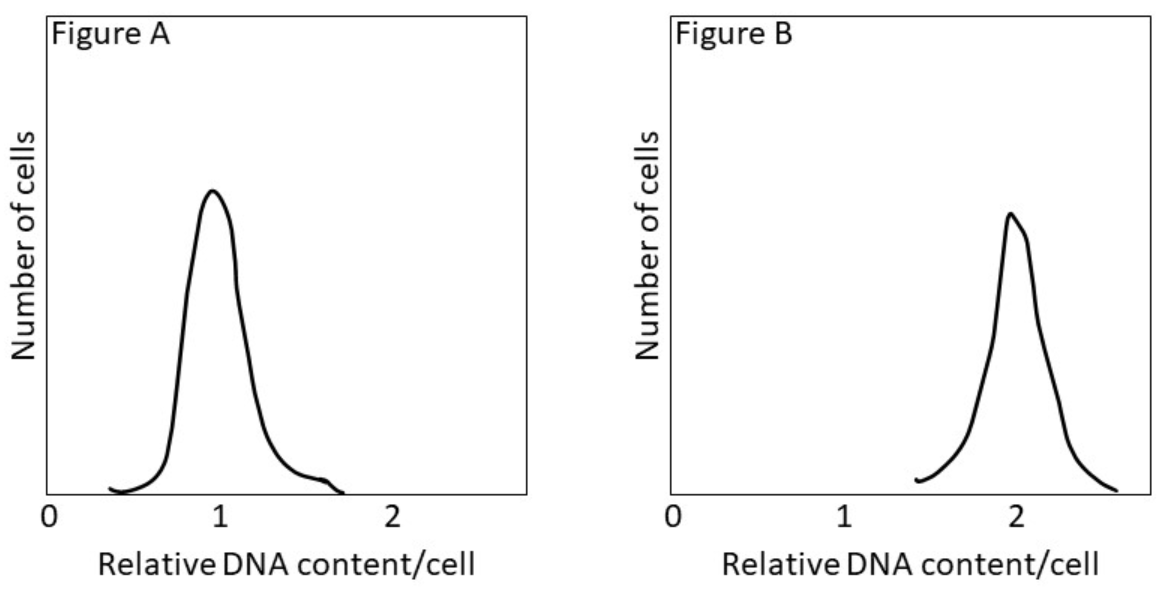
Which drugs produce a flow cytometry graph with a relative DNA content of 1 (Figure A) or 2 (Figure B)?
Figure A: Drugs that inhibit DNA synthesis, Cdc6, and Rb phosphorylation.
Figure B: Drugs that inhibit CDC25 and APC/C.
Which of the following are reasonable approaches that researchers can take to induce apoptosis in cancer cells?
Inhibiting the Bcl2 protein and activating the Bax protein.
When newborn mice are injected with antibodies that inactivate NGF, massive amounts of nerve cell death occur. What do these results suggest?
NGF is a survival factor for developing neurons.