Chapter 7: Human Capital
 Call Kai
 Learn
Learn Practice Test
 Spaced Repetition
 Match
Match Flashcards
 Knowt Play
1/24

There's no tags or description
Looks like no tags are added yet.
Name | Mastery | Learn | Test | Matching | Spaced | Call with Kai | Chat |
|---|
No analytics yet
Send a link to your students to track their progress
25 Terms
What is human capital?
The knowledge, skills, abilities, personality, and other qualities employees bring to a company.
What are HPWS?
Workplace practices that help employees become motivated, productive, and satisfied, improving the company.
What is the main idea of the chapter?
Employees are an investment, not a cost. Attracting, developing, and retaining good employees can give a company a competitive advantage.
What is employer attractiveness?
How appealing a company is to potential employees because of things like pay, benefits, culture, reputation, and opportunities.
What is a realistic job preview?
An honest description of a job, including both the good and bad parts.
What are employee qualifications?
The knowledge, abilities, skills, personality, and attitudes needed for a job.
What are validated selection tools?
Hiring methods proven to help predict how well someone will perform.
What are some common selection tools?
Applications, resumes, intelligence tests, personality tests, and interviews.
What is the difference between structured, unstructured, and semi-structured interviews?
Structured: same questions for everyone.
Unstructured: questions vary.
Semi-structured: a combination of both.
What do intelligence and personality tests measure?
Intelligence tests measure cognitive ability; personality tests measure traits such as conscientiousness, emotional stability, and agreeableness.
What are the 3 phases of training?
Needs → Development → Evaluation
Needs = find what training is needed
Development = create/provide training
Evaluation = see if it worked
What is training ROI?
Return on Investment — comparing the cost of training with the benefits it produces.
What is a performance appraisal?
An evaluation of how well an employee is doing their job.
What is leniency in performance appraisals?
Giving employees higher ratings than they actually deserve, which can make rewards unfair.
What makes a performance appraisal legally defensible?
It should be objective, unbiased, reliable, valid, clearly explained, and based on clear standards.
What is a 360-degree performance appraisal?
An employee gets feedback from multiple people, such as supervisors, coworkers, subordinates, and themselves.
What is compensation?
The pay, benefits, and financial rewards employees receive for working.
What are incentives and why do they matter?
Rewards or consequences that motivate employees to behave in ways that help the business.
What are lump-sum and piece-rate payments?
Lump-sum: fixed payment, such as a salary. Piece-rate: paid based on how much is produced.
What is an employment contract?
An agreement between an employer and employee about work and compensation.
What is a golden parachute?
A contract promising a senior executive a large severance payment after losing their job following a management change.
What do Title VII, ADEA, and ADA protect employees from?
Title VII: certain forms of workplace discrimination (employee’s don’t need proof that they were not hired, promoted, or discharged just need proof that that a hostile work environment exists.)
ADEA: age discrimination (must be 40 to sue or get replaced by someone younger than you if you are over 40)
ADA: discrimination against people with disabilities
What is the basic HR process in this chapter?
Attract good employees → Select the best candidates → Develop them through training → Retain them with fair rewards, support, and opportunities.
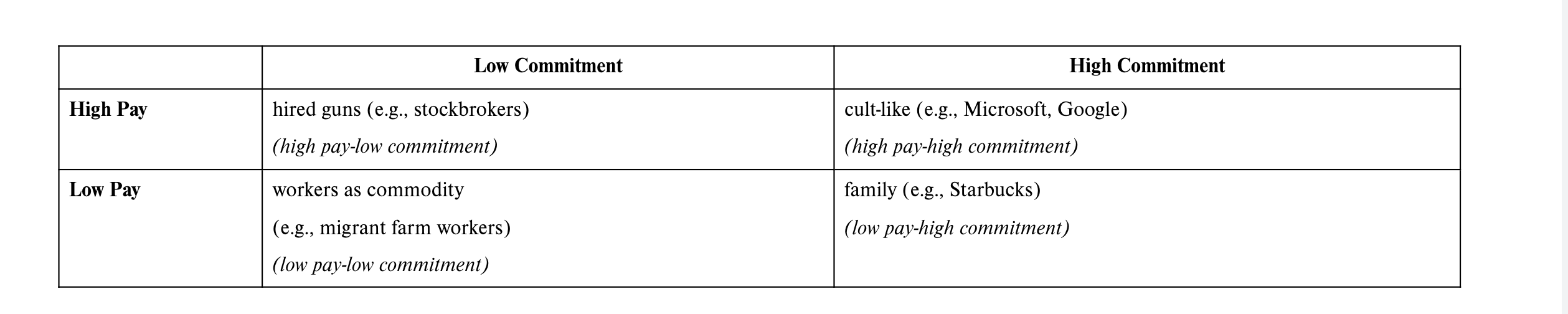
High/Low for Pay/Commitments
Equal Pay Act
Makes sure women and men are paid equally in their workplace. Does not matter if one person is getting paid higher in another builidng you must be under the same workplace building to file a claim.