biochem lecture 8 and 9
 Call Kai
 Learn
 Practice Test
 Spaced Repetition
 Match
 Flashcards
 Knowt Play
1/60

There's no tags or description
Looks like no tags are added yet.
61 Terms
biochemistry
the study of the chemistry of life
looks at all chemical processes/reactions in a living organism
ammonium ion and amine group
ion= -NH3+
group= -NH2
hydroxyl group
-OH
Carboxyl group, carboxylate ion, carboxylic acid
carboxyl= -COOH
carboxylic ion= -COO-

carbonyl group
C double bonded to O

Amide
amine connected to a carbonyl group

thiol, sulfide, disulfide
thiol= -SH
sulfide= -S-
disulfide= -S-S-
enzymes
catalyze biochemical reactions
called biological catalyst
hormones
messengers that regulate bodily functions
storage protein
stores essential substances for immediate availability
transport proteins
carry substances through blood and cell membranes
structural proteins
support and maintain shape of the cell
protective proteins
provide defense against invaders, protect from injury
contractile proteins
do mechanical work
(like muscle actin and myosin)
amino acid
-protein building block
-20 different kinds, 9 essential
-amine group, carboxylic acid group, alpha carbon, and side chain

constitutional isomer
isomers that differ from bonding order of atoms
stereoisomer
isomer with same order but different arrangements
enantiomers
mirror images of each other
would fold on top of one another

diastereoisomers
not mirror images
only small part/element is mirrored, rest are not

amino acid is classified by the properties of the….
side chain
non polar
-alkane and arene side chain→ AA as side chain
-hydrophobic, van der Waals interaction
MAPPLIG TV
Methionine, Alanine, Phenylalanine, Proline, Leucine, Isoleucine, Glycine, Tryptophan, Valine
!WATCH! tryptophan is non polar but has NH

neutral polar
-hydroxyl, thiol, or amide group side chain → HAT side chain
-hydrophillic, H-bonding
C STYNQ (see stink) with proper letters
STAT CG with actual starting letters
Cysteine, Serine, Threonine, Tyrosine (Y), Asparagine(N), Glutamine(Q)

acidic
-carboxylic acid group as side chain AC acidic=carboxylic
-NEGATIVE charge
-hydrophilic
-electrostatic (ionic), and hydrogen bonds
AGA
Acidic= Glutamate and Aspartate

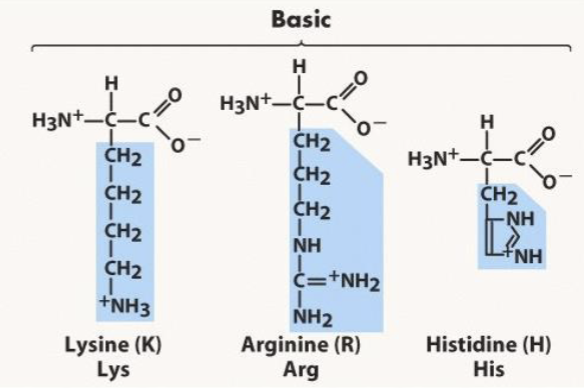
basic
-amine group as side chain. BA basic=amine
-POSITIVE charge
-hydrophilic
-electrostatic (ionic), and hydrogen bonds
BLAH
Basic= Lysine, Arginine, Histidine
zwitterion
-(amine)positive and (carboxylic acid)negative charge DIPOLAR
-all amino acids are zwitterionic at pH~7
-pH less than 2→ fully protonated, positive
-pH greater than 9→ deprotonated, negative
peptide bond
two amino acids are covalently linked together by an peptide/amide bond to form a dipeptide
basically the bond between two amino acids

shape determining interactions
-covalent bonds→ IM bonds, amino acids, peptides, disulfides
-electrostatic interactions(salt bridges)→ ionic bond btwn acidic and basic side chain, btwn amino and carboxyl termini
-H bonds→ btwn donors and acceptors
-van der Waals forces→ btwn all atoms
hydrophobic effect
hydrophobic groups cause the protein to fold so they are on the inside away from the water
structural amino acids
cysteine→ thiol groups form disulfide bonds in extracellular proteins
glycine→ flexible, no organic side chain
proline→ secondary amine forms tertiary amide upon formation of peptide bond
primary structure
-protein sequence
-IM covalent bonds btwn atoms of amino acids through peptide and disulfide bonds

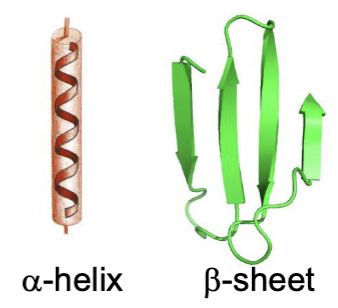
secondary structure
-a helix and B sheet
-noncovalent interactions where h-bonds occur btwn backbone peptide/amide groups
tertiary structure
-1 folded protein chain
-folding due to hydrophobic effect
-R group/side chain interactions
-covalent forces stabilizing protein sequence(primary structure)
-electrostatic interactions/ salt bridges
-H bonds
-Van der Waals forces
disulfide bonds form covalent bonds that stabilizes protein structure once it is folded into a tertiary structure

quaternary structure
-multiple folded protein chains
-hydrophobic effect
-electrostatic interactions
-H bonds
-Van der Waals
-can have disulfide bonds if structure is outside of the cell like blood or hair because it is an oxidizing environment (ex: hair, nails, teeth
L-chirality
Amine group on left side
amino acid type of chirality
L-chirality
L amino acids are found in nature
D-chirality
Amine on right side
alpha helix
stabilized by amide groups
L-chirality of aa produces right hander alpha helix
peptide bonds form btwn adjacent residues
H-bonds from btwn amide groups 4 residues away
helical secondary structures are stabilized by H-bonds forming btwn peptide bonds
B-pleated
stabilized by amide groups
made of B strands
form peptide bonds btwn adjacent residues and H bond btwn amide groups on adjacent strands
globular
forms globe like structure, typically water soluble as hydrophilic residues are on the surface
ex: enzymes
fibrous
forms fibers or sheets, insoluble containing small hydrophobic residues that pack tightly together in layers
glycoproteins
-covalently bound to carbohydrates
-form receptors on cell surface
lipoproteins
-covalently bound to lipids
-transport cholesterol through the blood
metalloproteins
metal ions for structure stabilization or catalytic function
phosphoproteins
-covalently bound to phosphate groups
-used to deactivate or activate a protein
-provide binding sites for protein attachment
hemoproteins
-contain heme groups or porphyrin rings
-oxygen transporters, drug metabolizing enzymes, E producing enzymes
nucleoproteins
-contain ribonucleic acids
-ribosomes used in protein synthesis
myoglobin
-found in the muscle
transports oxygen
-tertiary structure
-has higher affinity for oxygen than hemoglobin
(to remember think how many letters before “global” myo=3 so tertiary)
hemoglobin
-found in RBC
-transports oxygen
-quaternary structure
(to remember think how many letters before “global” hemo=4 so quaternary)
sickle cell anemia
-acidic residue is changed to a hydrophobic residue
-residue # 6 changes from glutamate to valine
-sickled RBC only last 10-20 days vs normal 90-120 days so there is lack go hemoglobin to carry oxygen
electrophoresis helps with determining what regarding proteins
protein charge and size(molecular weight)
collagen
-tropocollagen (3 strands)
-quaternary structure stabilized by H-bonds
in amino acid
-every 3rd residue is glycine (interior coil is all glycine for close packing of strands)
-predominant residues are proline and hydroxylated proline
in connective tissue
-covalent disulfide bonds occur btwn strands
bones and teeth
-Ca5(PO4)3OH calcium hydroxyapatite deposit in gaps
collagen related diseases
Scurvy
-vitamin C deficiency
-vitamin C is needed to created hydroxylated proline
-curable with diet
-symptoms: skin lesions, bruising, joint pain, swelling, gum or nasal bleed
Brittle bone disease:
-Type 1: normal collagen, insufficient amounts (bone fractures, brittle teeth, loose joints)
-Type 2: poor amounts and quality of collagen (fracture before birth, severe respiratory problems)
a and B keratin=fibrous protein in hair which is stabilized by what bond
disulfide bonds
chaperones
proteins and protein complexes that assist in folding of other proteins and protein assemblies; keeps proteins from forming nonfunctional units
prions
-proteins in the CNS→ brain
-Converts a helices to B sheets
-infections agents because they induce other normally folded prions to change shape
-converted proteins then also become infectious agents
transmissible spongiform encephalopathies(TSEs)
-result of prion malformation
-rare degenerative brain disorder
-brain has spongy appearance bc of tiny holes
-rapidly progressive, always fatal
-cant sterilize materials to prevent transmission of TSEs
-can be transmitted through infected tissue, bodily fluids, or medical instruments.
protein degradation/digestion/proteolysis
cellular process that breaks down unneeded, damaged, or short lived proteins into peptides and amino acids for recycling
autophagy
-self eating
-important for balancing sources of energy in critical times in development and response to nutrient stress
-housekeeper that removes misfiled or aggregated proteins, clear damaged organelles, eliminate intracellular pathogens
lysosomes
-recycle center
-degrades unwanted/unneeded material within cell and release nutrients
proteosomes
degrade unfolded or unneeded protein by proteolysis
protein denaturation methods
-heat→ disrupts non-covalent interactions
-mechanical agitation→ foam/air bubbles cause lack of water
-detergents→ can interact with hydrophobic sidechains and unfold the protein
-organic compounds→ polar solvents can disrupt H-bonds
-pH change→ basic and acidic side chains change charge disrupting salt bridges
-inorganic salts→ at high concentrations and disrupt salt bridges