KAAP400 Test 1
 Call Kai
 Learn
Learn Practice Test
 Spaced Repetition
 Match
Match Flashcards
 Knowt Play
1/80

There's no tags or description
Looks like no tags are added yet.
Name | Mastery | Learn | Test | Matching | Spaced | Call with Kai | Chat |
|---|
No analytics yet
Send a link to your students to track their progress
81 Terms
Define the research process and what its potential applications are
Cyclical, can be applied in any field
Steps:
Make observations/read related research literature
Formulate research questions
Formulate research hypothesis
Plan and conduct study
Analyze data and evaluate results
Results either suggest a follow-up study or a new research interest emerges
What are the key characteristics of research?
Systematic: follows clear plan/method
Objective: minimizes personal bias
Replicable: can be repeated by others to verify results
Evidence-based: relies on data, not opinions
“SORE”
Identify different types of research in health sciences
Basic: expands knowledge without immediate practical application
Applied: solves real-world problems
Quantitative: uses numbers and statistics
Qualitative: explores perceptions, behaviours, or experiences
Experimental: researchers manipulate variables to test their effect
Observational: researchers watch and record without interfering
Lab: research takes place in controlled settings where precise measures can be made, and conditions can be replicated
Field: research conducted in a natural setting, observing real-world behaviour without interference
Mixed methods: incorporation of multiple, different types of research methodologies
What is the importance of ethics in the research process?
Accountability and trust: ethical practices make researchers accountable to the public and regulatory bodies which is vital for maintaining confidence in scientific findings
Scientific quality: ethical lapses often lead to poor-quality data and invalid results
Compliance: adherence to ethical guidelines is usually a legal requirement for funding
What is the definition of research?
Fundamental definition: “Gathering and analyzing a body of information or data and extracting new meaning from it or developing unique solutions to problems or cases.”
As knowledge creation: “Research is creating new knowledge.”
As curiosity: “Research is formalized curiosity. It is poking and prying with a purpose.”
As observation: “Research is seeing what everybody else has seen and thinking what nobody else has thought.”
As process: “Science is a way of thinking much more than it is a body of knowledge.”
What is research?
Systematic investigation to generate new knowledge/validate existing knowledge
Answers questions across different fields
Follows planned, EB methods
Driven by curiosity, observation, and critical thinking
Conducted ethically, respecting participants and data, and designed to consider and maximize societal impact. Research is not done in a vacuum—it impacts people, communities, policies, etc.
Define evidence-based practice (EBP)
The process of combining the best available research evidence with your clinical knowledge and skill to make patient/population-centered decisions within the context of a given healthcare situation
What are the three steps of EBP?
Review evidence
Analyze evidence
Translate latest evidence
What is the goal of EBP?
to incorporate the best scientific information, clinical experience, and patient perspectives/preferences into clinical practice
True or false: EBP never changes, even with the introduction of new, potentially better, treatments
False. EBP is constantly evolving
(ie: modern heart surgery recovery shifted from long bed rest to aggressive early mobility)
What are the core principles of ethics?
Voluntary consent: participants must freely volunteer and fully understand the research
Avoid unnecessary suffering: experiments should not cause physical or mental harm
Risk vs. benefit: the potential benefits must »» the risks
Qualified researchers: experiments should be conducted only by scientifically competent individuals
Right to withdraw: participants can end their participation at any time
What are the three core principles in the Belmont Report (1979)?
Respect for persons
Beneficence
Justice
RBJ, applies for human subjects
What kinds of reforms did studies like the Tuskegee Syphilis Study bring about?
Led to reforms in U.S. clinical research laws, including establishing institutional review boards (IRBs) and informed consent regulations
Issues: researchers did not obtain informed consent/participants weren’t part of the study; participants were never told they had syphilis
Cure/treatment for syphilis (penicillin) became the standard in the 1940s, but researchers actively withheld or prevented treatment
What kind of reforms did the Nazi medical experiments bring about?
Nazi ‘doctors’ experimented on concentration camp prisoners without consent, often resulting in permanent injury
Led to establishment of the Nuremberg Code (1947)
Code established voluntary participation, avoidance of unnecessary suffering, risk vs. benefit, qualified researchers, and the right to withdraw as ethical requirements
Define ethics
A set of shared norms of conduct that guide decisions about what is acceptable/unacceptable behavior
Applied to all aspects of research
Who reviews human subject research?
Institutional Review Board (IRB)
Who reviews animal subject research?
Institutional Animal Care and Use Committee (IACUC)
What did the Milgram Obedience Study observe?
Studied obedience to authority to understand how regular people participated in WWII atrocities (Nazi soldiers saying they were ‘just following orders’)
Experiment measured “how far” participants would go under pressure from authority
What are the levels of IRB review?
exempt review: applies to certain minimal-risk studies (ie: anonymous educational surveys)
Still requires IRB confirmation and approval
expedited review: covers minimal-risk studies using procedures like non-invasive measures or existing data
full board review: required for studies involving more than minimal risk or vulnerable populations and is reviewed by the full IRB committee
Define privacy and confidentiality/data security
privacy: related to how information is collected
confidentiality/data security: involves protecting research data from unauthorized access/breaches
What are adverse events in research?
Adverse events (AEs): any unexpected harm to participants must be reported immediately to the IRB (ie: accidental disclosure of sensitive health or location data)
What is a continuing review?
A review that evaluates risk, consent procedures, and adherence to approved protocol
Some (not all) studies remain in ongoing review to ensure participant protection
Define non-compliance
Failure to follow IRB-approved protocols
consequences include: suspension of research, loss of funding, institutional penalties, etc…
True or false: if you have IRB approval, you do not need to adhere to broader responsibilities (ie: honest/integrity in data analysis, proper authorship, and disclosure of conflicts of interest)
False. You must always adhere to broader responsibilities
What scandal was Anil Potti in the center of?
Lied about/faked cancer research data
Lied on resume about being a “Rhodes Scholar”
Had 11 papers retracted, 7 papers corrected
Highlighted importance of peer review—two bioinformatic statisticians were the ones to raise the alarm
What are the takeaways from the Declaration of Helsinki (DOH)?
Research papers involving human participants must explicitly state that the studies were conducted following its ethical principles
Emphasizes informed consent, risk-benefit assessment, protection of vulnerable populations, serves as cornerstone for global research regulations
international
What are the principles of responsible conduct of research (RCR)?
Human and animal research ethics
Data management and integrity
Mentorship and collaboration
Publication and authorship
Conflicts of interest
Define responsible conduct of research (RCR)
The practice of research with integrity, honesty, transparency, and accountability
What were some of the research frauds and scandals discussed in class?
Bharat Aggarwal: claimed curcumin could kill cancer cells
He Jiankui: claimed to have created CRISPR (“designer") babies
Anil Pohatt: lied about data and credentials
Ranga Dias: claimed to have discovered superconducting materials at room temperature; falsified data, plagiarized grant applications and PhD thesis
Elizabeth Holmes: Theranos, claimed to be able to perform hundreds of blood tests on a single drop of blood
True or false: 20% of scientists admitted to having fabricated, falsified, or modified data or results at least once
False. 2% admitted this, but the truth is probably around ~5%
What are predatory journals?
Tend to lack rigorous peer review and exploit the open-access model, poses threat to the integrity of scientific research
“Pay for play”
Term coined by Jefferey Beall
Define scientific dishonesty
Falsification of data
Fabrication of data
Selective reporting of data
‘p-hacking’: trying multiple analyses to get significant results
Making hypothesis after results are known
Improper sharing and authorship practice
What is the importance of data management and integrity?
Accurate and transparent data management: critical for reproducibility, reliability, and credibility of research
Poor management can = errors, misinterpretation, and ethical breaches
Explain authorship and publication ethics
Authorship criteria: significant contributions to study design, data collection, analysis, or manuscript writing
Avoid gift authorship: including someone who made minimal contributions
Proper acknowledgement: credit other people in acknowledgements if not authors
Simply performing routine tasks (ie: data entry) doesn’t automatically = authorship
Discuss authorship at start of project and revisit as roles evolve
What is self-plagiarism?
occurs when you reuse your own previously published work without proper citation or disclosure
failure to disclose misleads readers about novelty
What is a conflict of interest?
Occurs when a researcher’s personal, financial, or professional interests could compromise (or appear to compromise) their objectivity in conducting, analyzing, or reporting research
Core principles for responsible use of AI in research
Accountability
Verification
Transparency and disclosure
Data security
Mitigation of bias
Originality
Define cultural competence in research
Designing and conducting studies that respect and respond to the cultural, social, and demographic diversity of participants
What are the stages of a research study?
Literature review → research question → hypotheses → research design → data collection → analysis → interpretation → dissemination
How do researchers choose a scientific topic?
Interest and expertise
Literature gaps
Relevance and impact
Feasibility
Collaboration opportunities
Career alignment
Pilot and refine
What does PICO stand for?
P: Population/patient/problem
I: Intervention/issue
C: Comparison/Control (optional)
O: Outcome of interest
not all research topics fit PICO
What is a Boolean Search?
Boolean search: based on logic system by George Boole, 3 cores (and, or not)
Steps of conducting a literature review
Start Broad
Narrow the topic
Define a research topic
Synthesize, don’t summarize
What is the anatomy of a research article?
Abstract
Introduction
Methods
Results
Discussion
What are the types of hypotheses?
Null hypothesis: States no effect of relationship exists
Vitamin D supplementation has no effect on BP in adults
Alternative hypothesis: suggests a significant effect of relationship
Vitamin D supplementation significantly changes BP in adults
Directional hypothesis: predicts the direction or the effect
Vitamin D supplementation reduces BP in adults
Non-directional hypothesis: predicts an effect without specifying its direction
ie: Vitamin D supplementation affects BP in adults
What are the control strategies in research design?
Control strategies: Approach for reducing alternative explanation
Strategy 1: Randomization
Strategy 2: Standardization
Strategy 3: Blinding in Applied Settings
Strategy 4: Reliability
What are the types of validity in research?
Internal validity: refers to how confidently we can say that the results of the study are caused by the variables being investigated, rather than by other factors or influences (confounding variables)
External validity: refers to how well results of a study can be generalized to other people, settings, or situations in the real world
Confounding variables: uncontrolled factors other than the IVs that influence the DVs
What is the Hawthorne Effect?
When participants change their behaviour simply because they know they are being studied
What is the difference between qualitative and quantitative research?
Qualitative: lens that listens and interprets meaning (ie: perceived experience)
Collects non-numerical data to understand experiences, perspectives, or behaviours
Focus on meaning, experience, context over measurements
Open-ended questions, interviews, observations, etc.
Quantitative: lens that measures and counts (ie: physiologic changes)
Collects and analyzes numerical data
uses structured methods to measure variables
objective, systematic approach
Experiments, surveys/questionnaires, structured observations
controlled environment
What are descriptive statistics?
Definition: describe and summarize data collected to show pattern or trends
“What does our data look like?”
Examples: mean, median, mode
What are inferential statistics?
Definition: test whether results are meaningful and can be generalized
“Infer beyond the data”
Examples: t-tests, ANOVA, regression
What are the pros and cons of quantitative research?
Pros:
Scientific objectivity
Theory testing
Efficient analysis
Easy replication
Precise hypothesis testing
Cons:
Controlled setting may not = real-world
Statistical expertise needed
Large samples required
Hypothesis focus
What are the pros and cons of qualitative research?
Pros:
Deep understanding
Discover new insights
Captures real-life complexity
Practical application
Cons:
Small sample sizes
Subjectivity and bias
Context-specific results
Time-intensive analysis
What are the ethical considerations for quantitative and qualitative research?
Quantitative must protect:
Privacy
Risk exposure
Data integrity
Qualitative must protect:
Emotional safety
Confidentiality
Accurate representation of voices
What is a case study?
about death of analysis (DOES NOT REQUIRE A SUBJECT TO BE ALIVE)
Allows researchers to explore unique or extreme cases in detail (ie: Albert Einstein)
What is historical research?
examines past events, people, ideas, or practices to understand how they have changed over time
Uses existing historical sources and records as evidence
Researchers evaluate the credibility and accuracy of historical sources
Can explain why and how changes occurred
What is a photo diary?
a method where participants document their daily experiences, behaviours, or training using photos, videos, or digital logs
Researchers analyze to understand patterns, motivations, and context
Define experimental design
“True” experimental design: research design where researchers actively manipulate one or more of the independent variables (IVs)
Strongest design when testing for causation
What is the purpose of experimental design in research?
preserve objectivity and standardization, make experiment replicable
What is the difference between a population and a sample?
population: “whole group”, entire group of people/objects/events a researcher is interested in studying
Includes everyone/everything that meets the study criteria
sample: smaller group (subset) that is selected from the population for your study
People who actually participate in the study
Denoted by ‘n’
Used to represent the larger population
Describe recruitment strategies
participant recruitment: process of identifying, approaching, and enrolling individuals who meet eligibility criteria for a research study
Defining target population
Inclusion criteria/exclusion criteria
Common strategies:
Advertisements
Clinical recruitment
Email lists or participants registries
Community outreach
Snowball sampling
Most ideal strategy depends on a target population and study design
Describe sampling methods
probability sampling: every member of the population has a known chance of being selected; helps create a sample more representative of the population
Skewed chances can = selection bias
Types of probability sampling:
Simple random sampling: every member of the population has an equal chance of being selected
Stratified sampling: population is divided into groups (strata/subgroups) and participants are randomly selected from each group
Cluster sampling: researchers randomly select groups (clusters) and study everyone within those groups
Systematic sampling: researchers select every nth person from a list
non-probability sampling: participants are selected without randomization (non-random)
Not everyone in the population has a known chance of being selected; used when time/access/resources are limited
Types of non-probability sampling:
Convenience sampling: participants are selected because they are easy to access
Quota sampling: researchers recruit participants until specific group quotas are met
Define power analyses
statistical method used to determine the probability that a study will detect the true effect (“power”) and to calculate the sample size needed to achieve that power
What are the core principles of experimental design
randomization
manipulation
control
What are the components of research design?
Variables
Procedure
Data collection and analysis
Documentation
What is participant retention?
Definition: the ability to keep participants involved in study until it’s completed
Strategies to improve retention:
Maintaining regular communication with participants
Providing reminders for appointments or surveys
Offering incentives/compensation
Keeping study procedures convenient and flexible
Build rapport/trust with participants
What is sample size estimation?
definition: the process of determining how many participants you need in a study to detect an effect reliably
Need to calculate sample size and power
What are the important aspects of sample size estimation?
Important aspects:
Sample size (n): number of people in a study
Significance level (alpha): probability of a false positive/Type I error
Type I error: false alarm/positive, detecting an effect when there isn’t one
Lower alpha = stricter test; less chance of a false positive
Typically requires larger sample size
Power (1-beta): calculated probability of detecting a true effect (beta) is the probability of making a Type II error
Common target: 80% (8/10) similar studies would detect the same effect
Low power: higher chance of Type II error (failing to detect a real effect aka “false negative”)
Larger sample sizes generally increase statistical power and reduce Type II error risk
Type II error: false negative, real effect does exist, study doesn’t detect it
What factors influence sample size?
effect size
statistical power
significance level
variability
What is the purpose of a pilot study?
conduct a small-scale preliminary study before main study
Tests feasibility of recruitment, procedures, and measures
Provides preliminary data on variability and effect size
Help refine study methods and materials
What is a pre-experimental design?
definition: type of design where researchers introduce an intervention, but design lacks random assignment or true control group
Weakest form of research design, provides very casual evidence
Typically used for pilot studies, feasibility studies, preliminary investigations
Define One-group Pretest-Posttest designs
a single group is measured before and after an intervention
no control or randomization
cannot establish causation
What are the types of “true” experimental designs?
Pretest-posttest control group design:
participants randomly assigned to control or intervention group
measured before and after intervention
stronger causal evidence because baseline is established during pretest
requires more time/resources
Posttest-only group design:
participants randomly assigned to control or intervention group
no pretest, just measure after intervention
assumes group was at a similar/same baseline
What is a factorial design?
investigate two or more IVs simultaneously
Example: exercise type (cardio and strength) and intensity (high vs low) effect on primary VO2 max
example of a 2×2 factorial design ^^
What is a repeated measure design?
each participant is measured multiple times
measures taken at different time points or under different conditions
Each participant serves as own comparison
Reduces variability
used to compare different treatments or conditions
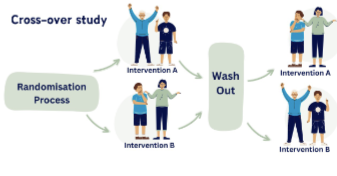
What are crossover designs?
special type of design only used in true experiments
Each participant receives two or more interventions sequentially, with a wash out period (planned intervention-free period to ‘wash out’ effects of first intervention) in between them
• Randomization often used to determine the order of interventions
• The washout period is critical to prevent carryover effects from the first intervention
• Each participant serves as their own control
Define randomized control trial (RCT)
research study that compares different treatments or interventions
participants randomly assigned to intervention or control groups
helps identify if an intervention → observed effect
Considered strong study design
Define blinding
keeping participants and/or researchers unaware of group assignments
Can be single (only participants don’t know), double (researchers also don’t know), or triple (even the statisticians don’t know)
What is the difference between placebo and sham effects?
placebo: inactive treatment given to participant to mimic real intervention; no active ingredient
controls for participants’ expectations/psychological effects of receiving treatment that is ‘supposed to do something’
sham: similar to placebo, refers to something ‘done’ instead of taken (ie: a device appears to stimulate the vagus nerve, but doesn’t actually)
What is the Solomon-4 Group design?
design that tests pretest and posttest only
lets us see if pretest affected the results (can bias participants; pretest effect)
participants randomly assigned to 4 groups

What is a quasi-experimental design?
research design in which the researcher manipulates an independent variable (IV), but does not randomly assign participants to group
no random assignment = harder to say if intervention caused outcome
researchers still examine effects of intervention/treatment
participants assigned to groups based on existing characteristics/groups
Often used when random assignment isn’t ethical/practical (ie: a school implements a new physical activity program in one school (intervention) and compares student fitness outcomes to another school that does not implement the program (control)
groups are pre-existing so differences in baseline fitness, motivation, or socioeconomic status may affect results