intro forensics midterm
 Call Kai
 Learn
Learn Practice Test
 Spaced Repetition
 Match
Match Flashcards
 Knowt Play
1/210

There's no tags or description
Looks like no tags are added yet.
Name | Mastery | Learn | Test | Matching | Spaced | Call with Kai | Chat |
|---|
No analytics yet
Send a link to your students to track their progress
211 Terms
what is forensic science
application of science to the criminal and civil laws that are enforced by police agencies in a criminal justice system
criminalistics
subcategory of forensics focused on services provided by crime lab
first major forensics lab
1932, FBI national laboratory under Hoover, offered services to entire country
first ever forensics lab
1923, LAPD by August Vollmer
an effective forensic scientist is:
-able to discover evidence using modern scientific techniques
-must be able to recognize potential value of evidence
-must be able to accurately apply testing scheme based on scientific method
Locard’s Exchange Principle
every contact leaves a trace; there is a scientific explanation that all actors in an event will leave evidence of their presence, not only on actors but scene; they also take away evidence of other actors on their person

Locard’s Triangle
3 major avenues available to police investigators for assistance in solving a crime
confession, eyewitnesses, evaluation of physical evidence from crime scene
why is physical evidence the most reliable
can’t be lied or coerced or misremembered (confession, eyewitness); is free from inherent error or bias
FBI
Federal Bureau of Investigation
DEA
Drug Enforcement Agency
ATF
The Bureau of Alcohol, Tobacco, Firearms, and Explosives
USPS
The United States Postal Service
IRS
Internal Revenue Service
DOD
Defensive Forensic Science Center
Sources of biological Evidence
blood, semen, saliva, and organs/ physiological fluids
Types of Physical Evidence
biological, handwriting analysis, drugs
types of drug evidence
alcohol, prescriptions, diverted pharmaceutics, explosives/petroleum products, materials (ie glass fiber, hair, etc), fingerprints, shoe prints, striations/toolmarks
diverted pharmaceutics
legal persecutions medications being sold or used by someone they were not initially intended for
striations (guns)
These are tiny, microscopic scratches inside the impression marks. They act like a fingerprint for the specific weapon
patterned evidence
fingerprints, firearms, treadwear, footwear, toolmarks, serial number restoration
Catch-up categories
plastic bags, powder residues, soil and minerals, vehicles lights
why examine physical evidence
comparison, individual characteristics (is there anything unique to single origin?) class characteristics (is there anything unique to certain group)
AFIS
automated fingerprint identification system
CODIS
combined DNA index system
NIBIN
National Integrated Ballistic Information Network
IBIS
Integrated Ballistic Identification System
PDQ
paint data query
SICAR
Shoeprint Image Capture and Retrieval
Blood Pattern Analysis
circumstances of crime, direction, velocity, size and mass,
Circumstances of crime (blood pattern analysis)
circumstances surrounding the crime including what happened, what weapon was used and who may have been involved
direction (blood pattern analysis)
can tell investigators how the victim and suspects were moving and their position in relation to one another
velocity (blood pattern analysis)
When a drop of blood exceeds a specific speed, the pressure from the air drag causes the drop to spatter into other smaller drops
size and mass (blood pattern analysis)
The size of the blood drop dictates the velocity in which it flew through the air. The mass of the blood drop is estimated by the width (diameter) of the drop and density (viscosity) of the blood.
arterial blood spray
bleed has a wavy, pulsing pattern because blood spurts out in synchronized waves with each heartbeat as the heart pumps high-pressure blood into the damaged artery

how arterial blood spurting works
Heart Action: The heart contracts (beats) and pushes blood out with high pressure
Pressure Peaks: Blood pressure rises when the heart beats and drops slightly when the heart rests between beats.
Wavy Pattern: This pulsing change in pressure creates a rising and falling flow, making the blood spurt out in waves instead of a steady stream.
Bright Color: Blood from an artery is rich in oxygen, so it looks bright red.
angles of impact (blood spatter)

the diameter of bloodstain increases as height increases
cast off stains
when a weapon is swung repeatedly blood might be thrown off it as it is reared back to strike again

cast off pattern at low velocity

cast off pattern at medium velocity

cast off patterns at high velocity


what is this pattern cause by?
hair swipe

what is this patten caused by?
hand swipe

what is this pattern caused by?
fabric swipe
back spatter
Biological material, such as blood or tissue, is ejected from a gunshot entrance wound back toward the direction of the shooter.
back spatter movement
It travels opposite to the line of fire, meaning it moves backward out of the hole the bullet just entered
back spatter causes
High-speed bullet impacts create pressure and physical forces (like Rayleigh-Taylor instability) that atomize and push fluids out of the entry wound.
back spatter droplet size
includes micro-stains (under 0.5 mm) as well as larger macro-stains.
back spatter distance
typically travels a short distance, often landing on the firearm, the shooter's hands, or nearby surfaces in close-range or contact shots
back spatter variables
The amount and pattern depend on the gun's caliber, distance, and the specific target area on the body. Muzzle gases from the gun can also interact with and influence the moving droplets.

what is this
a bullet wound, shows back and forward spatter from entry and exit wounds
what is a coroner
an elected official who may or may not have a medical degree
what is a medical examiner
an appointed official, usually a physician or board certified Forensic Pathologist responsible for certifying the manner and cause of death
who performs autopsies
pathologists
characteristics of a clinical autopsy
focus on internal
organs and medical condition
confirms clinical diagnosis
extent of diseased states
appropriateness of therapy
characteristics of forensics medicolegal autopsy
cause/manner of death
used in criminal proceedings
external and internal findings
establish correlations between injuries and crime scene
medicolegal death investigation
respond to the scene, document body and environmental findings, conduct witness interviews, and coordinate with law enforcement and medical staff.
forensic pathologist
These licensed physicians conduct post-mortem examinations and autopsies to identify internal trauma, disease processes, and precise causes of death
core investigation step of a medicolegal death investigation
scene assessment, autopsy and laboratory testing, manner determination
scene assessment (medicolegal death investigation)
Securing the location, noting body position, and collecting immediate physical evidence like medications or weapons
autopsy and laboratory testing (medicolegal death investigation)
Performing external and internal body assessments, microscopic tissue analysis, and toxicological screening for drugs or poisons.
manner determination (medicolegal death investigation)
Establishing whether the death was natural, accidental, suicide, or homicide based on synthesized multidisciplinary evidence.
cause of death
that which initiates the series of events ending in death (examples: Blunt force injury, Sharp force injury, Asphyxia, Gun shot wound, Substance abuse)
manner of death
circumstances that lead to the fatal result and is the culmination of complete death investigation, includes cause of death (examples: homicide, suicide, accidental, natural causes, undetermined)
manner vs cause of death
The cause of death is the specific disease or injury that starts the lethal chain of events, while the manner of death is the broad category explaining how those circumstances happened
strategies for estimating time of death
algor mortis, livor mortis, rigor mortis
algor mortis
equalization with the environmental temperature, lose heat at rate of 1-1.5 degrees an hour; is dependent on size of body, clothing, etc
livor mortis
ceasing of circulation; when heart stops pumping blood settles in part of body closer to the ground
rigor mortis
chemical changes that cause rigidity; condition evolves over 24-hour period and subsides typically within 36 hours
what happens seconds after death
ceasing of brain activity, body temperature drops
what happens minutes after death
beginning of putrefaction
putrefaction
cells die due to lack of oxygen and start to breakdown
what happens hours after death
calcium builds up cause’s rigor mortis, muscles eventually relax, skin shrinks making nails and hair appear to grow, livor mortis pulls blood to parts of body closes to ground
what happens days after death
parts turn green due to enzymes in organs digesting themselves, smell due to putrescine and cadaverine
what happens weeks after death
maggots/bugs digest body, turn purple to black as bacteria eats body, hair falls out
what happens months after death
about 4 months after soft tissues decompose until only skeleton
time frame of rigor mortis: 1-4 hours
jaws and neck rigid; rest of body limp
time frame of rigor mortis: up to 8 hours
everything down to legs is rigid
timeframe of rigor mortis: for 12 hours
everything in body remains rigid
time frame of rigor mortis: 24 hours
jaw is limp; rest of body rigid
timeframe of rigor mortis: 30-32 hours
everything but legs are limp
timeframe of rigor mortis: 36 hours
no rigidity
lividity
in livor mortis the bluish-purple discoloration of skin after death caused by pooling of blood in lowest part of body
blanching
in livor mortis where the skin is discolored white caused by the pooling of blood in body and pressure distribution
timeframe of livor mortis: 30mins to 4 hours
start of lividity
timeframe of livor mortis: 8-12 hours
blanching ends
timeframe of livor mortis: 12+ hours
blood becomes un-blanchable and fixed
what do lividity and blanching tell us?
time of death and position in which individual died, cause death based on lividity color
abrasions
when skin is rubbed off
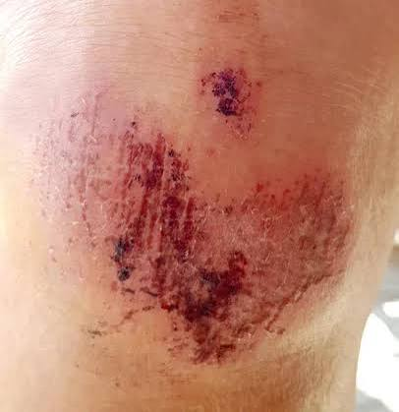
lacerations
a cut that goes thru the layers of skin

contusion
a bruise

petechiae
hemorrhaging in the eyelids, indictive of strangulation

black eye (eyelid and under eye)
blunt force trauma directly to eye

black eye (eyelid)
indicates blunt forces trauma to the back of the head

stippling
burn marks from hot gun powder and soot from firearm discharge (shows fired at close range)

1st time fingerprints were used for identification
a prison in 1904
anthropometrics
a system of measurements taken to identify people; developed by Alphonse Bertillon; no longer used
volar pads
tissue that appears during gestation that helps produce fingerprints; develops across 6 to 17 weeks
1sts principle of fingerprints
an individual characteristic; no two fingers have yet been found to possess identical ridge characteristics
2nd principle of fingerprints
will remain unchanged during an individual’s lifetime-barring any severe disease or injury