R2- Introduction to hepatic impairment
 Call Kai
 Learn
Learn Practice Test
 Spaced Repetition
 Match
Match Flashcards
 Knowt Play
1/32

There's no tags or description
Looks like no tags are added yet.
Name | Mastery | Learn | Test | Matching | Spaced | Call with Kai | Chat |
|---|
No analytics yet
Send a link to your students to track their progress
33 Terms
What are the functions of the liver?

What is the physiology
Key cells are the hepatocytes. help to see is there is any liver damage

What is an LFT?
Liver function test - measures synthesis and capacity to metabolise drugs
None of the liver function tests are specific to the liver; derangement may not be related to liver function
Abnormal LFTs do not indicate an underlying abnormality of function
not used in isolation - use with medical records ,signs and symptoms of liver disease

What is the transaminases lft ?
Transaminases in the hepatocytes produce amino acids; hepatocytes release the enzymes ALT and AST when they are damaged
AST is also found in the heart, skeletal muscle, pancreas, lung, kidney, and red blood cells
ALT is found in other organs; there is larger quantities in the liver = Liver specific enzyme
What is the transaminases clinical application?
0-40 IU/L
Increases in AST and ALT > 15 x ULN = acute hepatitis or hepatotoxicity, such as paracetamol overdose due to massive hepatocyte death or damage
Hepatocyte mass can be reduced in chronic liver disease
AST and ALT levels can be normal due to the reduced number of hepatocytes releasing enzymes ( already reduced; no cells to be damaged)
NOTE - chronic liver disease: “normal results “ can occur
What is bilirubin ?
Produced by the breakdown of rbc in the liver, spleen, and bone marrow
2 types:
Unconjugated - attached to albumin, transported in serum to the liver, insoluble in water and not excreted
Conjugated - water-soluble and excreted via bile into the intestine
What is the Bilirubin LFT?
Hepatocytes transform unconjugated bilirubin into conjugated bilirubin
Total bilirubin is measured as standard -can be measured separately if needed to aid diagnosis
In adults, serum bilirubin>50 micromol/L is termed clinical jaundice ( yellowing of the eyes )

What is the clinical application of bilirubin ?
Usual reference: 5- 21 micromol/L
Bilirubin and biliary tract enzymes ALP and GGT are raised in Cholestasis ( decreased bile flow)
Bilirubin is raised in acute liver injury due to damaged hepatocytes not being able to conjugate and excrete bilirubin
High fraction of unconjugated bilirubin = non-hepatic cause, if high bilirubin
What is ALP?
Alkaline phosphatase - hepatobiliary enzyme
a group of isoenzymes that are mainly produced in the liver and bone
Hepatic ALP is produced by cells that make up the biliary epithelium , more is produced when the biliary tract is damaged
What is the ALP LFT- how is it used ?
Usual reference range: 30- 300 IU/L ( higher in children due to bone growth)
ALP increases: extrahepatic causes ( malignancy, bone disease)
use ALP with other LFTS
long-term bed-bound patients have a significant rise in ALP
Raised GGT with raised ALP supports diagnosis of hepatobiliary origin ( cholestasis
What is GGT?
Gamma -glutamyl transferase ( GGT)
Enzyme in hepatocytes, biliary epithelial cells, kidney, pancreas, intestine, prostate
Role in drug metabolism
Increased in all forms of liver injury or dysfunction
What is the usual range of GGT?
0-50 IU/L
Could be increased due to high alcohol intake or enzyme- inducing drugs ( rifampicin, phenytoin)
What are albumin and prothrombin time?
Albumin
The liver produces the protein albumin - indicates synthetic liver function (determines drug dose changes)
Long half-life: 20 days - may not be reduced in acute liver impairment
Low level implies chronic disease
Prothrombin
Produced by liver, a vitamin K-dependent clotting factor
Severe liver injury will reduce overall production of prothrombin
Increases time to blood clot formation
Note - all LFTs albumin and prothrombin time have extrahepatic reasons for being prolonged ( should be used with other tests
What is extrahepatic reason?
a factor, condition, or disease that originates outside of the liver but still affects liver function, the biliary system (bile ducts and gallbladder), or blood flow related to the liver
How is liver damage classified ?

What are the patterns in lft rises?
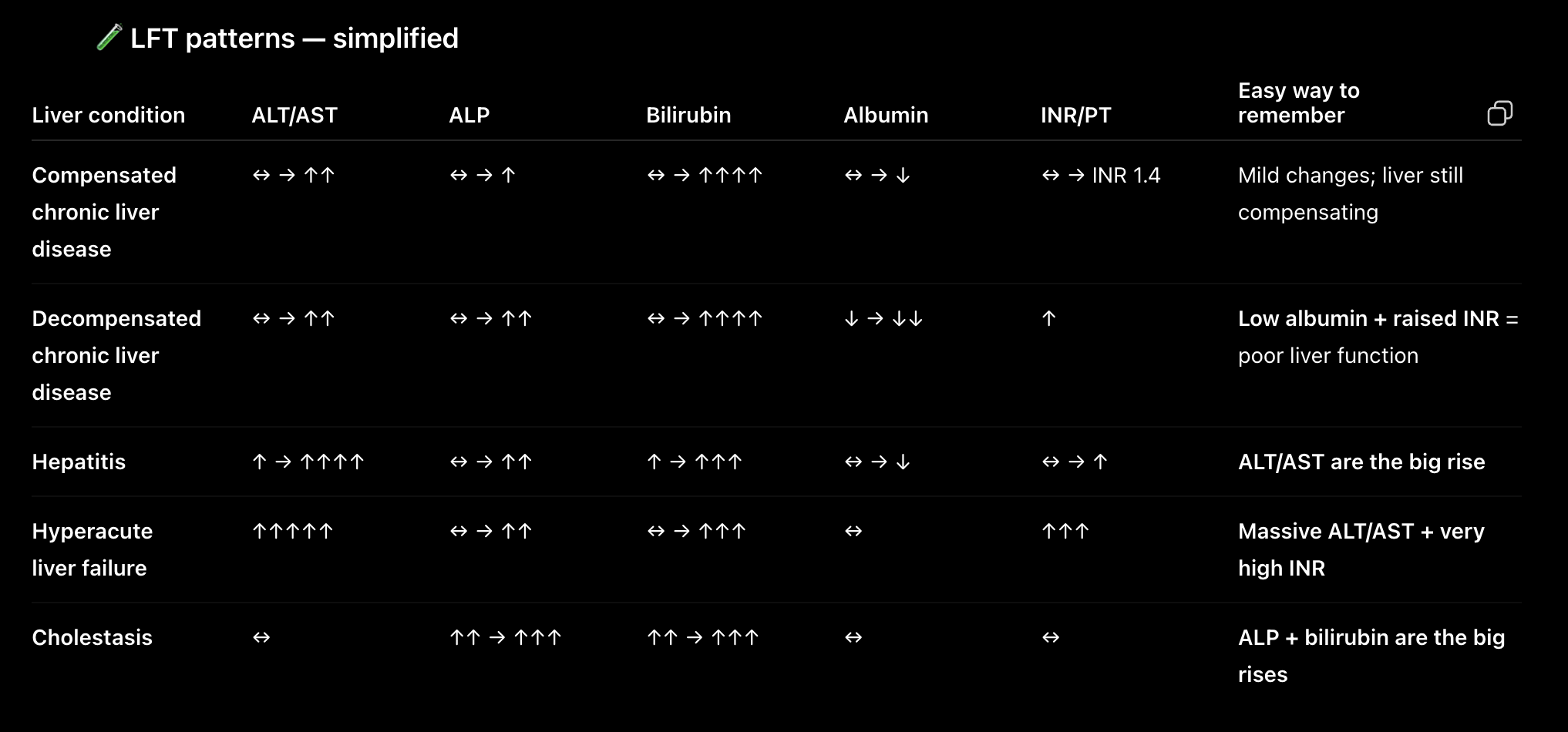
What is INR ?
INR stands for International Normalized Ratio, a standardised blood-clotting metric you must master for therapeutics and clinical pharmacokinetics
INR = (PT of patient / Pt of normal range )^IST
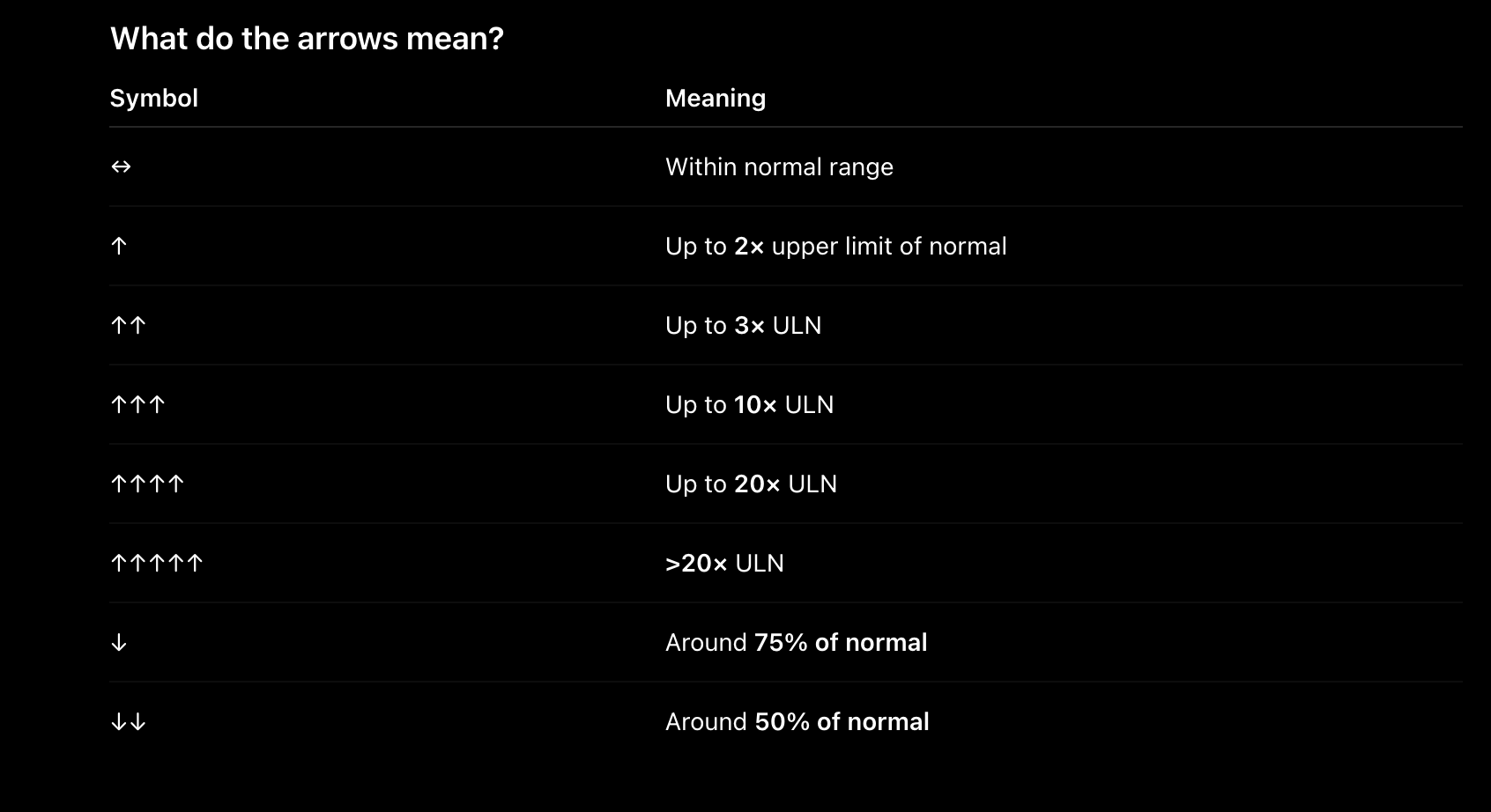
What are do the arrows mean ?

What are important patterns to recognise?

What are the further classifications/ TYPES?
acute vs chronic
acute - onset of symptoms <6 months
chronic- symptoms of liver disease>6 months
compensated vs decompensated hepatic impairment
compensated cirrhosis- liver able to carry out most of its functions
decompensated cirrhosis- liver extensively scarred,unable to carry out required functions

What is the Child-Pugh scoring system?
Used to make recommendations in a summary of product characteristics for drugs
Developed to predict disease severity and patient outcomes, not drug clearance
NOTE- for clinical diagnosis rather than actual diagnosis

What do you have to consider when dosing drugs in hepatic impairment?
No standard measures used; instead, use :
What is the LFT trend?
What is their synthetic function like (albumin, bilirubin, INR)?
How severe is the patient’s liver disease (cirrhotic or non cirrhotic, compensated or not )
Note - patients with poor synthetic function/cirrhosis are likely to have altered drug handling
what is synthetic liver function ?
Its capacity to build and release vital proteins, lipids, and other molecules into the blood.
Measured using blood tests that check the levels of proteins and clotting factors produced by the liver, specifically serum albumin and prothrombin time (PT) / International Normalized Ratio (INR)
What is Pharmacokinetics and pharmacodynamics ?
● Pharmacokinetics - what the body does to the drug
○ Absorption
○ Distribution
○ Metabolism
○ Excretion
● Pharmacodynamics – what the drug does to the body
○ Cerebral sensitivity
○ Increased bleeding risk
○ Fluid balance
How does hepatic impairment affect drug handling?
● Impaired drug metabolism- metabolism is the main route of elimination for many drugs
● Reduced excretion by bile- a few drugs are excreted unchanged in the bile
● Reduced protein binding- highly protein-bound drugs have more “free drug” available; therefore, higher levels and increased risk of toxicity
● Reduced hepatic synthesis of blood clotting factors- increases sensitivity to oral anticoagulants (drugs which prevent blood
clots)
How is absorption affected by hepatic impairemnet?
cholestasis Results in reduced absorption of highly lipophilic drugs; they depend on the excretion of bile salts
leads to reduced plasma concentration and clinical efficacy
How is elimination affected?
Drugs eliminated by bile; excretion is reduced with cholestasis, significant for drugs excreted in active form
Drugs that undergo enterohepatic recirculation are less likely to be effective in patients; less recirculation potentially reduces exposure
How is distribution affected?
Protein binding
Bilirubin can’t compete with medicine for binding sites, displacing them and increasing unbound drug levels and exposure
Albumin reduced ( hypoalbuminemia) - medicines bind to it, increased levels of free drug, increased clinical effect
Hydrophilic drugs
water soluble may distribute to ascites, increasing volume of distribution, lower conc. in other areas of the body = greater initial dose for a clinical effect
How is Metabolism affected?
Most drugs undergo hepatic metabolism , then are excreted in bile or urine
Enzymes metabolise wither active or inactive before excretion
the enzymatic activity determines rate at which drugs are metabolised
changes in drug metabolism by the liver affect oral bioavailability, which impacts safety and duration of drugs
What is first-pass metabolism and how does it link to hepatic impairment?
Drug metabolised by the liver or intestinal wall before it reaches systemic circulation - affects oral bioavailability ( drug absorption)
Only applies to oral medication
Lipid-soluble drugs have a high first-pass metabolism
link to hepatic impairment
first-pass metabolism significantly reduced
drugs with high first-pass metabolism for the same oral dose ,have significantly higher exposure to active drug = toxicity
How is enzymatic activity affected in hepatic impairment?
drugs metabolized by phase 1( oxidation,reduction hydrolysis) ,phase2 (glucuronidation)
Cytochrome P450 - essential in phase 1
link:
Drugs that are metabolised by the liver with active metabolites are more affected by impairment: higher levels, longer duration of action, side effects and toxicity
Aim to use drugs not metabolised by the liver or with inactive metabolites

What is drug-induced liver disease and types of reactions>
Liver damage caused by medication
reactions
Intrinsic - are predictable, reproducible, dose-dependent, and tend to
occur rapidly (e.g. within hours). E.g. paracetamol overdoseidiosyncratic - not predictable, not reproducible, do not depend on
dose and tend to take longer to occur (e.g. weeks to months)
What is hepatotoxicity ?
Damage to the liver caused by substances, increase risk with polypharmacy ( taking multiple meds at the same time )
Identify using BNF