E4 Head and Neck trauma
 Call Kai
 Learn
 Practice Test
 Spaced Repetition
 Match
 Flashcards
 Knowt Play
1/131

There's no tags or description
Looks like no tags are added yet.
132 Terms
Define tbi
brain function impairment that results from external force
- Blunt or penetrating
- Most often involves frontal and temporal areas
Mild GCS scores
14-15
Moderate GCS
9-13
Severe GCS
3-8
MCC of tbi in young adults and children
MVA
MCC of TBI in elderly
falls
Glascow coma scale
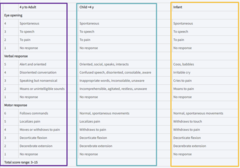
Hx of tbi
mechanism of injury and overall severity (info from ems)
Vomiting, HA, amnesia, LOC
PMH, meds (anticoagulants), drug or alcohol use
Decorticate vs decerebrate
Decorticate
- Damage to cerebral hemisphere
- Upper extremity flexion, lower extremity extension
Decerebrate
- Damage to brainsem
- Internal rotation and extension of LE

Clinical decision rule for when to order CT head in pts with minor head injury
Canadian CT head rule
Canadian ct head rule does not apply if
- Anticoag use or bleeding disorder
- Seizure prior to arrival to ED
- Age < 16 yo
NOLA/Charity head trauma/injury rule
HA
Vomiting
Older than 60
drugs or alc
Persistent anterograde amnesia (short term memory)
Visible trauma above clavicle
Seizure
If any present - CT head
Any suspicion of skull fx requires
ct imaging
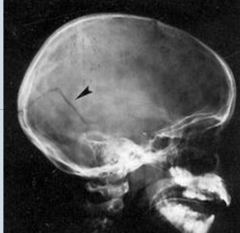
Linear skull fx
- Single fx extends through entire thickness of the skull
- Majority have NO minimal or no clinical significance unless they have some kind of underlying leak
- Some may disturb vascular structures and cause significant bleeding
Depressed skull fx
- Trauma of significant force drives a segment of skull BELOW the level of adjacent skull
- Often involves injury to the brain parenchyma
- Significant risk for CNS infx, seizures, and death if not ID

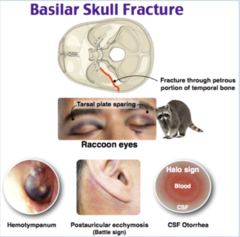
Basilar skull fx involve
What bone is mc?
bone at base of skull
Temporal bone mc
Clinical signs of basilar skull fxs
Battle sign
- retroauricular or mastoid ecchymosis
- Appears 1-3 days later
Racoon eyes
- Periorbital ecchymosis
- Appears 1-3 days later
Clear rhinorrhea or otorrhea
- Within hours to several days after trauma
Hemotympanum
- Blood behind TM
- within hours of injury
Epidural hematoma is a collection of blood in
potential space between skull and dura mater
MOR of epidural hematoma
Blunt trauma to temporal or temporoparietal area
- W/ associated skull fx
- Lacerates middle meningeal artery
- Higher foce injury w/ subdural hematoma
Classic hx (triphasic) of epidural hematoma
- Significant blunt head trauma with LOC or altered sensorium
- Followed by a lucid period lasting minutes to hours
- Subsequent rapid neurologic demise
CT of epidural hematoma
LEMON
- Biconvex mass, usually in temporal region
tx of epidural hematoma
Neurosurg emergency - prompt drainage
Subdural hematoma is a collection
of blood b/e arachnoid mater and dura mater
MOI subdural hematoma
sudden acceleration deceleration of brain parenchyma with tearing of bridging dural veins
- Collects more slowly d/t venous origin
- May occur w/ minor head trauma
- Frontal or temporal
Common pop for subdural hematoma
Alcoholics and elderly more susceptible - fall and hit head
CT of subdural hematoma
Banana
- Crescent shaped, concave hyperdense lesions that crosses suture lines
tx of subdural hematoma
Neurosurg emergency - prompt drainage
Traumatic subarach hemorrhage is a disruption of
CT?
Subarachnoid vessels
Texaco star
- Blood in cerebrospinal fluid
- Can be missed if CT not obtained
Clin fts of subarach
HA
Photophobia
Meningeal signs
Cerebral contusion and intracerebral hemorrhage is
MC in?
Often a/w?
Focal region of necrosis and hemorrhage involving cerebral cortex and subcortical white matter
MC in subfrontal cortex, frontal, and temporal lobes
Often a/w hemorrhage; often in pts on blood thinners/with coagulopathy
MOA of Cerebral contusion and intracerebral hemorrhage
Blunt trauma
Cerebral contusion and intracerebral hemorrhage occur at site of
blunt trauma or opposite side of brain - Contrecoup injury
CT of Cerebral contusion and intracerebral hemorrhage
Initial findings after injury can be normal
Intracerebral hemorrhage can occur days after significant blunt trauma (at site of resolving contsions)
ABCs intubate if GCS <
8
TBI mgnt
ABCs
BP
- Hypotension increases mortality
- IVF resuscitation to maintain systolic BP >=100 mmHg
Patient positioning
- Raise head of bed to 30 degrees if signs of increased ICP
Seizure tx and prophylaxis
- Acute seizure - Lorazepam or midazolam
- If seizure continues - tx as status epilepticus
- in consultation with neurosurgeon - prophylactic Fosphenytoin if (GCS
Concussion is
Head injury with impairment in brain function without overt hemorrhage or other gross lesions
- Usually results form acceleration/deceleration forces occuring secondary to a direct blow to the head
Clin fts of concussion
HA, dizziness, NV
Confusion and amnesia (retrograde and anterograde)
May occur with or without LOC
GCS 14 or 15
Full neurological exam and neck exam
Minor head injury (3)
- Witnessed LOC OR
- Definite amnesia OR
- Witnessed disorientation in pts with GCS 14 or 15
CT with concussion?
Cannot be dx with routine CT
Use canadian CT head rule to determine if indicated
TX concussion
Frequent reassessment
Reverse coagulopathy if present
Neurosurg consult if pathology on head ct or signs of inc ICP or herniation
When to admit concussion
Intracranial injury on ct
Abn GCS
Persistent neuro deficits
D/c instructions for a concussion (w/ family member)
Take acetaminophen or NSAIDs for pain
Rest for 24-48 hours THEN
Gradual return to activities (starting with light aerobics as tolerated), school, and work
Avoid activities that can cause another injury to head/brain
- Second Impact Syndrome: a 2nd concussion can lead to rapid evolution of malignant cerebral edema, over a short period of time (most often fatal)
Return for worsening HA, repeated vomiting, unusual behavior, seizure, LOC
Need to be cleared by a PCP or neuro
What is the PECARN rule
Pediatric Emergency Care Applied Research Network
Decision making tool for neuroimaging in pts younger than 18 with blunt head injury
Reduces unnecessary CT scans in children
Reduces radiation exp and cost
PECARN RULE

C5,C6
Deltoid, biceps
Arm abduction
Elbow flexion
C6,C7
Extensor carpi radialis
Wrist extension
C7, C8
Triceps
Elbow extension
C8, T1
Hand intrinsics
Flexor Digitorum profundus
Finger abduction
Hand grasp
T2-T7
Chest muscles
T9-T12
Abdominal muscles
L1,L2,L3
Iliopsoas
Hip flexion
L2,L3, L4
Quadriceps
Knee extension
L4,L5,S1,S2
Hamstrings
Knee flexion
L4,L5
tibialis anterior
Ankle dorsiflexion
L5,S1
Extensor hallucis longus
Great toe extension
S1,S2
Gastrocnemius
Ankle plantar flexion
S2, S3, S4
Bladder, anal sphincter
Voluntary rectal tone
C_ and C_ are designed to allow for head rotation
C1 (atlas) and C2 (axis)
Risks of spinal immobilization
Skin ischemia
Pressure sores
Inc resp effort
Pain
Aspiration risk
C_ to C_ controls movements of the head
C1-C3
C_ to C_ controls muscles of the diaphragm and breathing
C3-C5
C_ controls shoulder abduction and elbow flexion
C5
C_ to C_ controls DTRs of biceps, brachioradialis, triceps respectively
C5-C7
C_ to C_ controls elbow extension, wrist extension, and flexion
C6-C7
C_ controls finger extension and abduction
C8
Criteria to decide if you need imaging for a c spine injury
NEXUS
C spine views
Initial screening test - XR
- AP lateral and odontoid (open mouth) views
- Lateral view must include all 7 cervical vertebrae and C7 to T1 disc space
- Open mouth view must show dens and lateral masses

If you see abn on XR for c spine injury, what next?
CT of C spine = imaging test of choice
Canadian c spine rule NOT applicable if
GCS < 15
Age >= 65
Dangerous mechanism
Extremity paresthesias
Common c spine injuries
If the answer is yes, you scan them
- MVA (not simple)
- Diving into shallow pool
- Death of someone in the same vehicle
- Ejection from vehicle
- Struck by vehicle
Peds spine differs from adults bc
- Greater ligamentous elasticity and flexibility
- Different fulcrum d/t relatively large head
- Relatively weak musculature
What is a spinal cord injury without radiographic abn (peds) - SCIWORA
Unique peds dx found mainly in c spine
Patients demonstrate clin findings of spinal cord injury NOT visualized on xr and ct
Sxs of SCIWORA
Neck pain and reduced ROM
Numbness, weakness, abn reflexes, loss of bladder or bowel control
Dx and tx of SCIWORA
MRI may show visible spinal cord lesions
Rigid cervical collar, consult peds spine surgery, and hospital admit
C1 burst fx also known as
Jefferson fx
MOI of c1 burst
excessive axial loading of the atlas when the spine is NOT flexed or extended
- Compression fx
- Drives the lateral masses OUTWARD
- Disrupts ligaments
- Results in loss of integrity of the ring structure
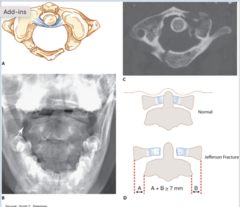
Is jefferson fx stable or unstable
unstable
Dx and tx of c1 burst fx
Dx:
- Fx of the anterior and posterior arches of C1
- Displacement of lateral masses of the atlas
Tx:
- Rigid cervical collar or halo traction
- Consult spine sx
C2 hangmans fx MOI
Unstable or stable?
High force hyperextension injury of the axis (C2)
- Head on MVA and diving accidents
Unstable

Dx and tx of C2 hangmans fx
Dx:
- Fx line through pedicles of C2
- anterior displacement of C2 on C3
- Disruption of spinolaminar line
Tx:
- Rigid cervical collar, consult spine sx
C2 odontoid fx MOI
Forceful flexion and extension of head
- Forward fall onto forhead
- low energy falls in elderly, or MVAs in younger
- Common C2 (Axis) fx
3 types of fx with C2 odontoid (stable or unstable)
Type I - stable
Type II and III - Unstable
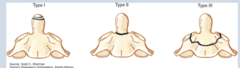
Dx and tx of C2 odontoid
Dx:
- Open mouth odontoid view
- Fx line through peg of odontoid process
Suspicious and not notable on Xr -> CT scan
Tx:
- Rigid collar, consult spine surgery
Flexion teardrop fx MOI and clin fts
MOI:
- Severe hyperflexion and compressive forces
- Extremely unstable injury - complete ligamentous disruption
Clin fts:
- Neurologic deficit is common - cord injury
- May have apnea from respiratory muscle paralysis (C3-C5)
Dx of flexion teardrop fx
Seen best on lateral view C3-C6
Large triangular fragment off the anterior portion of the vertebral body in the shape of a teardrop
Involved vertebra is displaced and rotated anteriorly

Tx of flexion teardrop fx
Possible intubation depending on cervical spine level (C3-C5 - respiration and breathing)
Immobilization and spine surgery consult
MOI clay shovelers fx
Stable or unstable?
Abrupt neck flexion combined with heavy upper body and lower neck muscular contraction
- Direct trauma to spinous process or MVA
- Avulsion type spinous process fx
- Lower c spine
STABLE
Dx and tx for clay shovelers fx
Dx:
- Best seen on lateral xr view
- Fracture line of 1 or more spinous processes (C6, C7, T1)
Tx:
- NSAIDs, rest, immobilization in hard collar
- Spine surg follow up

Anterior cord syndrome MOI
Occurs when the front 2/3 of the spinal cord is compressed often d/t decreased blood supply from the anterior spinal artery
- The blockage may be caused by surgery to repair an aortic aneurysm, or compression caused by herniated disc, tumor, burst fx, or a hyperflexion injury (when the head is forced down toward the chest)
Poor outcome in terms of regaining the function they have lost

S/sxs of anterior cord syndrome
Tx?
OCCURS BELOW LEVEL OF INJURY
- Motor weakness
- Loss of pain and temp sensation
- The posterior (rear) region of the cord remains intact, individuals still retain their sense of light touch, vibration, and proprioception (an awareness of the position and movement of the body)
- Motor dysfunction is determined by the level of the cord injury
Tx: consult spine surg
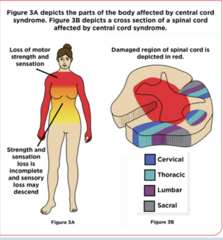
Central cord syndrome MOI
Usually seen in older patients w/ preexisting cervical spondylosis who sustain a hyperextension injury
- Injury preferentially involves the central portion of the cord more than the peripheral
- The centrally located fibers of the corticospinal and spinothalamic tracts are affected
MOI of brown sequard syndrome
Rare condition occurs when on half of the spinal cord = damaged
S/sxs of brown sequard
- Partial paralysis or weakness on the same side of the body as the lesion, beginning below level of injury
- Loss of pain and temp sensation on the opposite side of the body, beginning below the level of injury
- Decreased levels of touch, vibration, and proprioception (awareness of position and movement) on the same side as the injury
- Possible bowel and bladder

Tx of brown sequard syndrome
- Rigid cervical collar or halo traction
- Consult spine surg
Dx of cauda equina
- No one symptom or sign has 100% predictive value
- Emergent MRI of lumbosacral spine
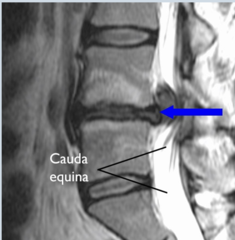
Cauda equina tx
SURGICAL EMERGENCY
- Urgent investigation
- Surgical decompression (
Cauda equina syndrome is not a
Not a true spinal cord syndrome - composed of lumbar, sacral, and coccygeal nerve roots
Compression of LS nerve roots below conus medullaris is secondary to (4)
- Large central herniated disc
- Extrinsic mass
- Infx
- Trauma
Clin fts of cauda equina (motor and sensory)
Motor:
- Weakness in distribution of multiple nerve roots
- Decreased DTRs (knee and ankle)
- Sphincter disturbance (urinary retention and fecal incontinence - loss of anal sphincter tone)
Sensory:
- Saddle anesthesia (MC sensory deficit) - over perineum, buttocks, inner thigh)
- Back pain radiating to legs
What is neurogenic shock
- A type of distributive shock occuring with CNS or spinal cord injury
- loss of peripheral sympathetic innervation extreme vasodilation secondary to loss of sympathetic arterial tone
- If the T1 - T4 cord levels = compromised, loss of sympathetic innervation of the heart, leaves unopposed vagal parasympathetic cardiac innervation
- Loss of sympathetic tone and subsequent inability to redirect blood from periphery to the core may cause excessive heat loss and hypothermia (even though they might be sweating and flushing)