Fatty Acid Synthesis
 Call Kai
 Learn
 Practice Test
 Spaced Repetition
 Match
 Flashcards
 Knowt Play
1/14

There's no tags or description
Looks like no tags are added yet.
15 Terms
Outline the cyclic process enabling acetyl groups from the mitochondria to move into the cytoplasm for fatty acid synthesis
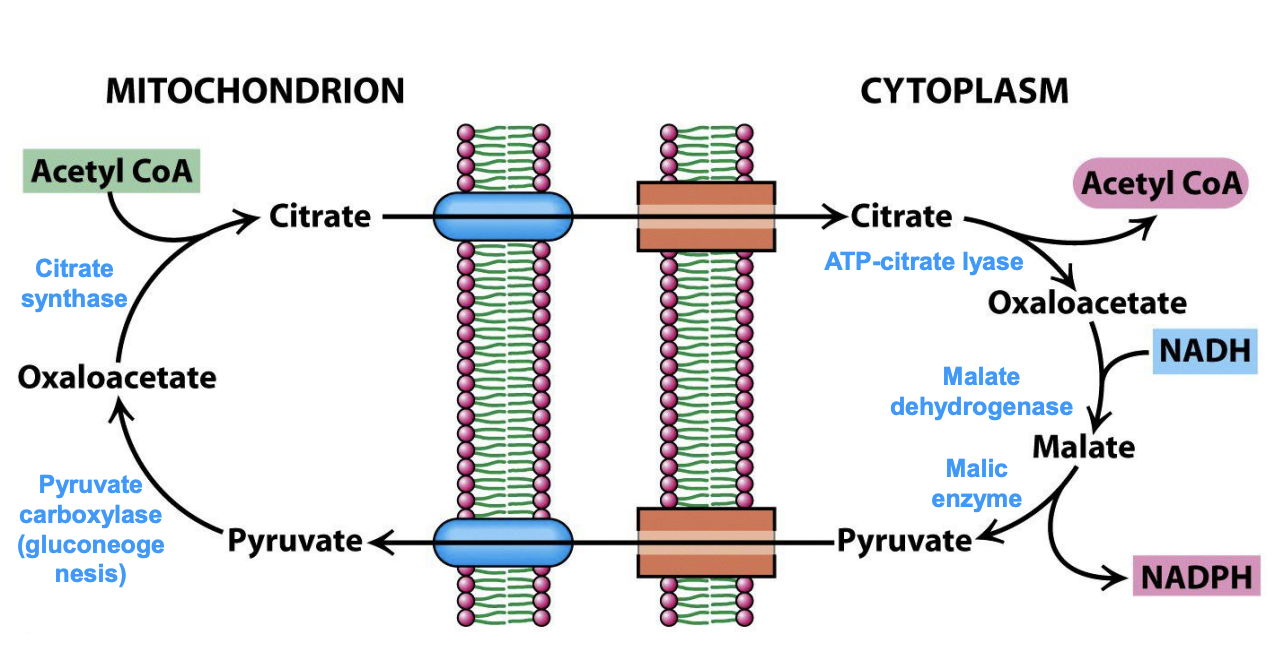
What is the name of the shuttle that moves the citrate from the mitochondria to the cytoplasm (and the other way)
Malate-citrate shuttle
What issue is resolved by the maltate-citrate shuttle?
Acetyl CoA is formed in mitochondria and is needed in the cytoplasm for fatty acid synthesis.
Acetyl CoA and OAA are condensed in the citric acid cycle to form citrate
Citrate is then transported through the malate-cirate shuttleA
Once in the cytoplasm citrate can be converted to Acetyl CoA or Oxaloacetate. What dictates these processes?
When citrate is plentiful, it is transported across the inner mitochondrial membrane and cleaved back to acetyl CoA at the expense of ATP by the enzyme ATP-citrate lyase
Remember that citrate is primarily used by the TCA cycle within the mitochondria, its relocation to the cytoplasm occurs when cells have no energy needs
What is the role of acyl carrier protein?
Acyl carrier protein (ACP) is the carrier in fatty acid synthesis rather than CoA
Both acetyl CoA and malonyl CoA are transferred to ACP to create acetyl ACP and malonyl ACP
Broadly describe the 3 steps of fatty acid synthesis
The 1st step is the comitted step - malonyl CoA 93-carbon compound) synthesis
The 2nd step is the transfer of malonyl and acetyl to ACP, to form malonyl ACP and acetyl ACP molecules
The 3rd step is the elongation with the addition of 2C (from acetyl ACP) per turn
Describe in detail the 1st step of fatty acid synthesis
This step occurs in the cytoplasm
It uses ATP to drive the reaction from Acetyl CoA to Malonyl CoA
Acetyl CoA carboxylase is the enzyme that catalyses this reaction
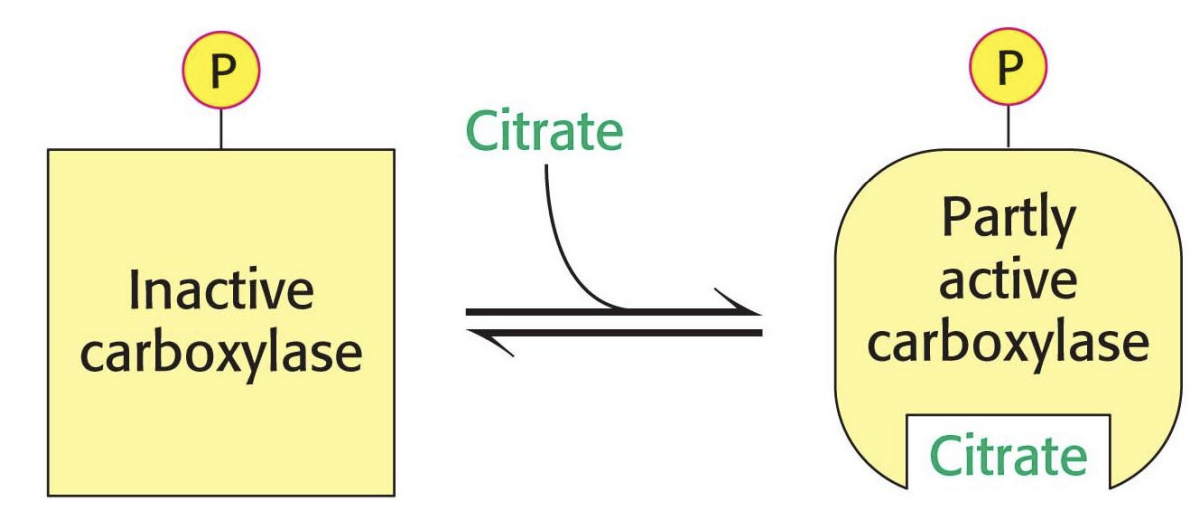
Allosteric activation by citrate
Allosteric inactivation by palmitoyl CoA

Describe the 2nd step of fatty acid synthesis

Compare and contrast fatty acid degradation with fatty acid synthesis and their oxidation states
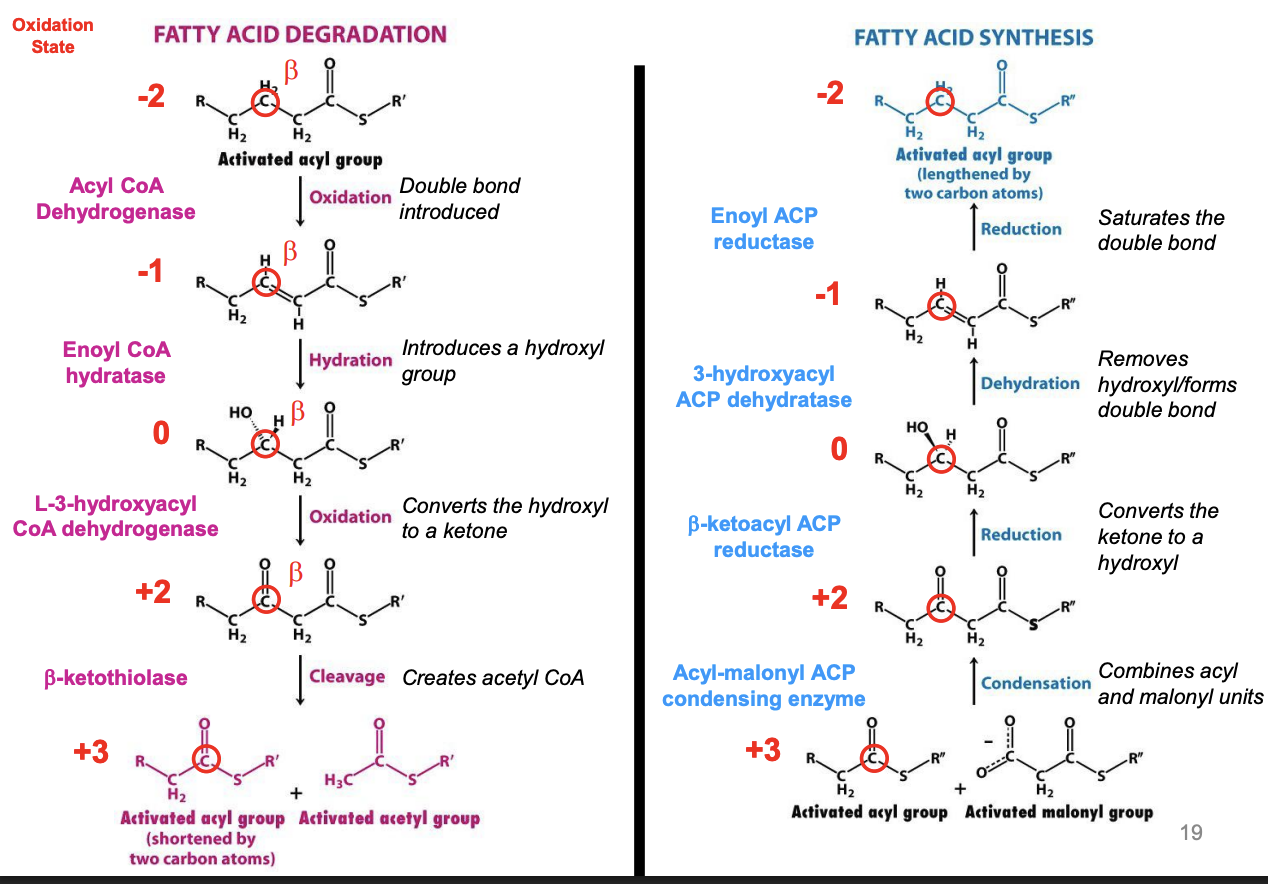
Write out the four main biochemical steps of the mammalian fatty acid synthesis pathway, including the names of the enzymes catalyzing each reaction.

What are the different needs in fatty acid synthesis? Specifically for palminate (C16:0)
8 molecules acetyl CoA
Acetyl CoA supplies the 16 carbon units in the fatty acid
14 molecules of NADPH
NADPH provides the electrons for the two reductions in each cycle
7 molecules of ATP
A molecule of ATP is needed for each malonyl CoA formed from acetyl CoA
Describe the two ways that fatty acid synthesis can be regulated
Acetyl CoA carboxylase is activated when ATP and acetyl CoA are abundant enough to raise citrate levels in the cytoplasm
When the fatty acid synthesis pathway produces increase levels of malonyl CoA, Carnitine acyltransferase I is inhibited, preventing the translocation of fatty acids into the mitochondria and preventing fatty acid oxidation

How does glucagon and epinephrine regulate fatty acids synthesis
They both signal the activation of AMP-activated protein kinase (AMPK) which in conjunction with relatively high levels of AMP (low energy charge) promotes phosphorylation and downregulation of acetyl CoA carboxylase

What is the role of insulin in the regulation of fatty acid syntheis and degradation?
Promotes phosphorylation of AMPK which inactivates it
This enchances the activitiy of phosphatases (PP2A) that will upregulated acetyl CoA carboxylase activity

What is the role of citrate in regulating fatty acid synthesis and degradation?
can partly activates the phosphorylated carboxylase. While the dephosphorylated form of the carboxylase is highly active even when citrate is absent.
Citrate can partially overcome the inhibition produced by phosphorylation