Sedentary behaviour - social media and health
 Call Kai
 Learn
 Practice Test
 Spaced Repetition
 Match
 Flashcards
 Knowt Play
1/27

There's no tags or description
Looks like no tags are added yet.
28 Terms

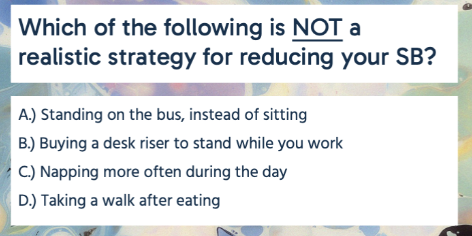
False - our body acc experiences chronic stress when we are engaging in excessive sedentary behaviours
C
Social media
Forms of digital communication through which users create online communities to share information, ideas, personal messages and other content (APA, 2026).
Super-app
An app that combines social media with other services like payment, commerce, ride-share, marketplace and food delivery. Example: WeChat.
How is social media becoming "more than" posting your life and messaging others? Give 2 examples.
Platforms now serve other purposes: Pinterest works as a digital pinboard, and LinkedIn is for networking and professional development.
What is the APA's position on whether social media is good or bad for young people?
Social media on its own is not "inherently beneficial or harmful."
The effects depend on how it's used, not on social media itself.
APA: american psychological association.
Health misinformation
Any health-related claim of fact that is false based on current scientific consensus
Which groups are more susceptible to health misinformation?
People with antisocial or conspiratorial mindsets, and people without access to education or evidence-based information.
Health literacy
Our ability to "access, understand, appraise and use information and services in ways that promote and maintain good health and well-being" (WHO, 2025).
low health literacy is linked to greater susceptibility to health misinformation.
What 3 abilities make up good health literacy?
ability to:
access health related info
follow prescribed health behaviours
think critically about health information as it relates to one’s own personal and societal needs for health.
Health literacy is a stronger predictor of health status than what?
Income, employment status, education level and ethnicity.
what does this mean - If you're not paying for the product, you are the product
Social media is free to join, but you pay with your engagement and data.
What's the relationship between engagement and data?
More engagement means more data, which means more accurate predictions of your behaviour, interests, social network and demographic features.
Brandolini's Law (Bullshit Asymmetry Principle)
The energy needed to refute a false statement is exponentially higher than the energy it took to produce it.
for example for vaccines cause autism - One false study spread the claim widely, but it has taken enormous effort and many studies to refute it, and the belief still persists.
this is often because platforms boost sensational content, which is often false, so it spreads fast. Correcting it then takes far more effort than creating it did.
Why is seeing health misinformation on social media inevitable?
Algorithms prioritize engagement over evidence.
What are the 5 strategies for combatting health misinformation?
(1) Public health campaigns on its harms.
(2) Increasing your own and others' health literacy.
(3) Challenging misinformation you see and have shared.
(4) Promoting accurate information from your own social media and credible sources.
(5) Getting evidence-based education and sharing it (knowledge brokerage).
Explain the cycle created by using social media as a coping mechanism.
You feel bad (stressed, lonely, bored), so you scroll. Scrolling leads to comparison and lower self-esteem, which makes you feel worse, so you scroll more. - further perpetuating negative feelings.
Addiction
chronic medical disease involving complex interactions among brain circuits, genetics, the environment, and an individual's life experiences
People with addiction use substances or engage in behaviours that become compulsive and often continue despite harmful consequences.
Social media addiction
Behaviour characterized by "excessive and compulsive usage that affects daily functioning and overall well-being
Social media addiction is more than just spending a lot of time online. What 3 other features does it involve?
Compulsively checking for updates, feeling anxious when offline, and negative impacts on real-life relationships and responsibilities.
When is dopamine released?
1. During or right after something pleasurable.
You eat a great slice of pizza and dopamine is released. Its job here is to teach your brain: "That thing we just did felt good, remember it." It links the action (eating pizza) to the feeling (good).
2. Before you do it again, when you're anticipating it.
Next time you walk past that pizza place, dopamine is released before you've even eaten anything, just because your brain remembers it felt good last time. This is what creates the craving, the "I want that" feeling that motivates you to go do it again. — anticipatory dopamine release
What does dopamine do after a pleasurable experience?
It strengthens the connection in the brain between what we did and how we felt about it.
Why do people with behavioural addictions seek bigger and bigger rewards over time?
Repeated dopamine flooding causes tolerance and desensitization, so the same reward no longer feels as good.
Variable reward system
The desired behaviour is rewarded intermittently and unpredictably, so you never know when the next reward is coming. Example: a slot machine.
social media is a varibale reward system, so you keep scrollying because not knowing when the reward is coming builds anticipation, and anticipation triggers dopamine release.
What behaviours can the social media variable reward system lead to?
Compulsive notification checking and frequent app use, which builds a habit.
what's more predictive of poor mental health, suicidal behaviour and ideation among youth: total screen time or screen use patterns?
Screen use patterns, such as addictive use.
How does one combat social media addiction?
CBT can be very helpful - it seeks to make unconscious social media use a conscious and deliberate behaviour.
other strategies: Mindfulness and emotional regulation, self regulation (hard limits), and professional help from media.
What does mindfulness and emotional regulation address?
The discomfort of boredom, stress or negative emotions, the feelings that usually trigger reaching for social media.