Chapter 5 - Electronic Structure of Atoms and Ions
 Call Kai
 Learn
 Practice Test
 Spaced Repetition
 Match
 Flashcards
 Knowt Play
1/57

Earn XP
Description and Tags
17/10/26
58 Terms
what is r (radius)?
the distance between an electron and the nucleus
what is coulomb’s law
V(r) ∝ (q1q2) / r, where
V(r) is the potential energy
q1 is the charge of particle one (likely an electron or number of protons)
q2 is the charge of particle two (likely an electron or number of protons)
r is the distance b/w the particles
can also be written as V(r) ∝ - Z / r,
this form is made for atomic units, where the charge of particle one is that of an electron (i.e. amu makes the charge = -1) and charge 2 (the only visible one) is that of the nucleus (Z)
we understand more of the s equation now!!!
the s equation for an atom contains terms representing the kinetic energy (what we looked at with the particle in a box) and the potential energy term describes the attraction between the electron to the nucleus. additionally this part of the s equation depends on three coordinates because the electron moves in three-dimensional space while being subject to the coulombic attraction to the nucleus
solving the s equation
it can only be solved analytically for one-electron atoms and ions. analytic solution are obtained by solving a system of equations on paper.
for atoms/ions with more than one electron, scientists use computers to determine very good approximations.
in either vase, since V depends on r, atoms have a spherical shapes, ergo we use spherical polar coordinates
solutions for one-electron-species, Ψ, that satisfy the schrodinger equation are called the atomic orbitals
wavefunctions as atomic orbitals
wavefunctions that satisfy the schrodinger equation for one-electron-species can be written in polar coordinates as a product of two parts:
Ψ(r, θ, φ) = R(r) Y(θ, φ)
the radial part:
R(r) a radial distribution function, depends only on r and describes the size of the orbital
the angular part:
Y(θ, φ) is a function of only the angles θ and φ, and corresponds to the shape and orientation of the orbital
atomic orbitals as spherical polar coordinates
r = distance from centre (nucleus)
θ = is the angle of radius line, but on the 3-D vertical Z-plane. it ranges from 0 to π, where 0 is straight upwards, and π is straight down
φ = the angle of radius line but on the horizontal x-y plane. it ranges from 0 to 2π in a flat circle.
quantum numbers
the solutions for the s equation for the one-dimensional particle in a box could be described with only one letter, n. but for one-electron atoms and ions, three quantum numbers (n, ℓ, mℓ) are needed to label each wavefunction. each set of three quantum numbers describes one solution of the s equation. they have restrictions to their values though
what does n mean?
n = principal quantum number
allowed numbers: integers 1- infinity
also referred to as a shell
describes:
the relative energy of the particle
the radius of the orbital
the number of nodes. still (n-1) in total
what does ℓ mean?
ℓ = the angular momentum quantum number
allowed values: integer 0 to (n-1)
also referred to as a subshell
describes:
the 3D shape of orbitals
because it determines the number of angular nodes in an orbital
what does mℓ mean?
mℓ = magnetic quantum number
allowed values: integers -ℓ to ℓ
describes:
specific orbital in a subshell
number of orbitals in a subshell
what are the possible values for the quantum number n?
the principle quantum number can be any positive (non-zero) integer, just like it was for particle in a box
what the fuck is a node?
just like in chapter four, a node is a place where the electron will not exist/never be. they come from points around the nucleus where the wavefunction will equal 0.
there are two types: radial and angular
radial nodes are nodes that result from the r coordinate/value of the orbital
angular nodes are nodes that result from the θ or φ coordinate/value of the orbital
for any given wavefunction:
total # of nodes = n-1
# of angular nodes = ℓ or (n-1)
# of radial nodes = (n-1) - ℓ
how to find nodes based on the wavefunction of an orbital?
look at the function
identify where the variables are: (r, θ, φ)
do things to them that’ll make this part of the func = 0
typically the angular parts will be attached to a cos or sin, so think about what values would make these = 0
but remember the value limits on θ
radial parts will be attached to a constant as part of σ = Zr / ao , so it’ll usually just have to be r = 0????
what are the possible values for the quantum number ℓ?
for a given n, the angular momentum quantum number takes on all interger values b/w 0 and n-1
ex: n=5, ℓ= [0, 4]
what are the possible values for the quantum number mℓ?
for a given ℓ, the magnetic quantum number takes on all integer values between ℓ and -ℓ
ex: n = 5, ℓ could be [0, 4], therefore m could be [-4, 4]
subshells and ℓ
ℓ = 0 means subshell s
ℓ = 1 means subshell p
ℓ = 2 means subshell d
ℓ = 3 means subshell f
because ℓ values are associated with subshells, what do they tell us?
because a quantum particle can have multiple ℓ values, we know which subshells that particle has.
a particle will always have n many subshells.
as well, there are always n many values of ℓ,
and for each value of ℓ, there are 2ℓ + 1 values of mℓ
how many orbitals are in a shell?
there are n2 orbitals in the nth shell. so the 2nd shell would have 4 orbitals innit
what are shells and subshells?
each value of n is a shell is referred to by chemists as a shell
and each value of ℓ is a subshell (remember 0 = s, 1 = p, d = 2, 3 = f, and 4 = g and so on and so forth)
the principal quantum number and angular momentum quantum number together represent a specific type of orbital (subshell, like 1s, 2s, 2p, 3d, and so on)
mid-point summary
each orbital is described by a set of quantum numbers, n, ℓ, mℓ
the principle quantum number, n, specifies the shell and size of the orbital. the possible values of n are 1, 2, 3… infinity
there are n2 orbitals in nth shell
an orbital has (n-1) total nodes (# total nodes = # angular nodes + # radial nodes)
the possible values of ℓ are ℓ = 0, 1, 2, 3, … (n-1)
for each value of ℓ, there are 2ℓ + 1 orbitals
that is, p orbitals come in sets of three, d orbitals come in sets of five, f orbitals in sets of seven
within these sets, each orbital has a unique value of mℓ
the magnetic quantum number mℓ, specifies the orientation of the orbital and possible values range from -ℓ to +ℓ
the probability of finding an electron at a particular location is proportional Ψ2, and is zero at a node
the phase of the wavefunction changes across every node

what the fucking fuck are these graphs bro?
NOTE: all of these graphs have distance for the nucleus, or radius, as their x-axis, and these are all for the 1s orbital, and are showing things about the RADIAL
the top one is the radial portion of the wavefunction for the 1s orbital
the middle is the square of that function, so the probability distribution of finding an electron at a point in space.
then, the third is that radial probability distribution multiplied by the area of a sphere, as the 1s orbital is spherical. what it demonstrates is the radial probability distribution of finding an electron in the spherical area around the nucleus (the first shell), based on the electron’s distance from the nucleus

s orbitals and probability distributions
all s orbitals have ℓ = 0 and therefore have no angular nodes
basically, we know all s orbitals to just be spheres, which means that they don’t have angular nodes, just radial nodes
the probability distribution of s orbitals varies with r only, which means they are spherical in shape.
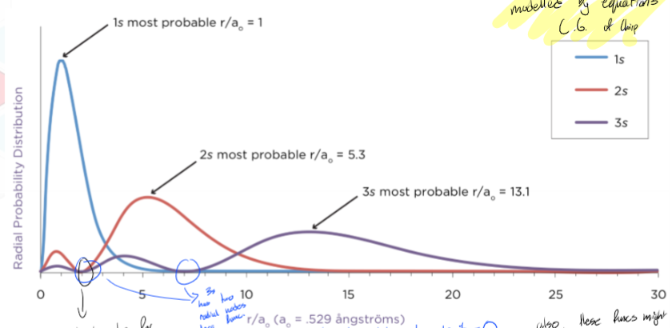
based on these graphs, there are a few trends:
as n increases, the distribution shifts to larger r, and the most probable values of r increases. WHICH MEANS, that increasing shell number means a greater probability of finding the electron further from the nucleus. however, this isnt always true, look at the little peaks.
the number of raidal nodes is n - 1, since there are no angular nodes in s orbitals. we dont count r = 0 as a node just as we didnt count the ends as nodes for wave-in-box. nodes increase as n does too.
the mathematical equations for all the wavefuncs have an exponential function that causes the probability curves to approach 0 exponentially forever. therefore, this means the probability extends to infinity, but the likelihood of finding something infinitely far from the nucleus is effectively zero. note that this doesn’t count as a node either
trends for s orbitals
based on these graphs, there are a few trends:
as n increases, the distribution shifts to larger r, and the most probable values of r increases. WHICH MEANS, that increasing shell number means a greater probability of finding the electron further from the nucleus. however, this isnt always true, look at the little peaks.
the number of raidal nodes is n - 1, since there are no angular nodes in s orbitals. we dont count r = 0 as a node just as we didnt count the ends as nodes for wave-in-box. nodes increase as n does too.
the mathematical equations for all the wavefuncs have an exponential function that causes the probability curves to approach 0 exponentially forever. therefore, this means the probability extends to infinity, but the likelihood of finding something infinitely far from the nucleus is effectively zero. not that this doesn’t count as a node either
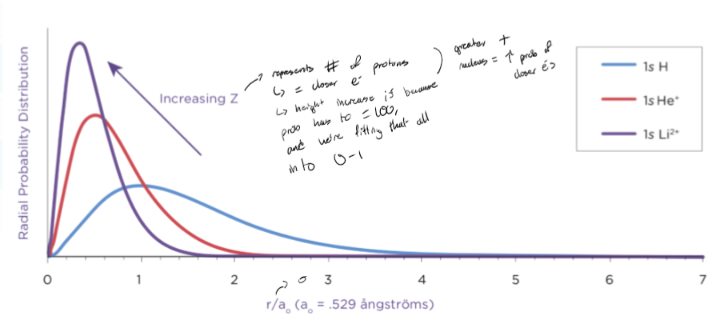
ANGULAR probability graphs for s orbitals, based on different elements
s orbitals are incapable of having angular nodes
note how as Z increases (Z = # of protons i.e. atomic number), the probability decays faster with r. this means that the more protons in the nucleus, the more likely it is to find the electron near it (cuz of the attraction b/w them (coulomb’s law) in s orbitals
note that we draw 90% of this when we draw orbitals
drawing orbitals
to make them graphically, we find the value of r at which the area under the probability distribution curve = 90% of the total.
from there you can make it into a 3D representation of the boundary surface (the outer edge) or a 2D one (a cross-section of the 3D one)
the 2-D ones are capable of showing nodes inside of the shell because its a cross section
how to find # of nodes of an orbital?
the total number is n - 1
then, subtract the ℓ number (based on spdf) (this also represents the number of angular nodes)
and what’s left is the number of radial nodes
how do the planes work for cross-sectional diagrams?
so, the typical x-y cartesian plane we know of becomes the horizontal cardinal directions, and then there’s a new z-axis, which goes through the origin, and is the vertical measurement
so, when we draw the cross-sections of an orbital, we need to slice them right? meaning we cannot make our plane be any of the angular nodes. there’s the drawn planes of xy xz and zy, and you want to be picking the one that best slices the orbital. there’s also x2-y2 and z2 planes (but they’re only available to d orbitals)

p orbitals
there’s three variants of this orbital (px py and pz), all with ℓ = 1, and thus have one angular node. one angular node translates to 3-D drawings with 2 lobes of probability. to imagine this, we’ve just cut the sphere of the s orbitals in half.
the different variants (px py and pz), are all the same orbital, just in different orientations described by the subscript which tells you which axis the lobes are speared by (and therefore the axis that NEEDS to be in your cross section)
the equations of the p orbital
the chirp lists:
Ψ(Px) ∝ xR(r)
Ψ(Py) ∝ yR(r)
Ψ(Pz) ∝ zR(r)
and these just tell you that the wavefunction multiplied by the p-orbital on a specific axis is proportional to the product of a along that axis, and an exponentially decreasing function of the radius, or distance from the nucleus

what kind of orbital is this?
that’s 2px!
notice how the axis that goes through the lobes (and the axis you should use to draw a cross section, is the one they list in the orbital name?)

which orbital is this?
thats 2py!
notice how the axis that goes through the lobes (and the axis you should use to draw a cross section, is the one they list in the orbital name?)

which orbital is this?
thats 2pz!
notice how the axis that goes through the lobes (and the axis you should use to draw a cross section, is the one they list in the orbital name?)
drawing p orbitals!
remember that the name tells you which axis to have them sit on
remember to change phase over nodes, which often also means over axes
and if there’s ever a radial node, just carve out a circle in the middle of the thing,
and remember to make 3px bigger than 2px, because the addition of a radial node will push the electrons a bit farther out
as a general rule for drawing orbitals, what happens when you add radial nodes?
going from a 1s to 2s, or a 2p to 3p adds in a radial node, which means you have to make the whole orbital bigger, because the probability has to go somewhere, and a node means it has to be further out
how do d orbitals work?
there’s five variants of d orbitals (dxy dyz dxz dx2-y2 dz2), and they all have ℓ = 2, which means they have two angular nodes
their equations are barely in the chirp, but would look very similar to the p orbitals, i.e. Ψ(dxy) ∝ xyR(r) Ψ(Px2-y2) ∝ x2-y2R(r). note that this means that each has two angular dependencies. Ψ(dxy) ∝ xyR(r) would = 0 when x or y = 0. note that x = 0 means there’s a nodal plane on yz, and y = 0 means a nodal plane on xz
why do different orbitals have different amounts of possible nodal planes?
because there’s exactly as many nodal planes as there is possible mℓ values, because the amount of mℓ values is how many different orbital there are (remember 2ℓ+1 different orbitals) for that letter, so we need new planes so that we can communicate that this drawing is actually different from the others
d orbitals and their fuckass planes and nodes and all of it
their equations are barely in the chirp, but would look very similar to the p orbitals, i.e. Ψ(dxy) ∝ xyR(r) Ψ(Px2-y2) ∝ x2-y2R(r). note that this means that each has two angular dependencies. Ψ(dxy) ∝ xyR(r) would = 0 when x or y = 0. note that x = 0 means there’s a nodal plane on yz, and y = 0 means a nodal plane on xz
this also applies to Ψ(Px2-y2) ∝ x2-y2R(r), which would have nodal planes where x2 = y2, which, when solved, would contain the planes where y = x and y = -x. plotting these planes on the 3-d graph, we would have diagonal nodes, and the probability lobes would fall on the x and y axes, which they usually do not.
the subscript of an orbital name tells you what key thing for the drawing of its cross-section?
they tell which axes need to be in your diagram.

what orbital is this?
thats 3dxy

what orbital is this?
thats 3dxz

what orbital is this?
thats 3dzy

what orbital is this?
thats 3dx2-y2

what orbital is this?
thats 3dz2
dr. kil showed you a testable question where you could be asked to create a probability distribution graph for an orbital, based on different values. what were those values?
R(r) (just the probabiltity based on radius) (CAN BE NEGATIVE)
4πr2 * R2 (probability func but the graphed one (CANT BE NEGATIVE)
θ
φ
how to plot a probability distribution based on R(r)
its the regular, radius-based probability distribution, and therefore only communicates radial nodes, and the distance at which their at
to graph, imagine a cross-section of the orbital, and then pretend as if you’re slowly moving outwards from the nucleus. at any point where there’s a node, the graph should equal zero, and then cross phase (BUT ONLY R(r) DOES THIS).
note, that the existence of radial nodes means that more of the probability will be pushed further out wards! (i.e. most of the mass should be on the right side of any node)
these graphs should approach zero, but go to infinity
how to plot a probability distribution based on 4πr2 * R2
its exactly like plotting based on R(r), but you can no longer cross phase. node just = 0, and then you remain in the positive half of the graph
these graphs should approach zero, but go to infinity
how to plot a probability distribution based on θ
imagine a 3D model of the orbital, or at least a cross-section, and pick an angular plane (that is not one of the angular nodes). then, circle around the orbital along that plane, and anytime you cross over a node, your graph should change phase
note from reece from the future, that ^^ is prolly a bad way of doing it, and instead, you should start at the tiop of the cross section, and just follow downwards from 0 to π, and cross 0 when you find nodes
these graphs should go from 0 to π
how to plot a probability distribution based on φ
similar to θ graphs, pick an angle, and see how many nodes it crosses. sometimes you wont cross any nodes, so your probability should be constant
these graphs should go from o to 2π

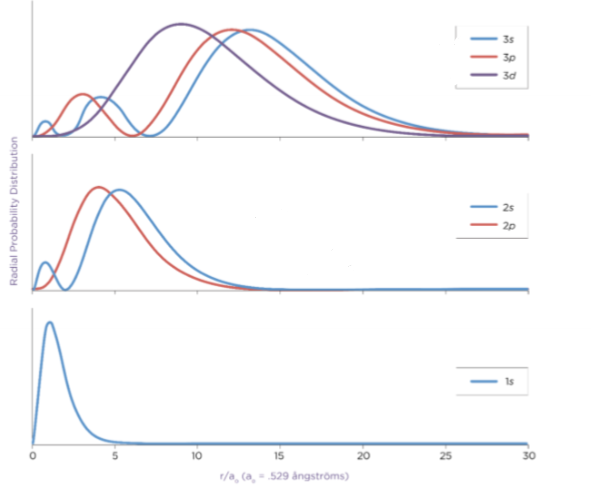
what does this graph mean?
this figure shows the radial probability distributions of orbitals in the n = 1, 2, 3 shells of hydrogen
obviously they differ, but all orbitals with the same n value have similar shapes, and similarly located peaks
in other words, this proves that different subshells (s, p ,d) in different shells (1, 2, 3) have similar behaviours based on their shell, and thus predicts that atoms are layered structures, like onions
as well, that electrons in the highest shells (highest n values) are further from the nucleus because there are more radial nodes and therefore the electrons are farther from the nucleus and easier to be lost to a chemical bond
energy for a wavefunction at a particular n value (of a one electron species)
En = -2.18 × 10⁻¹⁸ J (Z2 / n2)
where,
rydberg constant = -2.18 × 10⁻¹⁸ J
En= energy of shell n
Z = atomic number
n = principal quantum number
we use this to find the energy of a wavefunction for a particular n
what is the rydberg constant?
a fundamental physical constant 2.18 × 10⁻¹⁸ J. we dont really need to know why this exists but it does, and we use it.

what does this graph tell us?
this is a representation of En = -2.18 × 10⁻¹⁸ J (Z2 / n2) for Hydrogen and He+ (both one electron species)
key takeaways:
these values are negative because it represents that the electrons are attracted to the nucleus (attractive forces are represented by - due to coloumbs law), or “stuck in its potential well”.
what the negativity (attraction) means is that if the energy of an electron is 0, it is completely freed from the attraction of a nucleus, and freely floating away (this also means that n = infinity)
(if it were positive it would be repelled form the nucleus (sounds like a proton))
again, the further you are from the nucleus, the easier it is to get the energy you need to be freed and enter a chemical bond
this graph also illustrates degeneracy, because for every n value, it also shows their other subshells, and that they are on the same level vertically, meaning they all have the same energy
because again, the equation depends on the n value, and not ℓ or mℓ
note how the energy levels are closer together as you approach zero. thinking back to the equation, the value of n is on the denominator, and the larger it gets, the closer the En gets to zero
this also means that a higher n actually still makes for a higher energy in a way, because the magnitude is much less, but remember its negative, and therefore a small number means its a higher value than the larger negative En begotten by a small n.
also note how the n levels are further apart for He+, because Z is larger, and therefore can be divided by a larger n before it approaches zero
as well, the n = 7 line being further below zero than the H atom is because He+ may have the same amount of electrons, but because it has more protons, the attractive force the electron has to overcome to be freed (to reach 0) is larger, i.e. there’s a greater distance to zero, and that’s why n = 7 sits lower

what does the negativity of this graph come from and mean?
these values are negative because it represents that the electrons are attracted to the nucleus (attractive forces are represented by - due to coloumbs law), or “stuck in its potential well”.
what the negativity (attraction) means is that if the energy of an electron is 0, it is completely freed from the attraction of a nucleus, and freely floating away (this also means that n = infinity)
(if it were positive it would be repelled form the nucleus (sounds like a proton))
again, the further you are from the nucleus, the easier it is to get the energy you need to be freed and enter a chemical bond
what does the energy of a wavefunction for a particular n (of a one electron species) mean?
En = -2.18 × 10⁻¹⁸ J (Z2 / n2)
because the equation doesn’t involve ℓ or mℓ, this means that there’s no difference in energy between different subshells and orbitals, meaning all orbitals for a specific n value are degenerate
another key fact: En ∝ 1/n2 (which is opposite than particle in a box)

how does this graph illustrate degeneracy?
this graph also illustrates degeneracy, because for every n value, it also shows their other subshells, and that they are on the same level vertically, meaning they all have the same energy
because again, the equation depends on the n value, and not ℓ or mℓ
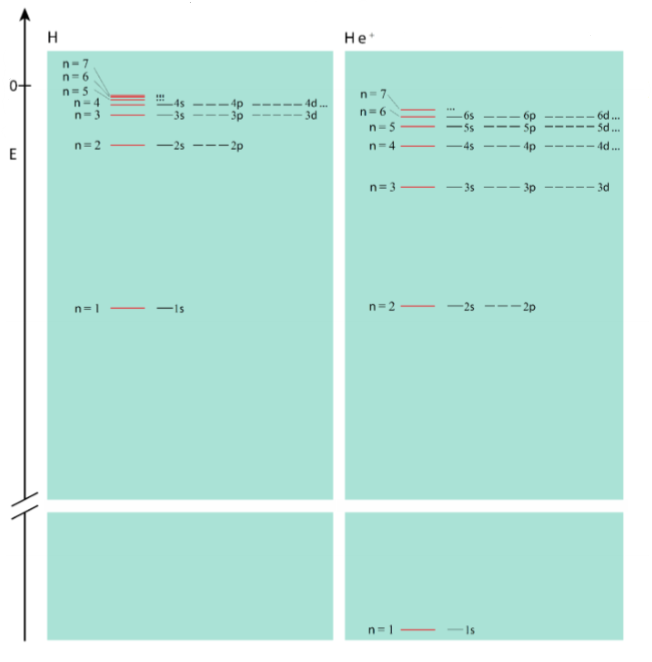
how does this graph illustrate the way the energy of the electron works for a one electron species?
note how the energy levels are closer together as you approach zero. thinking back to the equation, the value of n is on the denominator, and the larger it gets, the closer the En gets to zero
this also means that a higher n actually still makes for a higher energy in a way, because the magnitude is much less, but remember its negative, and therefore a small number means its a higher value than the larger negative En begotten by a small n.

how does the graph illustrate the impact of protons on the electron’s energy?
also note how the n levels are further apart for He+, because Z is larger, and therefore can be divided by a larger n before it approaches zero
as well, the n = 7 line being further below zero than the H atom is because He+ may have the same amount of electrons, but because it has more protons, the attractive force the electron has to overcome to be freed (to reach 0) is larger, i.e. there’s a greater distance to zero, and that’s why n = 7 sits lower
summary
orbital extend to infinity. the surfaces/shapes we draw represent the 90% probability threshold of finding an electron
the energy of an electron in an orbital is negative (due to coulombic attraction). the energy values are quantized and depend on n and z
for a particular one-electron species (fixed Z) an electron in any orbital of the same shell (same n value) will have the same energy. for one electron species, the energy does not depend on ℓ
for a series of one-electron specie, each with their electron in the same shell (same n), the species with the highest charge (higher Z) will have the lowest energy
the ground state (lowest energy configuration) of a one-electron species has the electron in the 1s orbital (recall that 1s indicates n = 1 and ℓ = 0)
the energy spacing between adjacent shells decreases as n increases
it is possible to excite (promote) the electron in a one-electron species to higher energy orbitals. these are called “excited states“
ionizing (removing an electron means promoting it to n = infinity. the energy of n = infinity is zero (Einf = 0)