Module 6.1 Microbial Growth
 Call Kai
 Learn
 Practice Test
 Spaced Repetition
 Match
 Flashcards
 Knowt Play
1/59

There's no tags or description
Looks like no tags are added yet.
60 Terms
Define macronutrient and provide examples
Needed in large amounts to provide energy & build physical structures
ex → carbohydrates, proteins, lipids, water
Define micronutrients and provide examples
Needed in small/trace amounts to support metabolism, immunity, & enzyme function (cofactors)
ex → vitamins, minerals (fe, ca, k, mg, zn)
Define phototroph (energy source)
Energy from light (photosynthesis)
Define chemotroph (energy source)
Energy from chemical compounds
Define autotroph (carbon source)
Uses inorganic CO2 as carbon source (can use CO2 to build organic molecules)
Define heterotroph (carbon source)
Requires organic carbon
Define Photoautotroph with regard to carbon and energy sources
Use light for energy to make sugar from CO2 (have chloroplasts like plants)
ex → cyanobacteria: microcoleus chthonoplastes
Define Chemoautotroph with regard to carbon and energy sources
Use chemicals for energy and inorganic CO2 as a carbon source
ex → methanogens: methanobrevibacter intestini
Define Photoheterotroph with regard to carbon and energy sources
Use light for energy and organic compounds as carbon sources
ex → purple photosynthetic bacteria: rhodospirillum rubrum
Define Chemoheterotroph with regard to carbon and energy sources
Use chemicals for energy and organic compounds as carbon sources (cellular resp & fermentation)
ex → staphylococcus aureus
Saprobe
Chemoheterotroph
Feeds on organic material from dead organisms
ex → decomposers - fungi
Parasite
Chemoheterotrophs
Feed on cells or tissues form living organisms; cause harm to host!
Can be viruses, bacteria, fungi, protozoa, or helminths
Ectoparasites – live on host
Endoparasites – live in host
Obligate parasites – unable to reproduce outside of a living host
ex → Mycobacterium leprae (leprosy bacillus)
Which gas is important for autotroph metabolism?
CO2
Which gas is important for aerobic respiration?
O2 (potentially toxic oxidizing agent)
Why is oxygen toxic to some organisms?
Can be converted into reactive oxygen species (ROS) that can oxidize macromolecules
Reactive Oxygen Species (ROS)
Can damage DNA, RNA, lipids, amino acids, coenzymes, etc
Singlet oxygen (O) extremely reactive
Superoxide ion (O2-) highly reactive
Hydrogen peroxide (H2O2) – toxic to cells
Hydroxyl radical (OH-) – highly reactive
Oxidation
Loss of electrons, hydrogen, & gain of oxygen
Obligate aerobe
Require O2 & can detoxify ROS with enzymes, produce ATP thru aerobic cellular resp.
ex → Mycobacterium tuberculosis & Bacillus
Microaerophile
Requires a small amount of O2 but harmed by levels in atmosphere, lives in soil or animal host, may perform aerobic cellular resp or fermentation
ex → Helicobacter pylori
Facultative anaerobe
Can use O2 when present, but doesn’t need it
Produce ATP thru aerobic cellular resp (when O2 available) & anaerobic respiration/fermentation if O2 not present
ex → E.coli, staphylococcus, salmonella, listeria
Aerotolerant anaerobe
Doesn’t use O2 but can survive around it, can detoxify oxygen species
ex → lactobacillus
Obligate anaerobe
Can’t use O2 & detoxify ROS, lack enzyme to detoxify and use oxygen
ex → many oral & intestinal bacteria
Lab connection: What does the catalase test tell you about an organism?
Determines whether organisms has enzyme catalase which detoxifies H2O2

A - Identify the growth pattern for obligate aerobes, obligate anaerobes, facultative anaerobes, microaerophiles, and aerotolerant anaerobes in the image below. (Growth in thioglycolate media (FTM))
Obligate aerobes
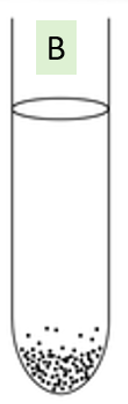
B - Identify the growth pattern for obligate aerobes, obligate anaerobes, facultative anaerobes, microaerophiles, and aerotolerant anaerobes in the image below. (Growth in thioglycolate media (FTM))
Obligate anaerobes

C - Identify the growth pattern for obligate aerobes, obligate anaerobes, facultative anaerobes, microaerophiles, and aerotolerant anaerobes in the image below. (Growth in thioglycolate media (FTM))
Facultative anaerobics
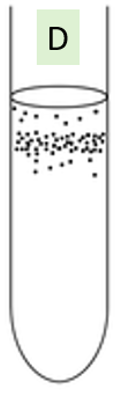
D - Identify the growth pattern for obligate aerobes, obligate anaerobes, facultative anaerobes, microaerophiles, and aerotolerant anaerobes in the image below. (Growth in thioglycolate media (FTM))
Microaerophiles

E - Identify the growth pattern for obligate aerobes, obligate anaerobes, facultative anaerobes, microaerophiles, and aerotolerant anaerobes in the image below. (Growth in thioglycolate media (FTM))
Aerotolerant anaerobes
Why is temperature an important parameter for microbial growth?
Minimum growth temperature – lowest temperature at which a given species will grow, below → too cold = metabolism stops/slows
Maximum growth temperature – highest temperature at which a given species will grow, above → too hot = proteins denature and the organism dies
Optimum temperature range = temp at which a given species grows the best/fastest
Define Psychrophile with regard to growth optimum temperature range
Cold-loving
Optimum temp < 15°C
No growth > 20°C
Grow freely in refrigerator (4°C)
Rarely pathogenic, will denature if temp is high
Define Psychrotroph with regard to growth optimum temperature range
Cold tolerant
Optimum temp 15-30°C
Slow growth in low temps
Some can cause food-borne illness
ex → Listeria monocytogenes - grows rapidly at refrigeration temps
Listeriosis
Psychotroph
Top 3 causes Food-borne illness/related deaths
Symptoms: fever, muscle aches, GI symptoms, sepsis (invasive infection)
Elderly and immunocompromised present with septicemia and meningitis
Pregnant women may experience a fever and other non-specific symptoms, such as fatigue and aches, followed by fetal loss or bacteremia and meningitis in their newborns
Mesophiles
Moderate-loving
Optimum temp range 20 - 40°C
Human pathogens opt temp 30-40°C
Medically significant
Inhabit animals, plants, soils, water
Can survive in temperate, tropical, subtropical regions
ex → Staphylococcus aureus
Thermophiles
Heat-loving
Optimum temp 45°C - 80°C, most euk cant survive above 60°c
Found in soil & water w/ volcanic activity, hot springs, compost piles, direct sun exposure
ex → Thermus aquaticus
Hyperthermophiles
aka extreme thermophiles
Optimum 80 - 121°C – Some can survive boiling water!
ex → archaeon Geogemma barossii which can survive up to 2 hours as 130°C
Why are many human pathogens mesophiles?
They thrive at human’s optimum temp of 37°C and a pH around 7.4 (human optimum pH)
What is an acidophile?
Organism that grows best in acidic environments (low pH)
What is the optimum pH range for acidophiles?
Usually pH 0–5.5
What is a neutrophile?
An organism that grows best at a neutral pH.
What is the optimum pH range for neutrophiles?
Approximately pH 5.5-8.0
Whats an example of a neutrohphilic bacterium
E.coli
What is an alkaliphile?
An organism that grows best in alkaline (basic) environments.
What is the optimum pH range for alkaliphiles?
Approximately pH of 8.5-11.5
Give an example of an alkaliphilic bacterium.
Bacillus alcalophilus
Which pH-loving organisms are most likely to be human pathogens?
Neutrophiles, because they grow best at the pH found inside the human body. (pH of 7.0-7.4)
Why are acids sometimes added to food as preservatives?
To lower the pH and inhibit microbial growth, preventing food spoilage and extending shelf life.
Define osmosis
Water moves from high water (low solute) to low water (high solute) concentration
Define tonicity
Ability of a surrounding solution to cause a cell to gain or lose water
Describes concentration of solutes (although water is moving)

Define isotonic
Same solute concentration
1% sol out/in, 99% water out/in
water moves back in forth equally = dynamic equilibrium
ex → humans

Define hypotonic
Lower solute concentration
1% sol in, 99% water in (goes out) → 10% sol out, 90% out
Swell & burst = lysis

Define hypertonic
Higher solute concentration
1% water in, 99% sol in →
Shrink & crinkle = crenation
Define osmotic pressure
External pressure that must be applied to stop inward flow of water across a semipermeable membrane
What are osmophiles?
Can survive in environments with high osmotic pressure (solute concentrations)
many are yeasts
protect themselves against dehydration by synthesizing compatible solutes or osmoprotectants (like specific amino acids & alcohols)
can cause spoilage of sugar foods/drinks
ex → some saccharomyces species
What are halophiles?
Organisms that grow at high salt concentrations
What are obligate halophiles?
Require high salt concentrations to survive
What are facultative halophiles? Provide an example
Can tolerate salt concentrations higher than normal (sometimes up to 10-15%)
ex → S. aureus
Why is mannitol salt agar (MSA) differential?
Contains sugar mannitol and pH indicator phenol red
organisms ferments mannitol & produces an acid = lowers pH & changes red/pink to yellow
Why is mannitol salt agar (MSA) selective?
Contains 7.5% NaCl which stops growth of most Gram-negative bacteria & nonstaphylococcal organisms, but allows salt-tolerant staphylococcal species to grow
What species do we use MSA to identify in lab?
S.aureus
What are barophiles?
Organisms that can survive in high pressure environments like deep ocean
evolved waxy cell layer = protects against crushing pressures & frigid temps
explode under normal atm conditions
ex → barophile Halomonas salaria