12-Leads & ACS
 Call Kai
 Learn
 Practice Test
 Spaced Repetition
 Match
 Flashcards
 Knowt Play
1/65

Earn XP
Description and Tags
Last one Twin Good Luck
66 Terms
Acute Coronary Syndrome ACS
Condition where bld flow to myocardium is suddenly decreased due to a blockage in the Coronary Artery
Acute Myocardial Infarction
Early critical stage of heart muscle necrosis
Caused by coronary artery blockage
STEMI
S-T Segment Elevation Myocardial Infarction
Non-STEMI
Non-ST Elevation MI
Still a heart attack
Bld work can confirm
Re-perfusion Therapy
Reopening blocked CA to restore bld flow to myocardium
Two types of Re-perfusion Therapy
Administration of Thrombolytics = Fibrinoytics
Mechanical reperfusion (PCI)
Fibrinolytics
Break down clots
Inhibit Platelet Aggregation/Fibrin accumulation + binding
Anti-platelet therapy usually also needed
Percutaneous Coronary Intervention (PCI)
Balloon Angioplasty
Stent put in CA
AMI Mortality
Approx. 30-50%
5% of STEMI Pt experience OHCA + have 10x mortality rate
30 day mortality following PCI is 2.3%
AMI Modifiable Risk Factors
Diabetes
Alcohol use
Smoking
Excersise Lvl
Social Hx
Hyperlipidemia
HTN
AMI Non-Modifiable Risk Factors
Older Age
Male
Family Hx of CAD
Pre-hospital Management of ACS
ASA
12-Lead + 15 lead
Nitro
PADS ON
ASA
Platelet Aggregate Inhibitor
Inhibits the COX-1 pathway reducing Thrombone A2
prevents thrombus from getting bigger/new clots forming
Nitro
Nitrate vasodialator
(-) Afterload via vasodilation of peripheral bld vessels
(-) Preload via (-) venous return
Overall decreases workload on Heart + O2 demand
In Hospital Management of ACS
Reperfusion Therapy
Fibrinolytics
PCI
Identifying RVMI
Perform 15 lead if:
Elevation in Leads I, III, aVF
Depression in Leads V1-V3
Must be done prior to Nitro Admin to rule out RVMI
Rescue PCI
Pt goes to PCI lab after fibrinolysis failure
Primary PCI
Pt goes straight to PCI lab = No fibrinolysis
STEMI Bypass Indications
18 yr
Pg is experiencing Chest pain = to cardiac ischemia
Onset of pain is < 12hrs
12 lead indicates STEMI + Paramedic agrees
STEMI Bypass Contraindications (Consider Patching still)
CTAS 1/unable to secure airway
12 lead indicates LBBB or STEMI mimic
PCI is > 60mins away
mod/severe respiratory distress + use of CPAP
Hemodynamically Unstable/SBP <90
VSA w no ROSC
PCI Process
Percutaneous Access either in leg or arm
Guiding catheter to CA
Coronary guide wire is placed across blockage
Angioplasty Catheter is pushed forward into blockage
Balloon is inflated inside block compressing plaque
Mesh Stent is put in to prevent future collapse
Drug-Eluting Stent
Alternative PCI Stent
Slowly releases drug to block cell proliferation
Prevent scar tissue like growth
STEMI Management Trends
STEMI Bypass was added to the BLSPCS in 2017
Allows early Identification of STEMI Pt’s to transport to PCI hospitals
Decreases in door to needle times
Improved outcomes and decreased mortality
3-Lead ECG Function
Determine Rate, Rhythm, and ECG interpretation
3-lead ECG Pros
Reduced artifact
non-invasive
fast to acquire than 12-lead
3-lead Cons
Cannot be used for 1st analysis
QRS/Ts are not always accurate
12-Lead Function
Diagnostic Quality ECG
12-lead Pros
Accurate representation if QRS/T waveforms
Higher Diagnostic Quality
12-lead Cons
More susceptible to artifact- Pt. must remain still
no 6 second strip (more difficult to interpret rhythm)
Importance of pre-hospital 12-lead
Track and recognize ECG changes
Identification of conditions other than STEMI
EMS Treatments may alter the ECG Changes
Importance of Proper lead placemet
Ensures accurate interpretation of findings
Minimizes false STEMI positives/negatives
Identification of elevation vs depression in specific heart areas
V1 placement
4th intercostal space to the right of the sternum
V2 placement
4th left intercostal space to the left of the sternum
V4 placement
5th intercostal mid-clavicular line
V6 placement
5th intercostal space midaxilary line
V3 placement
Between V2/V4
V5 placement
Between V4/V6
V4R Placement (prev V4)
5th intercostal space, R. midclavicular line
V8 placement (prev V5)
5th intercostal space, midscapular line
V9 placement (prev V6)
5th intercostal space, between V8 and spine
Methods to ensure proper lead placement
Check Physical ECG cables
Review expected QRS morphologies
Lead I + Lead III = Lead II
If PQRST in lead II is negative = wrong
aVR is must be the only fully negative QRS in the bipolar augmented leads
Positive Deflected leads
Lead I
Lead II
Lead III
aVL
aVF
V5
V6
Negative Deflected Leads
aVR
V1
V2
Isoelectric (positive/negative) leads
V3
V4
Contiguous Leads
Leads that look at the same area of the heart or anatomically adjacent areas
Inferior Leads
Lead II, Lead III, aVF
Septal Leads
V1 and V2
Anterior Leads
V3 and V4
Lateral Leads
Lead I, aVL, V5, V6
Posterior Leads
V8 and V9
Myocardial Ischemia ECG Findings
ST Depression or T-wave inversion
Subendocardial injury due to changes in depolarization and repolarization
Caused by lack of O2 to the endocardium
Permanent damage can be avoided
Myocardial Injury ECG Findings
ST ELEVATION
Transmural ishcemia
Caused by prolonged ischemia
Permanent damage can be avoided
Myocardial Infarction/necrosis ECG Findings
Possible “pathological” Q waves = death of myocardial tissue
Irreversible damage
Hyperkalaemia ECG Findings
Peaked T-waves
P wave flattening
PR prolongation
Wide QRS complex
Hypokalemia ECG Findings
T-wave inversion
ST depression
Prominent U wave
Pericarditis ECG Findings
PR elevation in aVR
Concave up ST elevations
PR depressions
When to acquire a 15 lead
Pt shows Inferior STEMI = ST elevation in Leads II, III, and aVR
Reciprocal ST depression in 2/3 leads V1-V3
Significance of a new onset of a LBBB
Increased AMI risk
Increased Risk of Arrhythmias
Computerized ECG Interpretation
Should not be sole STEMI confirmation since computer has high false-neg/pos rates
Should be used in conjunction with medic interpretation

Left Bundle Branch Block LBBB
Bunny Ears
Negative deflection V1
Present with ST elevation due to changes in depolarization

Right Bundle Branch Block
Bunny ears
Positive deflection
Indicated for STEMI Bypass
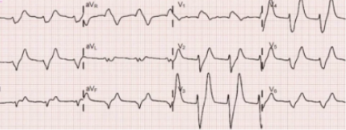
Hyperkalemia

Hypokalemia
LAD Leads
Anterior
Septal
RCA Leads
Inferior
Posterior (depending on dominance)
Circumflex
Lateral
Posterior (depending on dominance)