Pedigree/Product Rule/ChiSquare Test/Weird Genetics
 Call Kai
 Learn
 Practice Test
 Spaced Repetition
 Match
 Flashcards
 Knowt Play
1/31

There's no tags or description
Looks like no tags are added yet.
32 Terms
Pedigree Analysis
commonly used tool to determine inheritance patterns of human diseases

Recessive pattern
2 normal heterozygous individuals= 25% of offspring affected. 2 affected individuals will produce 100% affected offspring
Dominant
Affected individual will have inheritated the gene from at least 1 affected parent
Inheritance patterns in pedigrees
Autosomal recessive
Autosomal dominant
X-linked recessive
X-linked dominant
Autosomal recessive
Affected offspring will have two unaffected parents, two affected individuals have 100% affected children, trait occurs w/same frequency in both sexes, two unaffected heterozygotes= 25% affected children

Autosomal Dominant features
Affected offspring has 1 or both affected parents (can be altered by reduced penetrance) Affected individual w/ only one affected parent is expected to produce 50% affected offspring, two affected heterozygotes=25% unaffected offspring, trait occurs w/same frequence in both sexes

X-linked recessive
males more likely to exhibit the trait, mothers of affected males often have brothers or fathers who are affected, daughters of affected males will produce 50% affected sons

X-linked dominant
Doesn’t skip generations, males more likely to be affected, affected mothers 50% chance of passing the trait to daughters

Product rule
“and” order given, multiply the probabilities together
Binomial Expansion Equation
represents all of the possibilites for a given set of unordered events, n=total # of events, x= # of events in one category, p=individual probability of x q=individual probability of the other category

Chi square test
Used to see if observed data fits the expected data, if p-value is <0.05 the observed+expected data differ, O=observed data E=expected data

Simple mendelian inheritance
Single gene w/2 different alleles, alleles display a simple dom/rec relationship
Incomplete Penetrance
Dominant allele doesn’t influence the outcome of a trait in a heterozygote individual, in some cases, individuals carry the cominant allel but do not exhibit the trait

Expressivity
Degree to which a trait is expressed ex. polydactyly (high expression or low expression)

Environmental Effects on Gene expression
impact phenotype, temperature sensitive alleles
Wild-type allele
standard, most frequently occurring version of a gene found in a natural population of organisms
Genetic polymorphism
the presence of two or more variant forms of a specific DNA sequence or trait in a population, where the least common allele occurs at a frequency of at least 1%
Norm of reaction
the pattern or range of phenotypic expressions that a single genotype can produce across a continuous or discrete range of environments
Incomplete dominance
The heterozygote exhibits a phenotype that is intermediate between the corresponding homozygotes ex. pink phenotype after cross of red and white flowers
Codominance
Many genes have multiple alleles, ex ABO blood typing, Alleles IA IB are codominant
Type A genotype
IAIA or IAi
Type B genotype
IBIB or IBi
Type O blood type
ii
Type AB blood type
IAIB
X-linked genes
Certain traits are governed by genes on the sex chromosomes, a pedigree for x-linked diseases show that it is mosly males that are affected w/ their mothers as carriers
Lethal Alleles
Potential to cause the death of an organism, may produce ratios that seemingly deviate from Mendelian ratios (2/3 or 1/3)
Pleiotropy
genes have multiple effects, multiple effects of a single gene on the phenotype is pleiotropy ex. cystic fibrosis effects multiple organ groups
Gene interactions
two or more genes influence outcome of a single trait, ex epistasis
Epistasis
one gene masks phenotypic effects of alleles of another gene, ex. yellow labs ee gene masks the allel at 1st locus
Complementation
production of offspring with a wild type phenotype from parents that both display the same/similar recessive phenotype

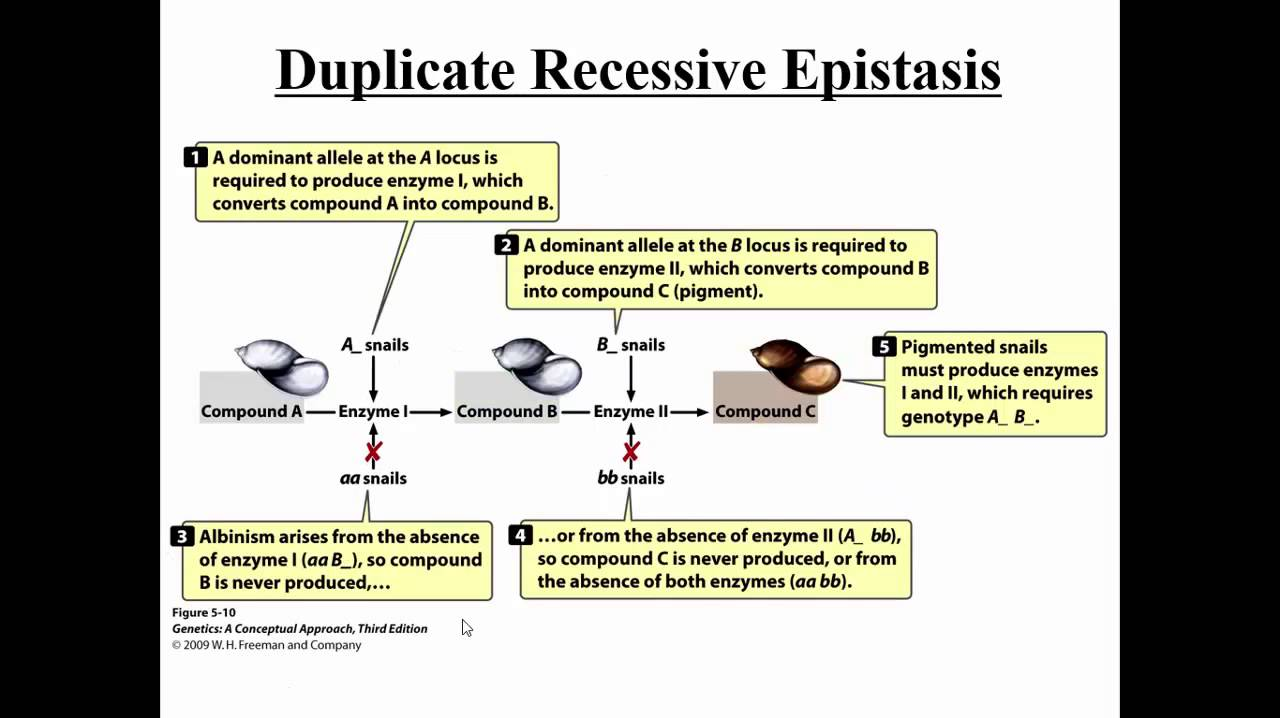
Double recessive epistasis
9:7 two genes in recessive copies that produce mutant phenotype
Molecular mechanism for double recessive epistasis