Chapter 1: Navigating the Body
 Call Kai
 Learn
 Practice Test
 Spaced Repetition
 Match
 Flashcards
 Knowt Play
1/57

There's no tags or description
Looks like no tags are added yet.
58 Terms
What is the anatomical position?
Facing forward, palms facing forward

What is the purpose of the anatomical position?
to create a map of the body for clear communiction
What are planes of movement?
3 imaginary planes that help clarify and specify movements

What is the sagittal plane?
a vertical plane that divides the body into right and left parts

What is the frontal (or coronal) plane?
a vertical plane that divides the body into anterior and posterior parts
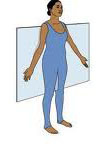
What is the transverse plane?
divides the body into superior and inferior parts

What is the midsagittal plane?
a vertical plane dividing the body into equal left and right halves

The action of flexion and extension happens along which plane?
Sagittal plane

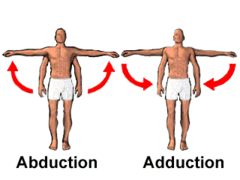
The action of abduction and adduction occur along which plane?
Frontal (or coronal) plane
The action of rotation happens along which plane?
Transverse plane

Superior
refers to a structure closer to the head
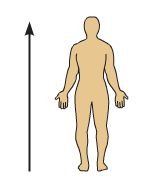
Inferior
closer to the feet

Cranial
closer to the head (in reference to structures on the trunk)
ex. the clavicles are cranial to the umbilicus

Caudal
closer to the buttocks (in reference to structures on the trunk)
ex. the umbilicus is caudal to the clavicles

Posterior (dorsal)
toward the back of the body

Anterior (ventral)
toward the front of the body
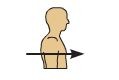
Medial
toward the midline of the body
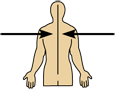
Lateral
away from the midline of the body

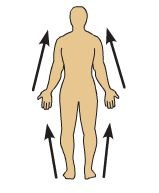
Distal
farther from the trunk or the midline of the body
only used when referring to the arms and legs

Proximal
Closer to the trunk of the body
only used when referring to the arms and legs
Superficial
nearer to the surface of the body
Deep
away from the surface of the body
Extension
a movement that straightens or opens a joint

Hyperextension
when a joint extends beyond its normal range of motion

Flexion
a movement that bends a joint or brings the bones closer together

Adduction
a movement toward the midline of the body
"add"ing to the body
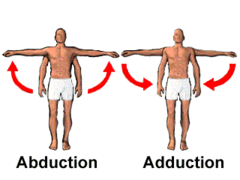
Abduction
A movement away from the midline of the body
abduct or carry away

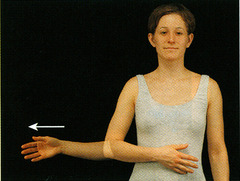
Medial rotation
when a limb turns in towards the midline
occurs at the shoulders and hip joints

Lateral rotation
when a limb turns away from the midline
occurs at the shoulders and hip joints
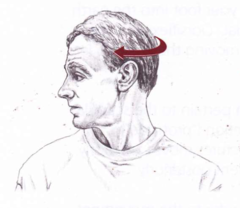
Rotation
pertains only to the axial skeleton, specifically the head and vertebral column
these movements happen along the transverse plane
Circumduction
involves a combination of flexion, extension, adduction and abduction; together these actions form a cone-shaped movement
occurs at the shoulder and hip joints

Lateral flexion
occurs only at the axial skeleton
ex. when the neck or vertebral column bends laterally to the side

Elevation
movement of the scapula or jaw superiorly

Depression
movement of the scapula or jaw inferiorly

Supination
occurs when the radius and ulna lie parallel to one another
"carrying a bowl of soup"

Pronation
takes place when the radius crosses over the ulna, turning the palm down
"prone to spill it"

Inversion
elevation of the foot's medial side that brings the sole of the foot medially
"turn in"

Eversion
elevation of the foot's lateral side and moves the sole laterally
"turn out"

Plantar flexion
movement of the ankle - pointing your foot downwards or into the earth.

Dorsiflexion
movement of the ankle - bringing your toes upwards towards your ankle

Protraction
occurs when a structure moves forward (or anteriorly)
pertains to the scapula, clavicle, head or jaw

Retraction
occurs when a structure moves backwards towards the spine (or posteriorly)
pertains to the scapula, clavicle, head or jaw

Deviation
means to wander from the usual course
lateral deviation occurs at the mandible during talking or chewing

Opposition
movement of the carpometacarpal joint of the thumb to touch tips of the other fingers

Supine
lying on the back, facing up

Prone
lying face down

Axial skeleton
part of the skeletal system that consists of the cranium, vertebral column, ribs, sternum and hyoid bone

Appendicular skeleton
part of the skeletal system composed of the arms and legs, pectoral girdle and pelvic girdle

What is a joint?
the point of contact between bones. it's structure determines its function
What are the 3 types of joints?
fibrous, cartilaginous, synovial
What type of joint contains a joint cavity that allows for movement?
Synovial joint
What are the 6 types of synovial joints?
ball and socket, ellipsoid, hinge, saddle, gliding, pivot

Ball and socket joint
this joint can move on all planes
ex. shoulder

Ellipsoid joint
permits flexion/extension and abduction/adduction
ex. wrist

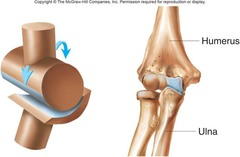
Hinge joint
only allows for flexion and extension like a door
ex. elbow
Saddle joint
modified ellipsoid joint that is shaped much like a saddle
ex. joint between trapezium and first metacarpal bone

Gliding joint
ususally between 2 flat surfaces and allows for the least amount of movement
ex. carpal bones in wrist or tarsal bones in foot

Pivot joint
allows one bone to rotate around the surface of another bone
ex. ulna and radius
