CH3H1 Analytical Science for Global Challenges
 Call Kai
 Learn
 Practice Test
 Spaced Repetition
 Match
 Flashcards
 Knowt Play
1/103

There's no tags or description
Looks like no tags are added yet.
104 Terms
what is precision and how is it described
gives you an idea of how reproducible a measurement is but it is limited by the random error
described using standard deviation
what is accuracy and how is it described
.gives an idea of how close to the true value a measurement is but is limited by the systematic error
described using the absolute or relative error
what is the mean and pros/cons
sum of values divided by the number of values
unbiased estimate of the mean value
can be skewed by significant outliers
what is the median and pros/cons
middle value of a data set
less biased by outliers
what is the mode and pros/cons
most common value
applicable to discrete finite measurement values
can be misleading
why is it good to take a large number of measurements in an experiment
larger the number, the closer the properties of the measurements will be to the true values
draw a positively skewed distribution

how much is within ± 2σ of the mean
~ 95%
what can cause errors in correlation
selection effects - if the experiment or observation is less sensitive to some combinations of parameters than others
e.g. if an instrument cannot detect anything beyond a certain point
a few outliers
a third variable
e.g. worldwide non-commercial space launches correlates to sociology doctorates awarded but they are actually linked by the economy
what are residuals
the differences between the y values and those predicted by the model
what does the coefficient of determination measure
how much of the variance in the measurements is explained by the fit to the data
why should you not use too many orders in a curve to fit data
you always get a better fit but overfitting the data means you also fit to random fluctuations in the measurements
what is the limit of detection
lowest value you can detect over noise
what is limit of quantification
lowest value you can quantify with certainty
what is limit of linearity
the value where the graph stops being linear
what happens when molecules in a sample interact with the stationary phase
the molecules rate of movement slows down
why do you get different distribution coefficients/different net rates of migration
each molecule interacts differently with mobile phase and stationary phase
what are the 4 types of chromatography
adsorption chromatography
ion-exchange chromatography
partition chromatography
size-exclusion chromatography
what type of molecule uses adsorption chromatography
polar groups
things dissolved in organic solvents
what type of molecule uses partition chromatography
things in polar solvents
what type of molecule uses size-exclusion chromatography
molecules with large size differences
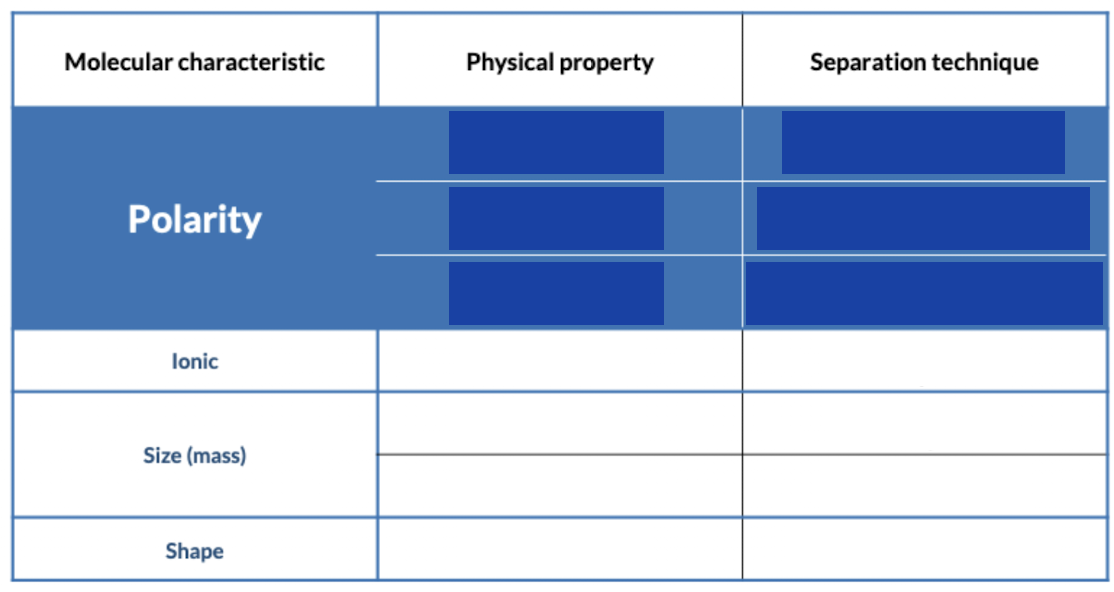
fill in table

what does it mean if stationary phase support is planar in chromatography
when the stationary phase is supported on a flat plate or in pores of paper. mobile phase moves through Stationary phase by capillary action, gravity or electrostatic forces
what does it mean if stationary phase support is a column in chromatography
stationary phase held in a tube and mobile phase pushed through using gravity or pressure
what is normal phase in chromatography
classic form of liquid chromatography using polar stationary phases and non-polar mobile phases
the analyte is retained by the interaction of its polar functional groups with the polar groups on the surface of the stationary phase
what is reversed phase in chromatography
the stationary phase is non-polar and the mobile phase is polar
the analyses are attracted to the surface by their non-polar functional groups
what order do analytes elute from normal phase chromatography
starts with the least polar compound followed by other compounds in order of their increasing polarity
in what order do these compounds elute from a normal phase chromotogram:
alcohol
carboxylic acid
ketone
ketone
alcohol
carboxylic acid
what order do analytes elute from reversed phase chromatography
most polar analyte elutes first followed by other analytes in order of decreasing polarity
why is reversed phase chromatography common
its compatible with aqueous solutions
describe HPLC machine
sample is introduced into the mobile phase under high pressure
stationary phase is packed in a stainless steel column
injection port prevents system from depressurising
column is kept in an oven to keep temperature constant
detector can be UV / IR / refractive index

what are the 2 types of mobile phase possible for HPLC
isocratic elution: single or mixture of solvents remains constant
gradient: 2 or more solvents, ratios vary during analysis
what is isocratic elution
single or mixture of solvents remains constant
what does it mean when a mobile phase is gradient
2 or more solvents, ratios vary during analysis
what are HPLC modes of separation
most common is reverse phase (partition)
can also be adsorption, ion exchange, affinity
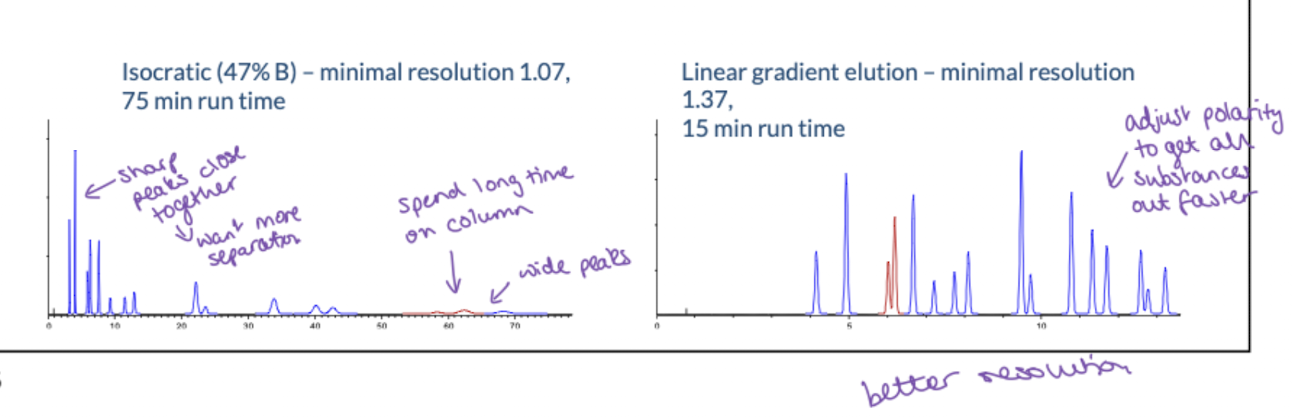
why would you use gradient elution as a mobile phase
allows mixtures with a wide range of hydrophobicity/polarity to be separated in one analysis
can reduce run time and resolution
how is a gaseous analyte transported in gas chromatography
through a capillary column by a gaseous mobile phase, called the carrier gas
when do you use gas chromatography
to separate volatiles
gases
small organic molecules (bp usually < 300°C)
trace analysis
analysis of very complex mixtures
draw a typical gas chromatography instrument

what is the stationary phase in gas-liquid partition chromatography
a non-volatile liquid coated on the inside of the column or on a fine solid support

what is the theoretical plate model
it supposes that the chromatographic column contains a large number of separate layers, called theoretical plates
separate equilibrations of the sample between the stationary and mobile phase occur in these “plates”
the analyte moves down the column by transfer of equilibrated mobile phase from one plate to the next

what are the assumptions in the theoretical plate model
chromatographic column is treated as a static system in equilibrium
each species is in equilibrium between stationary and mobile phase
column is of fixed length
flow is held constant
what does the plate model describe
the mechanism of retention and gives an equation allowing calculation of the retention times of a solute and the column efficiency
what does the plate theory ignore
diffusion
how do you get better separation on the column with the plate model
more plates to give more equilibrium steps
what are the 2 ways the theoretical plate model serve as a way of measuring column efficiency
stating the number of theoretical plates in a column (N)
the more plates the better
stating the plate height H
the height equivalent to a theoretical plate
the smaller the better
what are the 2 things in the theoretical plate model that would make columns more efficient
more plates
smaller height of plates
what is the equation HETP = L/N for?
HETP = height equivalent to a theoretical plate
L = length of column
N = number of theoretical plates in a column
what is this equation for: N = (5.54tR2) / w1/22 = 16tR2 / wb2
w1/2 = peak width at half height
N = number of theoretical plates in a column
tR = retention time of the analyte
wb = peak width at base

how do different solutes in a mixture behave in column in theoretical plate model
as if they have different numbers of plates

which of these columns has high N and which has high H
top one has high N (number of theoretical plates) and low H (plate height)
bottom one has low N and high H
definition of plate height (theoretical plate model)
length of column required for each MP/SP equilibrium to be established
what is retention volume, VR (in theoretical plate model)
volume of mobile phase required to elute a solute
what is retention time, tR (in theoretical plate model)
time required to elute a solute
what is t0 (in theoretical plate model)
time for solvent or non-retained solute to elute
what is k (in theoretical plate model)
capacity factor (partition ratio or retention factor)
draw a basic chromatography spectrum and label tR, t0 and t’R
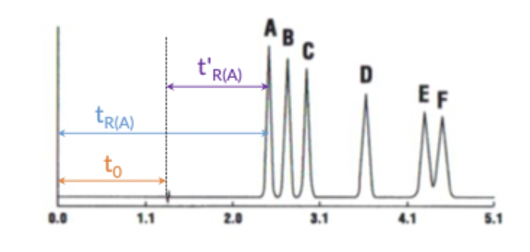
what is this equation used for: u = L / t0
u = mobile phase velocity (cm s-1)
L = column length (cm)
t0 = time for solvent or non-retained solute to elute (s)
what is this equation used for: kA = (tR(A) - t0) / t0
calculating the capacity factor
what is the ideal value of k, capacity factor (theoretical plate model)
ideal is between 1 and 5
large number means there’s a long run time
what is k (capacity factor in theoretical plate model) independent of
column dimension and mobile-phase velocity
what is the distribution constant, KC (theoretical plate model)
the ratio of solute concentrations in stationary and mobile phase
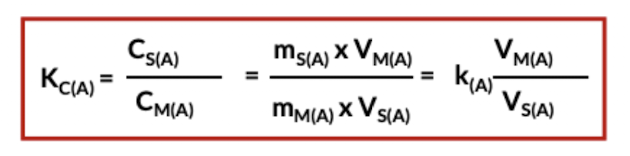
what does this equation do
allow you to calculate the distribution constant
what does the separation factor, ⍺, describe (theoretical plate model)
the selectivity of the chromatographic system for a particular pair of bands
the ability of a certain set of experimental conditions to discriminate between 2 components
how do you calculate the separation factor (theoretical plate model)
⍺ = kB / kA
what is the best way to compare how well a compound is retained on 2 different columns and why
capacity factor as it is independent of column size
what is resolution (chromatography)
the degree of separation of 2 adjacent bands

what does this equation tell you
allows you to calculate resolution based on retention times (tR) and either base width or half height width
what is a good Rs value (chromatography)
R of 1.5 gives > 99% separation
what do high values of Rs compensate for (chromatography)
increased band broadening
column ageing
small variations in conditions
how do you have to change the column length if you want to double the resolution
quadruple the column length

what is this equation for
calculating resolution
N = average column plate number for the 2 bands of interest
k = average capacity factor
⍺ = separation factor of 2 peaks
what are k, ⍺ and N controlled by
k, ⍺ = changing the column packing and by varying the composition of the mobile phase solvent
N = changing the mobile phase flow rate, packing particle size and column dimensions
what are the 5 limits of the plate model
assumption that equilibrium is instantaneous
flow rate is not accounted for
plates don’t reflect the efficiency accurately
no other physical processes accounted for other than adsorption
plates are imaginary
what are the different peak dispersion processes proposed (as a development of plate theory)
eddy diffusion
longitudinal diffusion
resistance to mass transfer in the mobile phase
resistance to mass transfer in the stationary phase

what does this equation do
the van Deemter equation - predicts a minimum plate height at an optimum velocity and maximum efficiency
A = random movement through stationary phase (eddy diffusion)
B = diffusion in mobile phase (longitudinal diffusion)
C = interaction with stationary phase
H = plate height
u = average linear velocity
draw a typical Van Deemter plot

what does a Van Deemter plot do
its a plot of plate height vs average linear velocity of mobile phase
such plots are of considerable use in determining the optimum mobile phase flow rate
describe Eddy diffusion
mobile phase moves through the column which is packed with stationary phase. solute molecules will take different paths through the stationary phase at random. this causes broadening of the solute band because different paths are of different lengths
how do you control eddy diffusion
control size/shape of particles in column to control uniformity of stationary phase
does eddy diffusion change with flow rate
no
what impact does eddy diffusion have on peaks
broadens them as different paths are of different lengths
what is longitudinal diffusion
the natural movement of molecules from high concentration to low concentration areas along a column
how does longitudinal diffusion impact band broadening
band broadening decreases when flow rate increases due to less time on the column
when does longitudinal diffusion dominate the Van Deemter model
at low u
is longitudinal diffusion more important in GC or LC
GC as DM(gas) > 104 DM(liquid)
what does the diffusion coefficient measure
the ratio at which a substance moves randomly from a region of high concentration to a region of lower concentration

what does this equation do
allows you to calculate term B in Van Deemter model (longitudinal diffusion)

how do you avoid mass transfer in the Van Deemter model
decease flow rate
what does this equation do: Cs = [(df)2] / Ds
calculates stationary phase mass transfer (Cs)
df = stationary phase film thickness
Ds = diffusion coefficient of analyte in SP
what does this equation do: CM = [(dp)2] / DM
calculates mobile phase mass transfer (CM)
dp = particle diameter
DM = diffusion in MP
what is mass transfer (Van Deemter model). draw a diagram
the analyte takes a certain amount of time to equilibrate between the stationary and mobile phase
if the velocity of the mobile phase is high, and the analyte has a strong affinity for the stationary phase then the analyte in the mobile phase will move ahead of the analyte in the stationary phase. this broadens the band of analyte

what makes band broadening as a result of mass transfer worse
higher velocity of the mobile phase
how do you optimise separation of a critical pair without increasing the run time of chromatography
decrease particle size in column
introduce solvent gradient
what is the rate theory of chromatography
the more realistic description of the processes at work inside a column
takes into account of the time taken for the solute to equilibrate between the stationary and mobile phase
what affects the band shape of a chromatographic peak in the rate theory of chromatography
rate of elution - it takes time for the solute to equilibrate between MP and SP
the different paths available to solute molecules as they travel between particles of the stationary phase
what are the steps to chromatographic method development
technique selection (HPLC, GC, IEX etc)
chromatographic system (SP, MP, pH, additives)
mobile phase composition/gradient
pH, temperature
draft method
validation
final method
what are the typical criteria of chromatographic method validation
accuracy
precision (repeatability, reproducibility)
linearity (LoL)
dynamic range
sensitivity (LoD, LoQ)
specificity
robustness
what phase does the sample need to be in for mass spectrometry
gas-phase ions
what does mass spectrometry measure
mass to charge ratio (m/z)