AP Psychology Biology of Psychology
 Call Kai
 Learn
 Practice Test
 Spaced Repetition
 Match
 Flashcards
 Knowt Play
1/67

There's no tags or description
Looks like no tags are added yet.
68 Terms
Acetylcholine (ach)
A neurotransmitter that enables learning and memory and also triggers muscle contraction.
Action potential
A neural impulse: a brief electrical charge that travels down an axon, The action potential is generated by the movement of positively changed atoms in and out of channels in the axon's membrane.
Adrenal glands
A pair of endocrine glands just above the kidneys. The adrenals secrete the hormones epinephrine (adrenaline) and norepinephrine (noradrenaline), which help to arouse the body in times of stress.
Agonist
Excite neurons by mimicking natural neurotransmitters or blocking their reuptake to keep more of them in your system. (pretends to be something else)
Alzheimer's disease
A progressive and irreversible brain disorder characterized by gradual deterioration of memory, reasoning, language, and finally, physical functioning.
Amygdala
Two lima bean-sized neural clusters that are components of the limbic system and are linked to emotion.

Antagonist
Inhibit neural impulses by blocking receptor sites or diminishing their release.
Aphasia
Impairment of language, usually caused by left hemisphere damage either to Broca's area (impairing speaking) or to Wernicke's area (impairing understanding).

Association areas
Areas of the cerebral cortex that are not involved in primary motor or sensory functions: rather, they are involved in higher mental functions such as learning, remembering, thinking, and speaking.
Autonomic nervous system
The part of the peripheral nervous system that controls the glands and the muscles of the internal organs (such as the heart). Its sympathetic division arouses: its parasympathetic division calms.
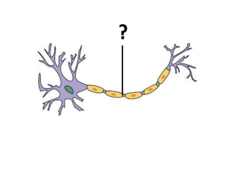
Axon
The extension of a neuron, ending in branching terminal fibers, through which messages pass to other neurons of to muscles or glands.
Biopsychology (biological psychology)
A branch of psychology concerned with the links between biology and behavior. (some biological psychologists call themselves behavioral neuroscientists, neuropsychologists, behavior genetics, physiological psychologists, or bio-psychologists.)
Behavioral genetics
The study of the relative power and limits of genetic ad environmental influences on behavior.
Brainstem
The oldest part and central core of the brain, beginning where the spinal cord swells as it enters the skull: the brain-stem is responsible for automatic survival functions.

Central nervous system (CNS)
The brain and spinal cord.

Cerebellum
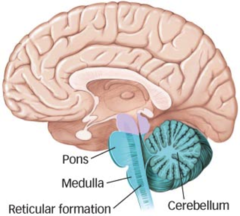
The "little brain" attached to the rear of the brain-stem; its functions include processing sensory input and coordinating movement output and balance.

Cerebral cortex
The intricate fabric of interconnected neural cells that cover the cerebral hemispheres: the body's ultimate control and information-processing center.

Corpus callosum
The large band of neural fibers connecting the two brain hemispheres and carrying messages between them.

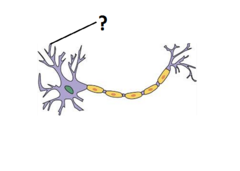
Dendrites
The bushy, branching extensions of a neuron that receive messages and conduct impulses toward the cell body.
Electroencephalogram (EEG)
An amplified recording of the waves of electrical activity that sweep across the brain's surface. These waves are measured by electrodes placed on the scalp.
Endocrine system
The body's 'slow" chemical communication system:set of glands that secrete hormones into the bloodstream.
Endorphins
"Morphine within"-natural, opiatelike neurotransmitters linked to plain control and to pleasure.
Forebrain
The largest and most complex region of the brain, encompassing a variety of structures, including he thalamus, hypothalamus, limbic system, and cerebrum.

Glial call
Cells in the nervous system that support, nourish, and protects neurons.
Hindbrain
Includes the cerebellum and two structures found in the lower part of the brain-stem, the medulla and pons.
Hormones
Chemical messengers, mostly those manufactured by the endocrine glands, that are produced in one tissue and effect another.
Hypothalamus
A neural structure lying below (hypo) the thalamus: is directs several maintenance activities (eating,drinking,body temperature), helps govern the endocrine system via the pituitary gland, and is linked to emotion.

Interneurons
Central nervous system neurons that internally communicate and intervene between the sensory inputs and motor outputs.

Lesioning
Tissue destruction, a naturally or experimentally caused destruction of brain tissue.
Limbic system
A doughnut-shaped system of neuronal structures at the border of the brain-stem and cerebral hemispheres: associated with emotions such as fear and aggression and dives such as those for food and sex. Includes the hippocampus, amygdala, and hypothalamus.

(MRI) Magnetic resonance imaging
A technique that uses magnetic fields and radio waves to produce computer-generated images that distinguish among different types of soft tissues: allows us to see structures within the brain.
Medulla
The base of the brain-stem: controls heartbeat and breathing.

FMRI) Functional MRI
A technique for revealing blood flow and, therefore, brain actity by comparing successive MRI scans. MRI scans show brain anatomy: FMRI scans show brain function.
Midbrain
The segment of the brain-stem that lies between the hindbrian and forebrain.

Myelin sheath
A layer of fatty tissue segmentally encasing the fibers pf many neurons: enables vastly greater transmission speed of neural impulses as the impulse hops from one node to the next.

Nerves
Neural "cables' containing many axons. These bundled axons, which are part of the peripheral nervous system, connect the central nervous system with muscles, glands, and sense organs.
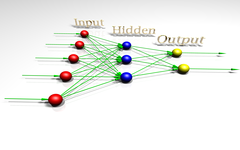
Neural networks
Interconnected neural cells. With experience, networks can learn, as feedback strengthens or inhibits connections that produce certain results. Computer stimulation's or neural networks show analogous learning.
Neuron
A nerve cell: the basic building block of the nervous system

Neurotransmitters
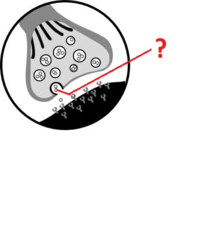
Chemical messengers that traverse the synaptic gaps between neurons. When released by the sending neuron, neurotransmitters travel across the synapse and bind to receptor sites on the receiving neuron, thereby influencing weather that neuron will generate a neural impulse.
Parasympathetic nervous system
The division of the autonomic nervous system that calms the body, conserving its energy.

Peripheral nervous system (PNS)
The sensory and motor neurons that connect the central nervous system (CNS) to the rest of the body.

Pituitary gland
The endocrine system's most influential gland. Under the influence of the hypothalamus, the pituitary regulates growth and controls other endocrine glands. Master gland
Plasticity
The brain's capacity for modification, s evidence in brain reorganization following damage (especially in children) and in experiments on the effects of experiments on brain development.
(PET) Positron emission tomography
A visual display of the brain activity that detects where a radioactive form of glucose goes while the brain performs a given task.
Reflex
A simple, automatic, inborn response to a sensory stimulus, such as the knee-jerk response.
Resting potential
Neuron is in its normal, resting state. Ions within the cell give the axon a small negative charge, fluid outside is positive charged.
Reticular Formation
A nerve network in the brain-stem that plays an important role in controlling arousal.

Somatic nervous system
The division of the peripheral nervous system that controls the body's skeletal muscles. Also called the skeletal nervous system.
sympathetic nervous system
The division of the autonomic nervous system that arouses the body, mobilizing its energy in stressful situations.

Synapse
The junction between the axon tip of the sending neuron and the dendrite or cell body of the receiving neuron.
Synapse cleft
The gap at the junction of the synapse.

Terminal buttons
Enlarged area at the end of the axon; contains the synaptic vesicle.

Thalamus
The brains sensory switchboard, located on the top of the brain-stem; it directs messages to the sensory receiving areas in the cortex and transmits replies to the cerebellum and medulla.

Threshold
The level of stimulation required to trigger a neural impulse.
motor neurons
a nerve cell forming part of a pathway along which impulses pass from the brain or spinal cord to a muscle or gland.
Broca's Area
part of the brain that is responsible for speech production
wernicke's area
part of the brain that is responsible for understanding spoken language
split brain patients
corpus collosum is severed, two hemispheres of the brain don't communicate as effectively
afferent neurons
carries nerve impulses from sensory receptors or sense organs toward the central nervous system.
efferent neurons
Neurons that send impulses from the central nervous system to your limbs and organs
neuron firing order
dendrite--soma---axon--terminal bulb
occipital lobe
The occiptial lobe is important to being able to correctly understand what your eyes are seeing.
temporal lobe
mainly revolves around hearing and selective listening.
frontal lobe
decision making
parietal lobe
processes sensory information
absolute refractory period
the period immediately following the firing of a nerve fiber when it cannot be stimulated no matter how great a stimulus is applied
relative refractory period
the period shortly after the firing of a nerve fiber when partial repolarization has occurred and a greater than normal stimulus can stimulate a second response
all or none principle
states that the strength of a response of a neuron or muscle fiber is not dependent upon the strength of the stimulus. If a stimulus is above a certain threshold, a neuron or muscle fiber will fire.