Lecture 11 and 12: Muscle and Levers
 Call Kai
 Learn
 Practice Test
 Spaced Repetition
 Match
 Flashcards
 Knowt Play
1/15

There's no tags or description
Looks like no tags are added yet.
16 Terms
Small motor units offer ____ _______.
fine control
Large motor units offer ________.
strength
Multiple motor units in a muscle allows for strength of __________ to be varied.
contraction
What is the action of a muscle?
It’s the effect produced by the muscle; muscles can be classified by their actions.
What are the different ways muscles can be classified by their actions?

_________ are a very common tool for transmitting force with a skeleton: used by us (bones in arms and legs).
levers
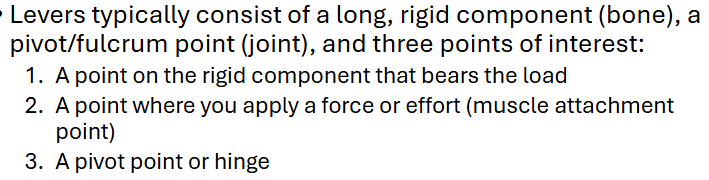
What do levers typically consist of?
Class 1 Lever
The load and effort are on opposite sides of the fulcrum. The load and effort forces are applied in the same direction. The load moves in the opposite direction of the effort.

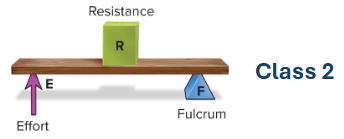
Class 2 Lever
The load and effort are on the same side of the fulcrum, with the load between the effort and fulcrum. The effort and load forces have opposing directions, but move in the same direction.
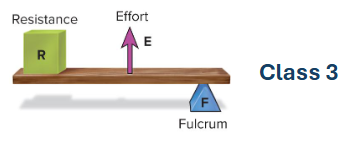
Class 3 Lever
The effort and the load are on the same side of the fulcrum, with the effort in between the load and the fulcrum. The load moves in the same direction as the effort.
Which lever class describes most of the lever arrangements in our musculoskeletal system?
Class 3
The shortest line perpendicular to the load and the pivot is called the _______ ____.
moment arm

The product of the moment arm and the force is _________.
the moment of the force
When the moment arm of the effort is long compared to the load, you are amplifying _________.
force (high mechanical advantage)
When the moment arm of the load is long compared to the effort, you are amplifying ______ and/or ______.
distance, speed (low mechanical advantage)
Does the lever system of the human forearm amplify distance or force?
The human forearm acts as a third‑class lever, which is a speed/distance multiplier — it sacrifices force for greater range of motion.