Organic Chemistry I First Exam
 Call Kai
 Learn
Learn Practice Test
 Spaced Repetition
 Match
Match Flashcards
 Knowt Play
1/79

There's no tags or description
Looks like no tags are added yet.
Name | Mastery | Learn | Test | Matching | Spaced | Call with Kai | Chat |
|---|
No analytics yet
Send a link to your students to track their progress
80 Terms
Alkane
A chain or ring of carbons with only single bonds. Example: propane, CH₃CH₂CH₃. Name ends in -ane.
Alkene
Has at least one carbon=carbon double bond. Example: propene, CH₃CH=CH₂. Name ends in -ene.
Alkyne
Has a carbon≡carbon triple bond. Example: propyne. Name ends in -yne.

Benzene ring (arene)
A six-carbon ring with three alternating double bonds. As a substituent it's called phenyl.
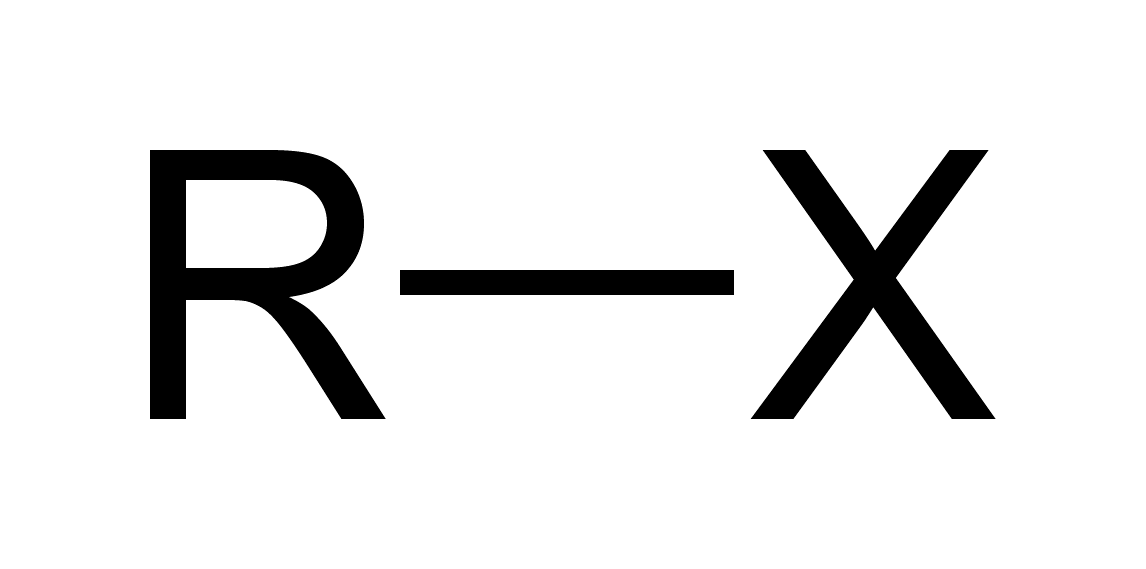
Alkyl halide
A carbon chain with a halogen on it (F, Cl, Br, or I). Example: CH₃CH₂Br is bromoethane.

Alcohol
A carbon with an OH group on it. Example: CH₃CH₂OH is ethanol. Name ends in -ol.

Ether
An oxygen sitting between two carbons, R–O–R. Example: CH₃OCH₃.

Amine
A nitrogen attached to carbons (and maybe H's). The N has a lone pair. Example: CH₃NH₂.

Carbonyl
A carbon double-bonded to an oxygen, C=O

Aldehyde
A carbonyl with an H on the carbonyl carbon, so it sits at the end of a chain. Example: CH₃CHO. Name ends in -al.

Ketone
A carbonyl in the middle of a chain, with a carbon on both sides. Example: CH₃COCH₃, acetone. Name ends in -one.

Carboxylic acid
A carbonyl with an OH on the same carbon, –COOH. Example: acetic acid. Name ends in -oic acid.

Ester
A carbonyl with an O–carbon attached, R–COO–R. Example: ethyl acetate. Name ends in -oate.

Amide
A carbonyl with a nitrogen attached, R–CO–NH₂. Name ends in -amide.

Nitrile
A carbon triple-bonded to nitrogen at the end of a chain, R–C≡N. Name ends in -nitrile.

Thiol
Like an alcohol, but with sulfur instead of oxygen: R–SH.
Primary carbon (1°)
A carbon attached to only one other carbon. Example: the CH₃ at the end of a chain.
Secondary carbon (2°)
A carbon attached to two other carbons.
Tertiary carbon (3°)
A carbon attached to three other carbons.
Quaternary carbon (4°)
A carbon attached to four other carbons, so it has no H's.
Primary, secondary, or tertiary hydrogen
Named for the carbon the H sits on. An H on a 3° carbon is a tertiary hydrogen.
Methyl (Me)
A single carbon branch, –CH₃.
Ethyl (Et)
A two-carbon branch, –CH₂CH₃.

n-Propyl
A straight three-carbon branch, –CH₂CH₂CH₃.

Isopropyl (i-Pr)
A three-carbon branch attached through its middle carbon. It looks like a Y.

n-Butyl
A straight four-carbon branch.
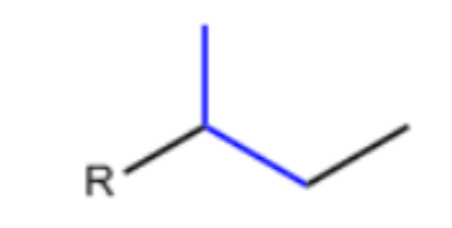
sec-Butyl
A four-carbon branch attached through its second carbon.

Isobutyl
A four-carbon branch that ends in a Y shape, –CH₂CH(CH₃)₂.

tert-Butyl (t-Bu)
A central carbon holding three methyls, attached through that central carbon. The bulkiest common group.
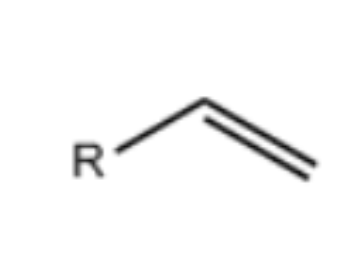
Vinyl
A double bond hanging off a molecule, –CH=CH₂.

Allyl
A CH₂ followed by a double bond, –CH₂–CH=CH₂.
Markovnikov
A rule for where things end up. The H goes on the carbon of the double bond that already has more H's, and the other group goes on the carbon with more carbons attached (the more substituted one). Example: HBr plus propene gives 2-bromopropane, with Br on the middle carbon.
Anti-Markovnikov
The opposite: the group ends up on the less substituted carbon.
Syn addition
Both new groups attach on the same side of the molecule.
Anti addition
The two new groups attach on opposite sides.
Carbocation
A carbon with a positive charge and only three bonds. More attached carbons means more stable (3° is better than 2° better than 1°).
Carbocation rearrangement
A neighboring H or CH₃ jumps over to the positive carbon so the charge moves to a more stable carbon. Example: 3-methyl-1-butene plus HBr mostly gives 2-bromo-2-methylbutane instead of the product you'd first expect.
HX (HCl, HBr, or HI) added to an alkene
Adds H and X across the double bond to make an alkyl halide. Goes Markovnikov. No control over sides. Rearrangement: YES, because it passes through a carbocation. Example: propene plus HBr gives 2-bromopropane.
HX (1 equivalent) added to an alkyne
Makes a vinyl halide (a double bond with a halogen on it). Goes Markovnikov, so the halogen goes on the more substituted carbon. Rearrangement: usually no.
HX (2 equivalents) added to an alkyne
Makes a geminal dihalide, meaning both halogens on the same carbon, and it's the more substituted carbon (markovnikov). Rearrangement: usually no.
H₃O⁺ (water with a little strong acid, H₂SO₄)
Adds H and OH across a double bond to make an alcohol (acid-catalyzed hydration). Markovnikov, so OH goes on the more substituted carbon. Rearrangement: YES. It is also reversible. Example: propene gives 2-propanol.
Br₂ or Cl₂ (in CH₂Cl₂)
Adds one halogen to each carbon of the double bond. No regiochemistry question since both carbons get the same atom. ANTI addition (the two halogens end up on opposite sides). Rearrangement: NO. Example: cyclohexene gives trans-1,2-dibromocyclohexane.
Br₂ or Cl₂ in water (halohydrin formation)
Adds a halogen to one carbon and an OH to the other. The OH markovnikov, and the halogen goes on the other. ANTI addition. Rearrangement: NO. Example: propene gives 1-bromo-2-propanol.
Br₂ or I₂ in an alcohol solvent (like CH₃OH)
Same as the water version but the solvent adds OR instead of OH, so you get a halogen plus an ether. The OR goes on the more substituted carbon. ANTI addition. Rearrangement: NO.
Chair
The usual 3D shape of a six-carbon ring. It is the most stable shape because there is no strain.
Axial bond
A bond that points straight up or straight down, parallel to the ring's axis. They alternate up, down, up, down around the ring.
Equatorial bond
A bond that points outward around the ring's edge, roughly flat.
Ring flip
The chair flips to the other chair, and every axial bond becomes equatorial and every equatorial becomes axial. Cis stays cis and trans stays trans.
Cis
Two groups on the same side of the ring (both up or both down).
Trans
Two groups on opposite sides of the ring (one up, one down).
Why equatorial is better
Axial groups bump into the two axial H's on the same side of the ring (1,3-diaxial strain), so big groups prefer equatorial.
1,2-cis (neighboring carbons, same side)
One group axial and one equatorial.
1,2-trans (neighboring carbons, opposite sides)
Both equatorial or both axial. Both equatorial is the more stable chair.
1,3-cis (one carbon between them, same side)
Both equatorial or both axial. Both equatorial is much more stable.
1,3-trans (one carbon between them, opposite sides)
One axial and one equatorial.
1,4-cis (opposite corners of the ring, same side)
One axial and one equatorial.
1,4-trans (opposite corners, opposite sides)
Both equatorial or both axial. Both equatorial is more stable.
Easy way to remember
1,2 and 1,4: cis is axial plus equatorial, trans is both the same. 1,3 is the reverse: cis is both the same, trans is axial plus equatorial.
How to pick the more stable chair
The one with the bigger group in an equatorial position. If one chair puts every group equatorial, it wins.
Axial methyl cost
About 1.8 kcal/mol of strain, from two small bumps with axial H's of about 0.9 kcal/mol each.
Gauche butane
About 0.9 kcal/mol of strain, the same as one of those small bumps.
tert-Butyl on a ring
So bulky it locks the ring so the tert-butyl is always equatorial.
Types of ring strain
Angle strain (bond angles squeezed away from 109.5°), torsional strain (bonds eclipsed), and steric strain (groups crowding each other).
Small rings
Cyclopropane and cyclobutane are very strained (about 26 to 27 kcal/mol), cyclopentane is a little strained, and cyclohexane in the chair has none.
Acid
Something that gives away an H⁺. The easier it gives it away, the stronger the acid.
Conjugate base
What's left after the acid loses its H⁺. It has an extra negative charge.
Main idea behind all acidity trends
If the leftover negative charge is comfortable (stable), the acid is stronger.
pKₐ
A number for acid strength. LOWER pKₐ means a STRONGER acid. Example: acetic acid (pKₐ about 5) is stronger than ethanol (pKₐ about 16).
Which way does an acid-base reaction go?
Toward the weaker acid (the one with the higher pKₐ). Compare the acid you start with to the acid you'd form, and the reaction goes to whichever is weaker.
K and ΔG°
If the products are favored, K is greater than 1 and ΔG° is negative. If the reactants are favored, K is less than 1 and ΔG° is positive.
Acidity Factor 1: element across a row
Further right is more acidic. The more electronegative atom holds the negative charge better. Order: CH₄ is weakest, then NH₃, then H₂O, then HF.
Acidity Factor 2: element down a column
Further down is more acidic. Bigger atoms spread the negative charge over more space. Order: HF is weakest, then HCl, then HBr, then HI.
Acidity Factor 3: charge
An acid that's already positive gives up its H more easily. H₃O⁺ is a stronger acid than H₂O.
Acidity Factor 4: resonance
If the negative charge in the conjugate base can spread over several atoms, the acid is stronger. That's why carboxylic acids (pKₐ about 5) are far more acidic than alcohols (pKₐ about 16).
Acidity Factor 5: inductive effect
Electronegative atoms nearby pull the negative charge toward themselves and stabilize it. The closer they are, the bigger the effect.
Acidity Factor 6: hybridization (for C–H bonds)
More s-character holds the charge closer to the nucleus. So alkyne C–H (sp, pKₐ about 25) is more acidic than alkene C–H (sp², about 44), which is more acidic than alkane C–H (sp³, about 50).
When resonance works against acidity
If the acid itself is stabilized by resonance (for example the amidinium ion in problem 3.74), it holds on to its H more tightly and is a weaker acid.
Order to check when comparing two acids
Check the charge, then the element, then resonance, then the inductive effect, then hybridization.
Bronsted acid and base
An acid gives away H⁺ and a base takes H⁺.
Lewis acid and base
A Lewis acid accepts an electron pair and a Lewis base donates one.