Chapter 7 and 8 Physics Test (range equation and transducers)
 Call Kai
 Learn
 Practice Test
 Spaced Repetition
 Match
 Flashcards
 Knowt Play
1/91

There's no tags or description
Looks like no tags are added yet.
Name | Mastery | Learn | Test | Matching | Spaced | Call with Kai | Chat |
|---|
No analytics yet
Send a link to your students to track their progress
92 Terms
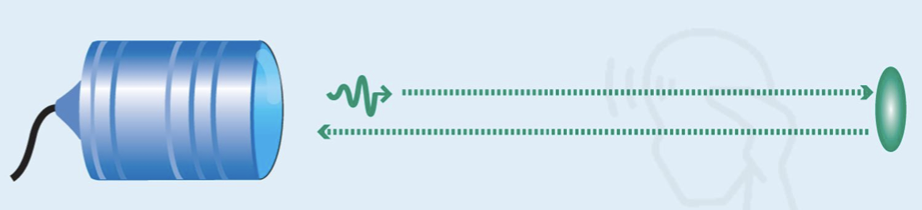
How is an Image created?
sound is transmitted
bounces off a reflector
sound returns to the transducer
speed that sound travels in soft tissue is known
the travel time of the sound allows the ultrasound system to accurately place the reflector on the image
Time of Flight / Go-Return Time
the time from pulse creation to pulse reception
time determines position of the reflector on the image created
superficial reflectors = short time of flight (shallow depths)
deeper reflectors = longer time of flight
Time of flight is _____ ______ to how deep a sound pulse travels
directly related

If a reflector is twice as deep, the time of flight is _______
twice as long
Depth Equation
depth = speed * go-return time (𝜇𝑠) / 2
depth = (1.54mm/𝜇𝑠) * go-return time (𝜇𝑠) / 2
13 Microsecond Rule
For every 13 𝜇𝑠 of go-return time, the object creating the reflector is 1cm deeper in the body
always applies when traveling in soft tissue
What is the Time of Flight / Go-Return Time when a reflector is 2cm deep?
26 𝜇𝑠
total distance travelled is _____ the reflector depth
twice
A sound pulse is emitted from the transducer and returns in 52 µs.
How deep is the reflector?
What is the total distance traveled?
4 cm
8 cm
A sound pulse is emitted from the transducer and returns in 130 µs.
How deep is the reflector?
What is the total distance traveled?
10 cm
20 cm
PRP and Maximum Imaging Depth
PRP is the go-return time to the very BOTTOM of the image
SHallow Depth = SHort PRP
Deeper Depth = Long PRP
PRP and Maximum Imaging Depth in relation to the 13 Microsecond rule
PRP (µs) = imaging depth (cm) * 13 µs/cm
PRP is ______ to maximum imaging depth
directly related
Speed of sound in soft tissue is
1.54 mm/µs OR 154,000 cm/s
If sound can travel a TOTAL distance of 154,000 cm over one second, the distance of the reflector would be
77,000 cm away
How many pulses can be sent in one second to a depth of 7.7 cm and return to the transducer
10,000
PRF
number of pulses per second
when the depth is set to 7.7 cm, PRF = ?
10,000 Hz or 10kHz
When depth is shallow, PRF is _____
high (inverse relationship)
when depth is deep, PRF is _____
low (inverse relationship)
PRF and Depth Equation
PRF = 77,000 (cm/s) / imaging depth (cm)
Transducer Definition
device that converts one form of energy into another
Ultrasound machines convert ______ to ______ on transmission
electrical to acoustic
Ultrasound machines convert ______ back to _____ on reception
acoustic to electrical
Two Functions of Ultrasound Transducers
Transmit
electrical energy from ultrasound system converted to sound wave
Receive
reflected sound pulse is converted to electrical
Piezoelectrical materials are
deformed resulting in an electrical field
this is how the ultrasound transducer transforms the electrical energy to sound and then sound to electrical energy
how is a voltage created
when mechanical stress is applied to certain materials
noted by Curie Brothers in 1880’s
Piezoelectric Effect 2 Parts
Transmission (electric to acoustic):
the reverse piezoelectric effect explains transmission of ultrasound
ultrasound machine produces a voltage that is applied to piezoelectric material
material changes shape
Reception (acoustic to electric):
the piezoelectric effect explains reception of ultrasound
pressure is applied to the piezoelectric material by the return of the sound pulse
a voltage is created by the pressure/deformation of material
Another name for Piezoelectric Materials
ferroelectric
Piezoelectric Materials Definition
materials that convert sound into electricity OR electricity into sound
PZT
the material commonly used in ultrasound transducers
manmade piezoelectric material
PZT is also known as…
ceramic
active element
crystal
Naturally Occurring Piezoelectric Materials
ceramics
quartz
tourmaline
Rochelle salt
Manufactured Piezoelectric Materials
barium titanate
lead zirconate titanate
PZT; MOST COMMON IN U.S TRANSDUCERS
barium lead zirconate
method to improve the characteristics of piezoelectric materials
Poling
Poling Steps
high voltage and very high heat are applied to align the poles
electric voltage will cause dipoles to vibrate, changing the shape of PZT which in turn creates a sound wave
when sound wave returns and hits the crystal, the opposite effect occurs and sound is transferred to electrical energy

Curie Point
the temperature at which transducers piezoelectric material is polarized
temperature required for polarization
Curie Point for PZT
300-400 degrees Celsius
heating above this will depolarize the crystals
What will happen if the crystal is reheated to the Curie Point
depolarization
crystal will lose its piezoelectric properties
7 Components of the Basic Transducer
Case
Electric Shield
Acoustic Insulator
PZT or active element
Wire
Matching Layer
Backing Material AKA Damping Element

Case
the plastic or metal cylindrical tube that covers the crystal and internal components

What does the Case Protect?
protects the crystals from damage
protects the patients from being electrically shocked

Cleaning Protocol for Case to not Damage It
wiped down
intracavitary transducers are soaked in disinfectant (Trophon)

Electrical Shield
thin metallic barrier lining the inside of the case
prevents electrical noise from outside of the reflections from the patient

Acoustic Insulator
barrier or cork or rubber that separates the internal components of the transducer from the case
prevents vibrations from returning and interfering with true echoes from the patient
(yellow line)

Active Element (PZT)
the crystal itself (heart of transducer)
transmits and receives sound
coin-shaped

dimensions of the active element determine…
the characteristics that are emitted by the transducer
the thickness of the PZT is…
½ the wavelength
Wire
connects transducer to PZT element
provides electrical connection between ultrasound unit and crystal
TRANSMISSION: voltages from ultrasound system causes crystals to vibrate and produce an ultrasound wave
RECEPTION: crystal vibration produces a voltage that can return to the system to be processed into an image

Matching Layer
in front of PZT at a face of the transducer
increases efficiency of sound energy transfer between active element and the body
protects the active element

Matching Layer thickness is….
¼ of the wavelength
Anything that comes between the crystal and the skins surface must have ____ impedances.
similar
as the difference of impedance increases, reflection
increases
The matching layer has an impedance between that of the _____ and the ______
active element and the skin
PZT impedance is ________ than the impedance of the skin
20 times greater
Matching Layer Impedance Benefit
multilayer and allows more sound to transmit into the body by lessening the impedance differences
ex: gel
What Would Happen if the Matching Layer were Not Present to Bridge the Impedance Differences?
the majority of the sound beam would reflect at the interface and never make it into the body
What makes the transducer efficient enough to transfer sound into the body?
the matching layer and gel
Acoustic Impedance high to low
PZT (high)
matching layer
gel
skin (low)
Backing Material/Damping Element
bonded to the back of the active element
reduces “ringing” of the PZT
made of epoxy resin and tungsten filaments
(green)

what does the backing layer restrict?
the excitement of the PZT from the electrical voltage
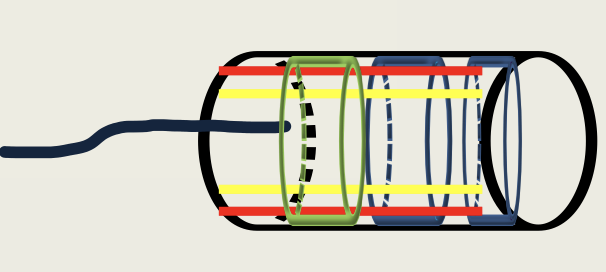
the backing material ____ the sound pulse
DAMPENS
reduces number of cycles per pulse
shortens the pulse duration and spatial pulse length
better image resolution

Characteristics of Damping Material
high degree of sound absorption
acoustic impedance similar to PZT
allows sound to be absorbed into the backing material and away from the patient
Consequences of Backing Material
decreased sensitivity
wide bandwidth
low quality factor
Decreased Sensitivity
backing material cannot be removed between transmit and receiving
vibration is reduced during reception as well
reflections back to transducer are tiny
less able to convert the low-level reflections into electrical signals
RECEPTION = DECREASED SENSITIVITY
Wide Bandwidth
backing material does not allow the PZT to vibrate freely
dampening of tone produces sounds at varying frequencies both above and below the main frequency of the transducer

Bandwidth Definition
the range of frequencies in the pulse, or the difference of the highest and lowest frequencies

longer pulse = ____ bandwidth
narrow bandwidth
fewer frequencies

shorter pulses = _____ bandwidth
wider bandwidth
more frequencies

imaging probes (PW) broadband or Wideband
short duration pulse
wide range of frequencies
CW and therapeutic probes with narrow bandwidth
long duration pulse
one frequency
Low Quality Factor
a measure of the efficiency of the transducer in converting electrical energy to sound energy and vice versa
unitless
inversely related to bandwidth
Q factor Equation
Q-Factor = main frequency / bandwidth
high/wider bandwidth probes have
low Q factor
shorter pulses
more frequencies per pulse
better image quality
ex: imaging probes (use damping material)
low/narrow bandwidth probes have
high Q-factor
longer pulses
less frequencies per pulse
ex: CW and therapeutic probes (lack of damping material)
Sterilization
destruction of all microorganisms by way of extreme heat, chemicals, or radiation
Disinfection
application of chemicals to reduce or eliminate organisms on an object (reduce germs)
Intruments that penetrate skin need to be ____
sterilized
Ultrasound transducers require
disinfection
should you expose transducers to heat?
no
CW and PW transducer frequencies depend on
the SOURCE (ultrasound machine)
Continuous Wave Transducers
electrical frequency determines the CW frequency
crystal is constantly supplied with an electrical voltage
the crystal constantly (or continuously) emits sound waves
electrical frequency = acoustic frequency

Pulsed Wave Transducers
short duration electrical spikes travel through the wire to the PZT crystal in the transducer
characteristic of THAT element (PZT) determines the frequency
Frequency is determined by
speed of sound in the PZT element
thickness of the PZT element
Speed of Sound in PZT is ____ ______ to the frequency
directly
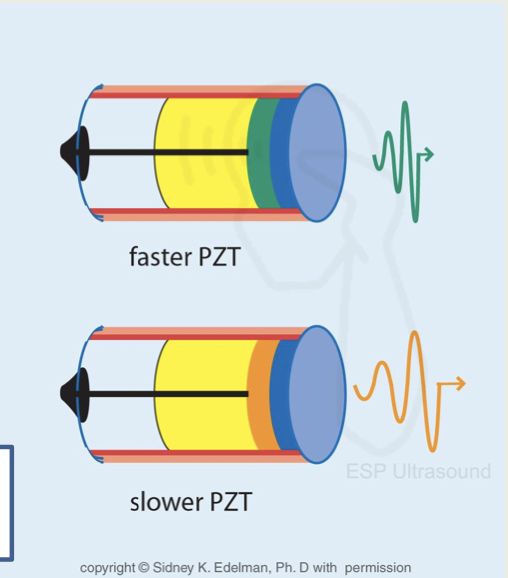
when the speed of sound in the PZT is faster, the frequency created by that transducer is ____
higher
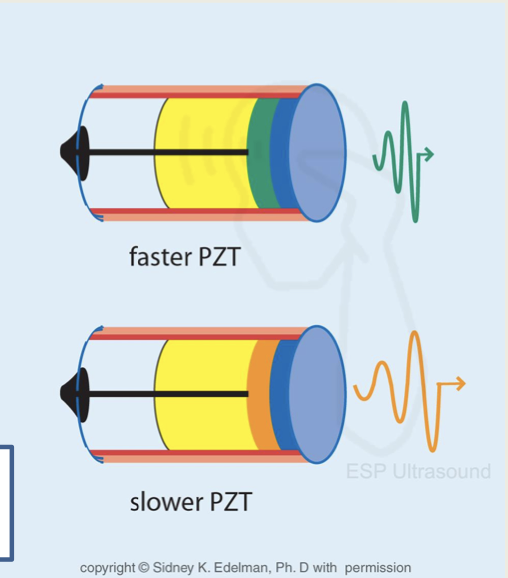
when the speed of sound in the PZT is slower, the frequency created by that transducer is ____
lower

PZT Thickness and frequency are _____
inversely related
the thinner the active elements (PZT) the _____ the frequency (_____ wavelengths)
higher
shorter
the thicker the active elements (PZT) the _____ the frequency (_____ wavelengths)
lower
longer
typical thicknesses in diagnostic imaging
.2-1 mm
Thickness of the PZT crystal in pulsed wave transducers = ______
½ the wavelength of sound in the PZT