Lecture 32: Head and Neck: Digestive Organs
 Call Kai
 Learn
 Practice Test
 Spaced Repetition
 Match
 Flashcards
 Knowt Play
1/141

There's no tags or description
Looks like no tags are added yet.
142 Terms
what is the palatoglossal arch also know as?
isthmus of the fauces

where is the oral cavity located?
in between the lips and the palatoglossal arch
what is the groove underneath your nose called?
philtrum
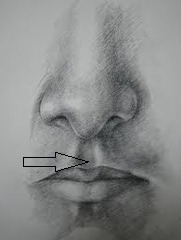
true or false: the philtrum is more pronounced in cats
TRUE
what regions is the oral cavity divided into?
outer vestibule, external lips/cheeks, and central mouth cavity
how are the regions of the oral cavity divided?
by teeth and margins of the jaw
outer vestibule of mouth

central mouth cavity

true or false: the labial vestibule is the most rostral area in between the lips/teeth/gums
TRUE

true or false: the buccal vestibule is the most caudal portion of the lips/teeth/gums
TRUE
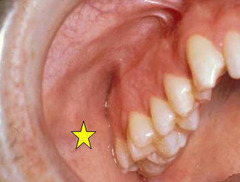
is the buccal vestibule supposed to hold food in carnivores?
NO
what does buca mean?
cheek
what is the principial support of the cheeks (buccae)?
buccinator muscle

what is the function of the buccinator muscle?
returning any food to the central cavity that has escaped into the vestibule

why is the buccinator muscle so important in babies?
it creates a vacuum inside the oral cavity to allow suckling
what 2 muscles form the floor of the oral cavity?
geniohyodieus m and mylohyoideus m
what direction do the 2 muscles making up the oral cavity travel with every swallow?
ROSTRALLY
characteristics of mylohyoideus m
1st muscle underneath the skin, very thin
characteristics of geniohyoideus m
made up of 2 strong muscles, located dorsal to mylohyoideus
what is the main action of the geniohyoideus m?
pull muscles rostrally
what is the main action of the mylohyoideus m?
raises floor of oral cavity
what is the oral cavity?
very strong hard palate
what 3 bones form the oral cavity?
incisive, maxillary, and palantine bones
what is the incisive papilla?
small elevators of mucosa just caudal to the incisors

true or false: the incisive papilla is located very rostrally
TRUE
in what direction fo the palantine ridges travel?
concave caudally and convex rostrally

true or false: the teeth of the dog are heterodont
TRUE
what does heterodont mean?
different types of teeth
what are the 4 types of teeth that dogs have?
incisive, canine, premolar, and molar
true or false: the teeth of the dog are also diphyodont
TRUE
what does diphyodont mean?
successive development of deciduous (baby teeth) and permanent (adult) set of teeth
what is the function of the incisor teeth?
to grab/cut
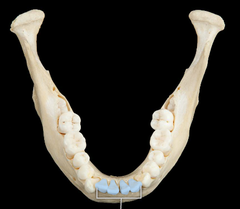
what is the function of the canine teeth?
kill/defend

what is the function of the premolars/molars?
chewing/breaking bones

true or false: the premolars and molars are the strongest teeth in the mouth?
TRUE
what is the crown of the tooth encased in?
enamel
what is the root of the tooth encased in?
cement
what is the hardest structure in the body?
enamel
what is gomphosis?
fibrous joint between the root of a tooth and the alveolus
what attaches the root of the tooth to the alveolus, making up the gomphosis?
periodontal ligament
what is the periodontal ligament?
hard connective tissues

what nerve travels to the teeth?
trigeminal n (CN V)
what is the formula for BABY TEETH in the dog?
2 (I 3/3, C 1/1, P 3/3) = 28 teeth
what does I represent in the teeth formula?
incisors
what does the NUMERATOR represent in the teeth formula?
superior teeth
what does the DENOMINATOR represent in the teeth formula?
inferior teeth
what does I stand for in the teeth formula?
incisors
what does the C stand for in the teeth formula?
canines
what does the P stand for in the teeth formula?
premolars
what does the M stand for in the teeth formula?
molars
true or false: the puppy formula DOES NOT contain M (molars)
TRUE
what is the formula for the permanent ADULT teeth of a dog?
2 (I 3/3, C 1/1, P 4/4, M 2/3) = 42
why do we multiply the number of teeth x2?
because we are only calculating the formula for one side of the mouth
what is considered the labial surface of the teeth?
the surface that faces the lip

what is considered the buccal surface of the teeth?
the surface that faces the bucca (cheek)

true or false: only the superior teeth have a palatine surface
TRUE
what is considered the palantine surface of the teeth?
the surface that faces the hard palate
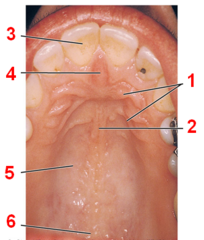
true or false: the lingual surface of the teeth is only located only the inferior/mandibular teeth?
TRUE
what is the considered the lingual surface of the teeth?
the surface facing the tongue

what is considered the mesial surface of the teeth?
the surface facing/in contract with the rostral tooth, towards the middle line
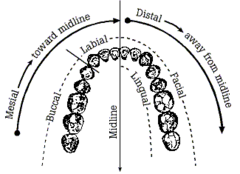
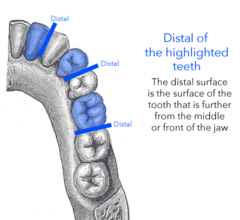
what is considered the distal surface of the teeth?
the surface facing/in contacts with the caudal tooth, away from the middle line
what is the occlusal/masticatory surface of the teeth?
the surface facing/in contact with the opposite upper/lower dental arch

what 2 teeth are known at the sectorial/carnassial teeth?
4th superior premolar and first inferior molar
how old is a puppy when their baby teeth come in?
3-5 weeks
how old is a puppy when their adult teeth come in?
5-7 months
how old is a puppy when their premolars start to come in?
4-5 months
true or false: premolar 1 DOES NOT have a baby tooth, only grows in as an adult tooth
TRUE
what is the adult teeth formula for cats?
2 (I 3/3, C 1/1, P 3/2, M 1/1) = 30
what is the baby teeth formula for kittens?
2 (I 3/3, C 1/1, P 3/2) = 26
true or false: cats have fewer premolar teeth than dogs
TRUE
what are the 4 quadrants of the mouth? (PERMANENT TEETH ONLY)
right/left upper permanent, right/left lower permanent

what is quadrant 1 of the mouth considered?
right upper permanent
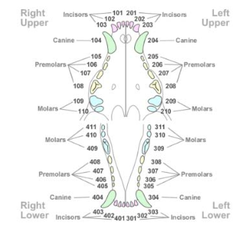
what is quadrant 2 of the mouth considered?
left upper permanent

what is quadrant 3 of the mouth considered?
left lower permanent

what is quadrant 4 of the mouth considered?
right lower permanent
what teeth are located in quadrant 1?
teeth 101-110 (starting with most rostral incisors)
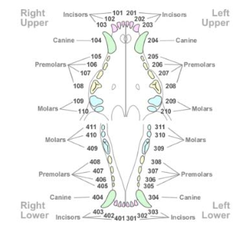
what teeth are located in quadrant 2?
teeth 201-210 (starting with most rostral incisors)
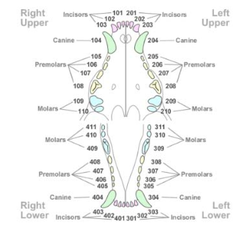
what teeth are located in quadrant 3?
teeth 301-311 (starting with most rostral incisor)

what teeth are located in quadrant 4?
teeth 401-411 (starting with most rostral incisor)

what is unique about the canine teeth in the numbering system?
they will ALWAYS be labeled #4, no matter their quadrant (104, 204, 304, 404)

location of the tongue
occupies greater part of oral cavity, extending into oropharynx
true or false: the tongue has an attached root and body, but has a FREE APEX
TRUE
true or false: the tongue is extremely muscular
TRUE
what nerve innervates the root of the tongue?
glossopharyngeal n (CN IX)
what innervation does glossopharyngeal n at the root of the tongue have?
provides sensory innervation and taste
what 2 nerves innervate the body AND apex of the tongue?
trigeminal n (CN V) and facial n (CN VII)
what innervation does the trigeminal n. at the apex of the tongue have?
sensory innervation
where are the conical papillae located?
in the root of the tongue

what do the conical papillae do?
mechanical action
what are the vallate papillae and what are they used for?
big and easy to see, used for taste

what is the median groove of the tongue?
divides the tongue in the middle line
what is the function of the filiform papillae of the tongue?
mechanical function/traction

what are the fungiform and foliate papillae of the tongue used for?
taste!
where are the foliate papillae located?
near the root of the tongue

where are the fungiform papillae located?
apex of tongue
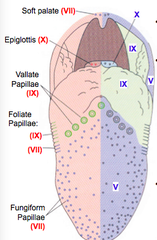
what is located rostrally to the vallate papillae?
body of the tongue
what is located caudal to the vallate papillate?
root of the tongue
true or false: marginal papillae are digitations on the border of the tongue and are ONLY seen in newborns
TRUE

what is the frenulum of the tongue?
plica of CT

what is the sublingual caruncle?
the exit of salivary ducts
