Carbohydrates - Polysaccharides
 Call Kai
 Learn
 Practice Test
 Spaced Repetition
 Match
 Flashcards
 Knowt Play
1/36

There's no tags or description
Looks like no tags are added yet.
37 Terms
What are Polysaccharides?
Polysaccharides are complex carbohydrates made up of many monosaccharides joined via glycosidic bonds
What are some examples of polysaccharides?
Starch
Glycogen
Cellulose

What is starch?
Starch is an example of a polysaccharide used by plants to store excess glucose.
This means that starch can be hydrolysed back into glucose when plants require energy.
How/ what is starch made up of?
Its made up of many alpha-glucose monomers joined via glycosidic bonds to form chains.
What are the 2 forms ( and their percentages) that Starch chains can come in
1.) Amylose - 20%
2.) Amylopectin - 80%
What is Amylose and its structure
It’s a long, unbranched chain of alpha- glucose joined by 1-4 glycosidic binds.
The angles of these bonds cause the chain to coil into a helix to make a compact structure
What’s the estimate of the number of alpha glucose units in 1 amylose molecule ?
There’s 200 - 500 alpha glucose units
What causes the shape of amylose?
the bonds lie below the rings, so the molecules naturally coils into a spiral, held together by hydrogen bonds
What is Amylopectin and its structure?
It’s a long, branched chain of alpha- glucose joined by both 1-4 and 1-6 glycosidic bonds.
Its side branches allows enzymes to hydrolyse alpha-glucose monomers easily
What’s the estimated number of alpha glucose units in 1 molecule of amylopectin?
one amylopectin molecule contains 5000 - 100,000 alpha glucose units
Features of starch that helps it to function as a energy STORE: Solubility & Reactions
Insoluble - It does not affect the water potential, so water does not enter cells by osmosis.
Hydrolysis releases alpha-glucose monomers - These are readily used in respiration.
Features of starch that helps it to function as a energy STORE: Size
Large - It cannot diffuse out of cells.
Features of starch that helps it to function as a energy STORE: Structure
Many side branches - These allow enzymes to hydrolyse the glycosidic bonds easily to rapidly release glucose.
Features of starch that helps it to function as a energy STORE: Shape
Coiled - This makes it compact so that a lot of glucose can be stored in a small space
What is Glycogen?
Glycogen is an example of a polysaccharide used by animals to store excess glucose.
This means that glycogen can be hydrolysed back into glucose when animals require energy.
Glycogen is very similar to starch, but it is used by animals rather than plants.
How is Glycogen formed/ what’s its structure?
Glycogen is made up of many alpha-glucose monomers joined via 1-4 and 1-6 glycosidic bonds to form highly branched chains. (Mainly amylopectins)
Features that allow glycogen to function as a energy STORE: Solubility & Reactions
Insoluble - It does not affect the water potential of cells, and so water does not enter cells by osmosis.
Hydrolysis releases alpha-glucose monomers - These are readily used in respiration.
Features that allow glycogen to function as a energy STORE: Size
Large - It cannot diffuse out of cells.
Compact - A lot of glucose can be stored in a small space
Features that allow glycogen to function as a energy STORE: Structure
More highly branched than starch - Enzymes can easily hydrolyse the glycosidic bonds to rapidly release glucose.
What is cellulose?
Cellulose is a polysaccharide formed from beta-glucose.
Primary use of cellulose
To provide structural support for plant cell walls.
How is cellulose formed?
Cellulose is made up of many beta-glucose monomers joined together via glycosidic bonds.

What is the problem with bonding two beta-glucose molecules together?
If two beta-glucose monomers line up next to each other, the hydroxyl groups (OH) on carbon 1 and carbon 4 are too far from each other to react.
What’s the solution to opposite hyrdoxyl groups on the beta glucose?
Every other beta-glucose molecule is inverted by 180° (flipped upside down). This brings the hydroxyl groups (OH) close enough together to react.
What happens when many beta-glucose molecules are bonded together?
They form long, straight, unbranched chains.
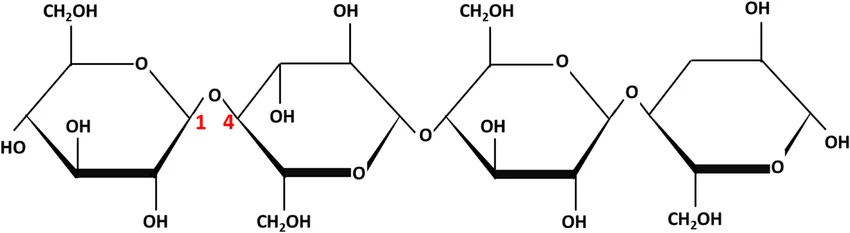
What is the general order of a straight, ubranched chain of a beta glucose molecule?
Every other glucose unit has to be turned upside down (first is right side up, the other is upside down).
The glycosidic bonds alternate above and below the ring therefore the molecule doesn’t coil like starch but forms a straight chain.
What provides the great strength to cellulose as a whole?
The hydrogen bonds - Although each hydrogen bond itself is relatively weak, the huge number of these bonds provides great strength to cellulose as a whole.
Where exactly do these hydrogen bonds form (i.e on which carbon specifically)?
Forms between the partially negative Oxygen on carbon 3 on one chain and the partially positive hydrogen on carbon 6 of another. This provides strength
What is the straight chain supported by?
It’s supported by hydrogen bonds between the oxygen atom in the ring and the O-H on carbon 3 of another glucose unit. As a result, it allows many chains to lie parallel.
What are Microfibrils?
They are bundles of (60 -70) cellulose molecules. So, multiple cellulose chains become tightly cross linked via hydrogen bonds to form bundles called Microfibrils.
When Microfibrils join together, what do they make?
Macrofibrils aka cellulose fibers. (400 microfibrils form macrofibrils)
What are cell walls made of and what holds them together?
They are made of several layers of fibres running in all directions
Pectin holds he fibres together
Adaptations of cellulose for its role - Numerous hydrogen bonds
These allow for high tensile strength to be achieved as plant cell walls need to be able to withstand high pressure without breaking or stretching.
these bonds form between parallel molecules due to the fact that they are straight.
Adaptations of cellulose for its role - Long, straight and unbranched chains
These provide rigidity to the cell wall.
Adaptations of cellulose for its role - Microfibrils
Provide additional strength
Adaptations of cellulose for its role - Digestion difficulty
The beta-glucose molecules are difficult to digest because of the different orientation of the bonds.
Adaptations of cellulose for its role - Gaps between Macrofibrils
This allows for the cell wall to be fully permeable.