Lecture #3: Carbon - based life, isomers, functional groups
 Call Kai
 Learn
 Practice Test
 Spaced Repetition
 Match
 Flashcards
 Knowt Play
1/17

There's no tags or description
Looks like no tags are added yet.
Name | Mastery | Learn | Test | Matching | Spaced | Call with Kai | Chat |
|---|
No analytics yet
Send a link to your students to track their progress
18 Terms
What is a key experiment u have to know that happened in 1953?
Miller-Urey Experiment
Scientists knew that living things contain organic compounds, like amino acids, which are the building blocks of proteins
But they wondered:
How did the molecules needed for life first form if living things weren’t yet around to make them? Could these molecules naturally have been found on Earth?
They tried to recreate conditions they thought existed on primordial Earth (early Earth, before life existed).
They used:
💧 Water to represent the early oceans.
🌫 Gases to represent the early atmosphere.
⚡ Electrical sparks to simulate lightning.
They let the system run and then examined what chemicals had formed.
They produced many organic compounds, including 11 different amino acids!
Remember, amino acids are the building blocks of proteins, which are essential to living organisms.
This showed that some organic molecules associated with life could form naturally from simpler, nonliving chemicals under certain conditions.
REMEMBER: THE EXPERIMENT DID NOT CREATE LIFE!!!! It showed that some of the building blocks of life could form without living organisms already being present.
Carbon is a versatile atom. List some of the properties of Carbon
Carbon can form covalent bonds with upto 4 different atoms
“Carbon Skeletons” can attach to functional groups
Functional Groups: Parts of molecules that are responsible for chemical reactions
Think: Carbon skeleton is the person’s body
Functional Group is the accessory
Two organisms may have similar carbon skeletons but differ due to different functional group
Carbon can form single and double bond
Carbon skeletons can be linear, branched, or circular

Are Alkanes saturated or unsaturated? Why?
Saturated:
They have the max number of hydrogens possible for their particular open-skeleton structure
They have only single carbon-carbon bonds
Think: if u have only single bonds its more easier to pack linerally, and nice and orderly and also tightly; and they also have the max so its more packed

Are Alkenes saturated or unsaturated? Why?
Unsaturated:
The carbon has a carbon-carbon double or triple bond; hence the molecule has fewer hydrogens than the corresponding saturated hydrocarbon
Think now that u have double, or triple bonds too in the picture its a bit harder to line up linerally and there tends to be more space and a bit crinkley (kink); they also don’t have the max of hydrogens so again its less packed

T/F: We do not see pure hydrocarbons in living cells and WHY
True
Remember hydrocarbons are nonpolar and hydrophobic
Typically life is made of mostly water; recall water is polar; and water is also self-obssessed and loves itself and things like itself
So hydrocarbons cannot dissolve properly in water; but since we are made up so much water well it wont make sense
Also remember difference between PURE and like js hydrocarbons; typically there are hydrocarbons ofc in cells but js not like PURE PURE like on its own and as a the main foundational building block
What are isomers?
Molecules with the same types and numbers of atoms (same chemical formula) but with different shapes

What are cis trans isomers?
When the functional groups are on the same side

What are trans isomer
When the functional groups are on opposite sides

Are trans fatty acids saturated or unsaturated? also in what state are they at room temperature?
Saturated
solid at room temp
because them not being next to each other actually makes it easier to align

Are cis fatty acids saturated or unsaturated? also in what state are they at room temperature?
Unsaturated
Liquid at room temp
because them bec

Is cis fat or trans fit linked with heart health?
cis fat
trans fat is linked with heart disease
What are enantiomers?
isomers that are mirror images
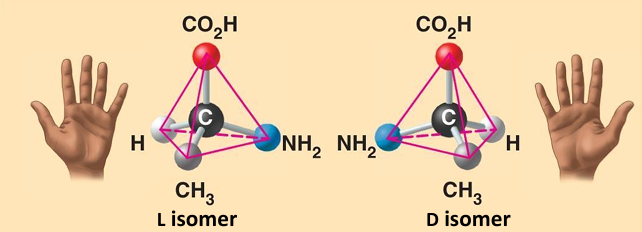
What is an asymmetric carbon?
A carbon bonded to 4 different molecules
(4 different means like if a carbon is bonded to like carbon, hydrogen, oxygen, and nitrogen that counts) so its okay if a carbon is bonded to a carbon

Practice Question:
2

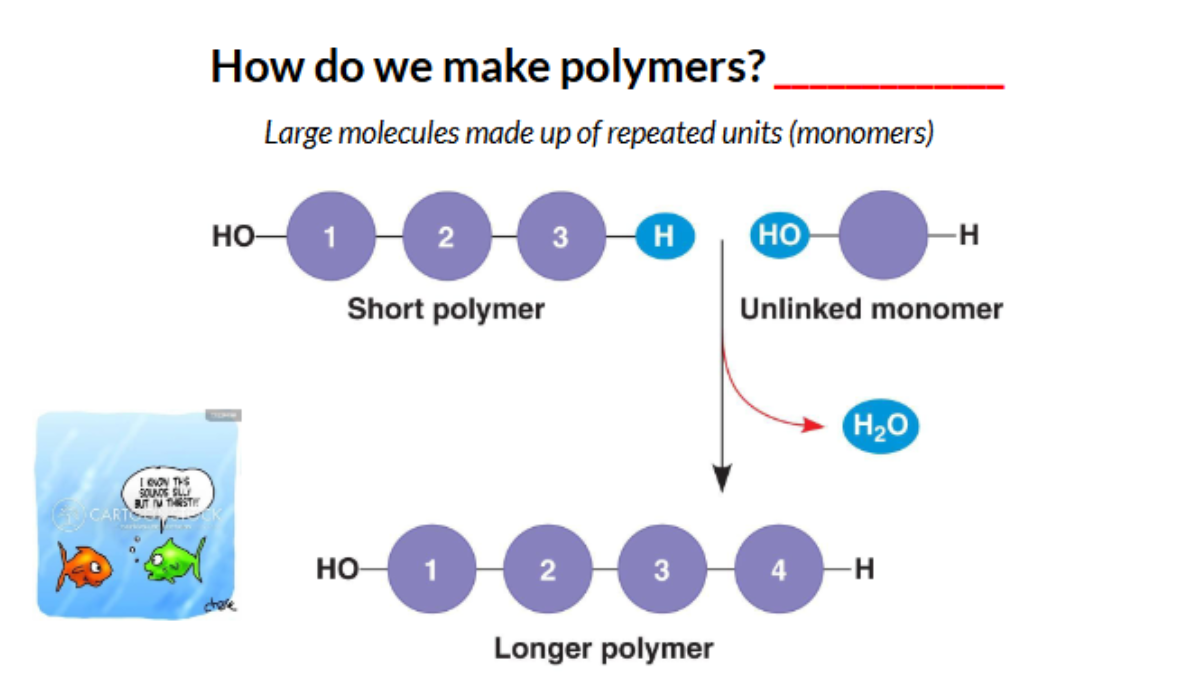
What are polymers?
Large molecules made up of repeated units (monomers)

How do we make polymers?
Dehydration
making polymers through dehydration makes sense because u have to take the water out for them to connect
How do we break down polymers?
Hydrolysis
You add water to break the bonds btwn polymers apart

What are functional groups? And for the sake of this class how many are there?
Chemical groups that add diversity (in terms of chemical activity) to carbon skeletons
7