Developmental - Week 8
 Call Kai
 Learn
 Practice Test
 Spaced Repetition
 Match
 Flashcards
 Knowt Play
1/18

There's no tags or description
Looks like no tags are added yet.
Name | Mastery | Learn | Test | Matching | Spaced | Call with Kai | Chat |
|---|
No analytics yet
Send a link to your students to track their progress
19 Terms
Bronfenbrenner’s Integrative Ecological Systems Theory
Microsystem
Mesosystem
Exosystem
Macrosystem
Chronosystem
Belsky’s (1984) Determinants of Parenting Model
1) Parent characteristics
2) Child characteristics
3) Contextual factors
Predictors of Positive Parenting: Heinickle, 2002 → Personality Characteristics
1) Adaptation-competence/Ego Strength
Efficient, non-anxious, persistent, flexible approach to problem solving
Psychological maturity
2) Capacity for sustained relationships
Empathy, positive mutuality, perspective taking, quality of partner relationship, support networks
3) Self-development (maturity)
Autonomy and confidence vs. insecurity
Predictors of Positive Parenting: Minnesota Longitudinal Study → Individual’s Level of personality integration – Maturity?
Ability of parent to recognise/reflect on own psychological needs and processes
Ability to perceive psychological needs and processes in others
Ability to integrate the two competing agendas
Predictors of Positive Parenting: Intergenerational Attachment studies → Working model of attachment predicts security of attachment of offspring → Moderate effect size
Characteristics of an adult secure/autonomous state of mind regarding attachment
Flexibility (non defensive thinking; open)
Capacity for perspective taking
Autonomy
Parenting/Childrearing Styles (Baumrind, 1967; 1991; 2013)
1) Parental Warmth/Responsiveness
2) Parental Demandingness/Control
Parental Warmth/Responsiveness
Warm and involved caretaking
Expressed concern for child’s well-being
Clarity and inclusiveness of communication
Expressed pleasure in child’s accomplishments → “delight in me”
Parental Demandingness/Control
Discipline and regulation of behaviour in accord with parental standards
Maturity Demands – age appropriate?
Baumrind’s Parenting Typologies
Authoritative
Permissive
Authoritarian
Uninvolved/Neglectful
Authoritative
High Warmth/Responsiveness
High Demandingness/Control
Authoritarian
Low Warmth
High Control
Permissive
High Warmth
Low Control
Uninvolved/Neglectful
Low warmth
Low Control
Expansion of Baumrind’s Parenting Typologies (Maccoby & Martin, 1983)
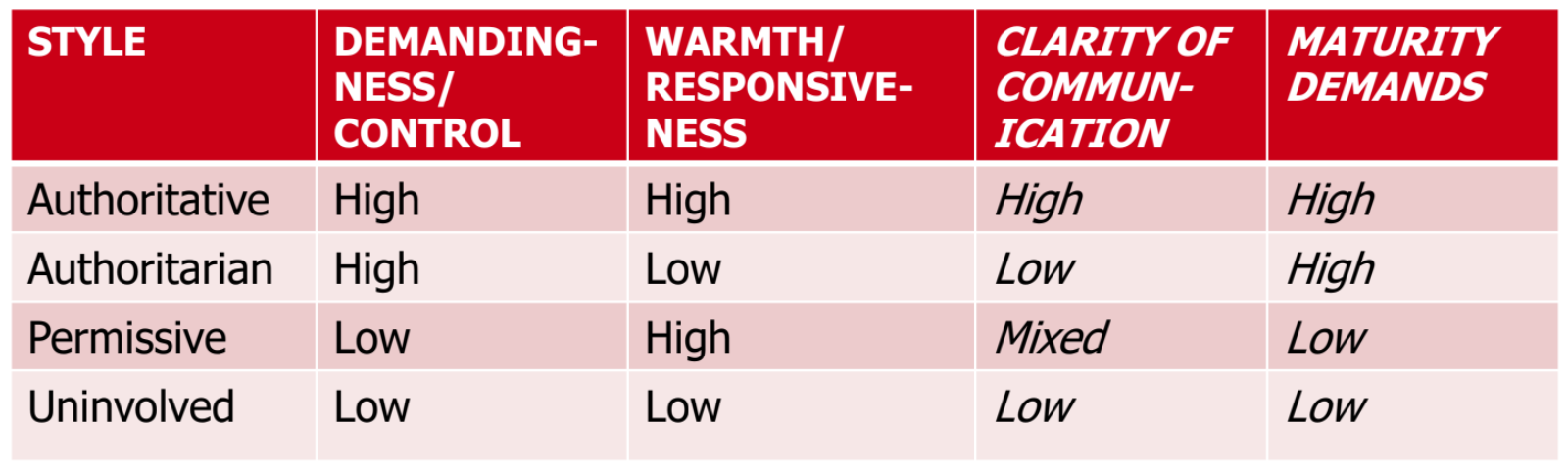
Child Outcomes → Authoritative
• Positive self-esteem
• High adaptability
• High competence (especially for boys)
• Internalised locus of control
• Self-reliant, self-regulated (Amato & Fowler, 2002)
• Popularity with peers
• Low levels of anti-social behaviour
• Altruistic
Child Outcomes → Authoritarian
Children have little control over environment
Fearful of asserting themselves
Unhappy, conflicted, neurotic behaviour common in children
Low self-esteem (Babour et al., 2016)
External locus of control
Low scores on measures of conscience – i.e., don’t internalise standards, poor self-regulation
More negative long term outcomes for boys (who may become hostile) than girls
Child Outcomes → Permissive
• Uncontrolled, impulsive
• Demanding, dependent (Baumrind, 1997l; Querido et al., 2002)
• In adolescence, disengaged from school, involved in drug and alcohol use, school misconduct, early sexual activity
• Strongly oriented towards peers
BUT
• May feel close to parents
• May have high social competence/self-confidence
• Role reversal reactions
Child Outcomes → Neglectful/Uninvolved
Compromised child competence, self-perceptions, behaviour, psychological distress
Disruptions in attachment – Disorganised “D” Pattern (? Role reversal)
Poor self control – impulsivity, aggression, non-compliance
Low self-esteem
Poor peer relationships
In adolescence, more severe delinquency
What is Tiger Parenting?
Chua (2011)
• Highly controlling, authoritarian
• Assumes child strength– little concern with self-esteem
• Parent knows best and over-rides to achieve desired outcome