Ch.4 XRay Circuit Basic Terminology
 Call Kai
 Learn
 Practice Test
 Spaced Repetition
 Match
 Flashcards
 Knowt Play
1/78

There's no tags or description
Looks like no tags are added yet.
79 Terms
electrons and protons
smallest UNIT of charge
electrodynamics
study of electric charges in motion and ehat we often consider as “electricity”
coulomb
The SI unit of electric charge
T
electrical charges reside only on the external surface of conductors.
T/F
electrostatic force
how much attraction or repulsion are between 2 charges
directly
electrostatic force is _____ proportional to the product of their quantities ; MORE charge, MORE attraction/repulsion
ex: if you DOUBLE the number of electrons then you DOUBLE repulsion
inversely
electrostatic force is ____ proportional to square of the distance between them
-if charges get further away from each other, then they are going to have lesser repulsion/attraction
-increase distance, decrease electrostatic force (1/4)
-decrease distance, increase electrostatic force (x4)
F
concentration of charges on a curved surface of a conductor is greatest where the curvature is least
T/F
negative charges (electrons)
what kind of charges are free to move in solid conductors?
electric potential
the ability to work because of a separation of charges or potential difference between two points in an electric field.
volts
what is electric potential measured in?
electric potential
having more electrons at one end of a wire and less electrons (positive charge) at the other end of the conductor
-electrons flow from high to low
conductors
materials with a large number of electrons free to move about that allow electric current to flow easily.
insulators
materials inhibiting flow of electrons and do not conduct electricity well. They have few free electrons.
conductors
copper, gold, nickel
insulators
glass, plastic, wood
electric potential
the more separated electrons are from positive charges, the higher the ______ differences
electric current
flow of electrons in conductor; how many electrons flowing
ampere
unit measurement for electrical current
ohm
unit measurement for electrical resistance
electrical resistance
property of an element circuit that resists or impedes the flow of electricity
volts
potential difference that will maintain a current of 1 ampere a circuit with a resistance of 1 ohm.
-difference in electrons and protons positive and negative charges that has to happen to move 1 amp of circuit with resistance of 1 ohm
volts
___is also an equal to amount of work (in joules) that can be done per unit of charge
amperage; ampere
defined as the amount of current flowing with electric potential of 1 volt in a circuit with a resistance of 1 ohm
(for this to exist, there has to be electric current to flow)
amperage; ampere
also known as measuring intensity of electrical current
ohm’s law
shows relationship between voltage, amperes, and resistance
(potential difference) voltage = (current) amperes x resistance
V=IR
ohm
defined as electrical resistance = to the resistance between 2 points along a conductor that, when a potential difference of 1 volt is applied, produces a current of 1 ampere
resistance length
longer conductor, more resistance than shorter conductor
cross-sectional
a conductor with a large _____ area has LOWER resistance than one with small b/c there is a greater external surface area which electrons can travel
bigger = less resistance
T
with metallic conductors, the resistance becomes GREATER as the temperature of the conductor rises
T
material, length, cross sectional area, temperature
4 things the amount of resistance depends on
closed
what kind of pathway allows electricity to flow, creating an electrical circuit?
x-ray circuit
complex circuit that has different voltages and current flowing through different sections ( 3 areas w/ 3 diff types of circuits)
open
what kind of circuit is broken, stopping electricity to flow?
direct current (DC)
current travels only one direction through time with constant voltage
eg. flashlight turned on
alternating current (AC)
current that travels one direction, stops, then travels the opposite direction creating pulsating voltage
battery
device that produces electrons through chemical reaction. stores electric charge for long term and provides an electric potential
battery

capacitor
device that is like a battery (stores electrical charge) but works very differently in that it cannot produce new electrons and stores the charge only temporarily
-has to be recharged
capacitor

diode
a one-way valve device that allows electrons to flow in only one direction
eg. solid state rectifier
diode

fuse
section of special wire, usually encased in glass, that quickly melts if the current flow rises excessively, thus opening the circuit (stops flow of electricity)
circuit breaker
if current flow rises excesively, this internal switch is tripped (opened), stopping the flow of electricity
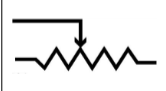
rheostat
an adjustable or variable form of resistor
ex. dimmer
fuse

circuit breaker

resistor
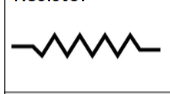
rheostat
switch
device that opens a circuit (breaks the pathway)
transformer
device that can increase/decrease voltage by as predetermined amount
switch

transformer

magnetism
ability of material to attract iron, cobalt, or nickel
magnetic domains
when dipoles/”magnetic magnets” form groups of similarly aligned atoms
flux
magnetic field consists of lines of force in space
south to north
which poles do lines of flux travel INSIDE of a magnet?
north to south
which poles do lines of flux travel OUTSIDE of a magnet? (creating elliptical loops)
repel, attract
like poles ____, opposite poles ____.
directly
force of attraction or repulsion varies ___ withj the STRENGTH of the poles
inversely
force of attraction or repulsion varies ____ with the square DISTANCE between them
tesla
magnetic force SI unit
nonmagnetic, diamagnetic, paramagnetic, ferromagnetic
4 categories that materials can be classified by their magnetic properties
nonmagnetic
not attracted to magnetic fields at all
eg. glass, wood, plastic
diamagnetic
weakly repelled by magnetic fields
eg. water, mercury, gold
paramagnetic
weakly attracted to magnetic fields
eg. aluminum, platinum, gadolinium
ferromagnetic
strongly attracted to magnetic fields and can become permanently magnetized.
eg. iron, nickel, cobalt
electromagnetism
any flow of electrons, whether in a space or in a conductor, will be surrounded by a magnetic field
-a MOVING magnetic field can create an electric current
electromagnetic induction
moving a conductor (such as copper wire) through a magnetic field, induces an electric current in that conductor
-when you make electrons move, you create electrical current
mutual induction
the induction of electricity in a second coil by a moving magnetic field
-when moving magnetic field is placed NEAR a secondary coil, electricity is induced to flow in that coil
self induction
because we have an expansion and contraction of magnetic flux around the wire, it is going to “cut” the coils of the wire as it’s coiled
-cutting creates a current within the same conductor that opposes the original
-occurs with one coil of wire; when the current in a coil changes, it induces a voltage in the same coil that opposes the change.

electric generators
devices that convert some form of mechanical energy into electrical energy using electromagnetic induction to produce electricity.
electric motors
devices that convert electrical energy to mechanical energy using electromagnetic induction
-taking electric current and causing motion
transformers
devices used to increase or decrease voltage (or current) through electromagnetic induction
step-up transformer
increases voltage, increase amp, decrease current
step-down transformer
decreases voltage, decreases amp, increases current
current
as we increase voltage with a step-up trransformer, what decreas
amp
as we increase voltage with a step-up transformer, what also increases?
autotransformer
A type of transformer that allows for voltage adjustments by tapping into different points of the winding, typically used in X-ray circuits to control incoming voltage.
-operates with self-induction
-it has only one coil of wire around a central magnetic core serving as both the primary and secondary coil