MCAT: Psychology and Sociology
 Call Kai
 Learn
Learn Practice Test
 Spaced Repetition
 Match
Match Flashcards
 Knowt Play
1/387

Earn XP
Description and Tags
388 Terms
What binocular cues inform vision?
Retinal disparity and convergence
What is retinal disparity?
Your eyes are in different places so they provide slightly different views of the world and your brain combines the images adding depth to vision
What is convergence in vision?
Eye muscles are relaxed when looking far away and contracted when looking close which clues the brain into the depth of an object
What are the monocular cues for vision?
Relative size, interposition, relative height, shading/contours, motion parallax
What is relative size?
When an object looks bigger, it is often perceived to be closer
What is interposition in vision?
When an object is in front of/blocking another object, we infer that it is closer to us
What is relative height?
Objects that are higher are perceived to be further away than objects that are lower
What is shading/contour?
The shading of an object implies whether it is convex or concave
What are the degrees of perceptual organization?
Depth, form, motion, constancy
What is motion parallax?
Objects closer to you appear to be moving much faster than objects far from you(relative motion)
What is size constancy?
Sometimes we know that 2 objects are the same size in reality even though one looks bigger because it is closer
What is shape constancy?
Sometimes we know that an object maintains its shape even though it may appear to change shape because our view of it is changing
What is color constancy?
Sometimes we know that the color of an object is constant even though lighting can make it appear to be multiple colors or color changing
What is sensory adaptation?
A change in the sensitivity of your perception of a sensation
How does sensory adaptation in hearing work?
Loud noises cause an inner ear muscle to contract which dampens the incoming noises to protect against inner ear damage
How does sensory adaptation in touch work?
Sensory nerves become saturated and stop firing as much(desensitized)
How does sensory adaptation in smell work?
Sensory receptors in nose get desensitized to certain molecules
How does sensory adaptation in proprioception work?
Your brain will correctly process up and down(after a while) even if you’re vision of the world has shifted
How does sensory adaptation in sight work?
Increase in light cause pupils to constrict to limit light that might damage the retina and the rods and cones lose sensitivity to light over time; decrease in light causes the opposite: dilate pupils and increase light sensitivity in rods and cones
What is the “Just noticeable difference” (JND)?
The minimum difference in sensation that would cause you to notice it has changed for a given stimulus(ex: change in weight or volume)
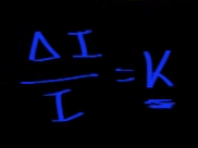
What is Weber’s law?
The ratio of an initial sensation to the just noticeable difference is constant implying a linear relationship (I=sensation and K=constant ratio)
What is the absolute threshold of sensation?
The minimum intensity of a stimulus that a person requires to detect it half the time(right below most of the time)
What affects the absolute threshold of sensation?
Expectations(are you expecting a stimulus), experiences(are you used to the stimulus), motivation(is there a reward for sensing the stimulus), alertness(you up?)
What is somatosensation?
A collection of sensation that helps us understand the environment
What is thermoception?
Sensation of temperature
What is mechanoception?
Sensation of pressure
What is nociception?
Sensation of pain
What is proprioception?
Sensation of location in space
How do we sense intensity?
How quickly the neurons fire
What is a non-adapting neuron?
The neuron fires consistent action potentials for the entire length of the stimulus
What is a slow-adapting neuron?
Starts firing really fast at the beginning of the stimulus then slows down over time
What is a fast adapting neuron?
It fires a few times at the start of stimulus and then stops and fires again at the end of the stimulus
What is a dermatome?
A part of the body being innervated by a specific nerve so the brain can understand the general location of a stimulus
What fluid is found inside the semicircular canals?
Endolymph
How do we sense rotation?
The movement of endolymph in the semicircular canals, including the amount and speed of the fluid which can help us sense the strength of rotation
What are the otolithic organs?
The utricle and the saccule which help us to detect linear acceleration and head positioning
How do the otolithic organs sense acceleration and positional changes?
Calcium carbonate crystals move within a gel like substance and pull on attached hair cells
How does dizziness after spinning occur?
The endolymph continues to move even after you stopped which confuses your brain
What is signal detection theory?
How we make decisions under conditions of uncertainty; d etermining how strong a signal has to be for us to decide it’s on
What is d’ in signal detection theory?
strength of the signal in comparison to the noise distribution(stronger leads to more hits than misses)
What is C in signal detection theory?
strategy, the minimum signal needed to determine that the signal is present
What are the main 2 strategies of signal detection theory?
Conservative and liberal
What are the characteristics of a conservative strategy?
Mostly say no(C>0); leads to correct rejections but risks misses
What are the characteristics of a liberal strategy?
Mostly say yes(C<0); finds all hits but risks false alarms
What is an ideal observer in signal detection theory?
C=0
What is the beta strategy in signal detection theory?
ln(beta)=d’xC
What is bottom up processing?
We allow the stimuli to influence our perception of our surroundings
What is top down processing?
We allow our own background knowledge and expectations to influence our perception of our surroundings
What are the Gestalt principles?(generally and list)
How we interpret visual stimuli; Law of similarity, Praganz, proximity, continuity, and closure
What is the law of similarity?
Items that are similar are grouped together in your brain
What is the law of Praganz?
Reality is often organized to the simplest form possible
What is the law of proximity?
Objects that are close to one another are grouped together by our brains
What is the law of continuity?
Lines are seen as following the smoothest path
What is the law of closure?
Objects grouped together are viewed as a whole; our brains fill in gaps
Define afferent nerve fibers
Send signal from stimulus to CNS
Define efferent nerve fiber
Sends signal from CNS to muscle(or responding organ)
What are A-delta fibers?
Afferent fibers that signal for pain and temperature
What are A-beta fibers?
Afferent fibers that signal for everything but pain and temperature
What are Meissner’s corpuscles?
Mechanoreceptor that detects light touch in non-hairy(glabrous) skin; requires changing stimuli(a constant force will not be registered after initial)
How is an action potential generated by a Meissner’s or Pacinian corpuscle?
Pressure causes epithelial discs to shift which allows Na+ to enter the cells and continues down until the Na+ reaches the afferent nerve fiber at the base(M) or center(P) of the corpuscle
What is a Pacinian’s(lamellar) corpuscle?
Mechanoreceptor that detects deep touch in non-hairy(glabrous) and hairy skin; requires changing stimuli(a constant force will not be registered after initial)
Where are Pacinian’s corpuscles located?
Hypodermis
What is a Merkel’s disk?
A specialized keratinocyte that detects light touch in non-hairy(glabrous) and hairy skin; senses sustained stimuli(as long as the stimulus is there we keep noticing it)
How do Merkel’s disks generate an action potential?
Force causes vesicles to release a neuropeptide which activates a receptor which lets in Na+
Where are Merkel’s disks located?
between the stratum basale and papillary dermis
What is a Ruffini’s corpuscle/ending?
Mechanoreceptor that detects deep touch in non-hairy(glabrous) and hairy skin; senses sustained stimuli(as long as the stimulus is there we keep noticing it)
How does a Ruffini’s corpuscle generate an action potential?
Collagen stretches and allows Na+ into the corpuscle and nerve
Where are Ruffini’s corpuscles located?
Reticular dermis
What is a hair follicle receptor?
Mechanoreceptor that detects hair deflection(light touch) on hairy skin; requires changing stimuli(a constant force will not be registered after initial) since collagen will plug the opening
How does a hair follicle receptor generate an action potential?
Shifting of hair allows Na+ to enter afferent nerve fiber wrapped around the base of the hair
Where are hair follicle receptors located?
Reticular dermis
What is the conjunctiva?
The layer of epithelial cells protecting the cornea
What is the difference between aqueous and vitreous humor?
Aqueous is thinner and in front of the lens
What is the fovea in the eye?
Dimple full of cones and with less axons on top that allows you to see in high definition
What is the macula in the eye?
The area at the center of which there is the fovea
Difference between rods and cones
Rods very sensitive to light(good for night vision), more plentiful, have rhodopsin, slower recovery time, and on periphery; cones sense light(red, green, and blue), less plentiful, have photopsin, faster recovery time, and more centered & tons in the fovea
Order of signaling when light hits rod
light turns rod off → turns bipolar cell on → activates ganglion cell → signal travel through optic nerve to brain
What is the phototransduction cascade?
The turning off of a rod; retinal inside rhodopsin is straightened by light energy which activates PDE which decreases cGMP which results in the closing of Na+ channels which causes hyper-polarization
What happens in the optic chiasm?
The optic nerves cross so that vision from the left eye goes to the right side of the brain and vice versa
What is feature detection?
Breaking down an object into color, form, and motion
What is the Parvo pathway?
Pathway for spatial resolution in the brain(figures out boundaries and details of a stationary object) and color perception; really bad at temporal resolution(can’t really recognize moving objects)
What is the Magno pathway?
Pathway thats really good at temporal resolution(great seeing moving objects) but bad at spatial resolution(bad at clear details of a stationary object)
Differentiate between photopic, mesopic, and scotopic vision
Photopic high light more cones, meso dawn/dusk both rods & cones, scotopic low light more rods
What is selective attention?
The ability to maintain attention while being presented with masking or interfering stimuli
What is joint attention?
The focusing of attention on an object by 2 separate individuals
What is divided attention?
When an individual must perform 2 tasks which require attention simultaneously
What is directed attention?
Focusing sustainably on a single task
What is basilar tuning?
Sound waves with higher frequencies activate hair cells closer to the front/base and the opposite with low frequencies
What is the somatosensory homunculus?
A map of the body in the brain(on the sensory strip) where signals from different parts of the body will synapse.
What is kinesthesia?
Sensing whether or not your body is moving
What are the states of conciousness?
Alertness, daydreaming(light meditation), drowsiness(deep meditation), sleep
What are the characteristics of beta brain waves?
12-30 Hz, associated with alertness, can cause stress if too high(alert too long)
What are the characteristics of alpha brain waves?
8-13 Hz, associated with light meditation(disappear during deep meditation but reappear with deep sleep)
What are the stages of sleep?
3 stages of non-REM(N1-N3) and REM
What are the characteristics of N1 non-REM sleep?
Stage between sleep and wakefulness, brain begins producing theta waves, brain produces hypnagogic hallucinations and hypnic jerks
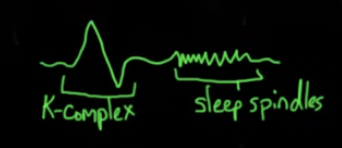
What are the characteristics of N2 non-REM sleep?
Harder to wake up, more theta waves, sleep spindles(associated with ignoring stimuli), K-complexes(ignore cortical arousal and help with sleep based memory consumption),
What are the characteristics of N3 non-REM sleep?
Slow-wave sleep, delta waves(0.5-2 Hz), really difficult to wake up, sleepwalking/talking
What are the characteristics of REM sleep?
Eye’s move rapidly, most other muscles are paralyzed, paradoxical: very active mind very limited body, dreaming
What are circadian rhythms?
Our regular bodily rhythms across 24-hour period(internal biological clock)