Chapter 5.5: Life Is Supported by the Sun: Light Energy Captured during Photosynthesis Converts Carbon Dioxide to Carbohydrates
 Call Kai
 Learn
Learn Practice Test
 Spaced Repetition
 Match
Match Flashcards
 Knowt Play
1/19

Name | Mastery | Learn | Test | Matching | Spaced | Call with Kai | Chat |
|---|
No analytics yet
Send a link to your students to track their progress
20 Terms

Photosynthesis
An anabolic process utilizing solar energy to convert carbon dioxide and water into carbohydrates, similar in equation to the reverse of aerobic catabolism
Light reactions
The reactions in photosynthesis that convert light into chemical energy via ATP and NADPH, producing O2 as a byproduct
NADPH
An electron carrier produced in the light reactions of photosynthesis, similar in structure to NADH but with an additional phosphate group
Carbon-fixation reactions (dark reactions)
Reactions that utilize the formed ATP and NADPH with CO2 to produce carbohydrates, proceeding after the light reactions
Photons
Individual packets of light energy, the strength of which depends on the source’s electromagnetic wavelength

Visible spectrum
The range of light used in photosynthesis, avoiding bond breakage but preserving the necessary amount of energy for reactions

Pigments
Molecules that may absorb photons in specific sections of the visible spectrum, allowing the associated energy to be absorbed via excited electrons
Divided into chlorophyll a and b for photosynthesis

Absorption spectra
A graph showing which wavelengths of light of a certain pigment or substance can be absorbed, roughly corresponding to its action spectrum

Chlorophyll
A pigment used in photosynthesis featuring a magnesium ion surrounded by a ring as well as a hydrocarbon tail for thylakoid membrane anchoring
Absorbs red and blue light, with accessory pigments absorbing intermediate wavelengths
Antenna complex
The combination of several light-harvesting complexes to capture light energy through pigments
Reaction center
The area where energy is transferred from the antenna complex to electron acceptors after exciting a chlorophyll electron
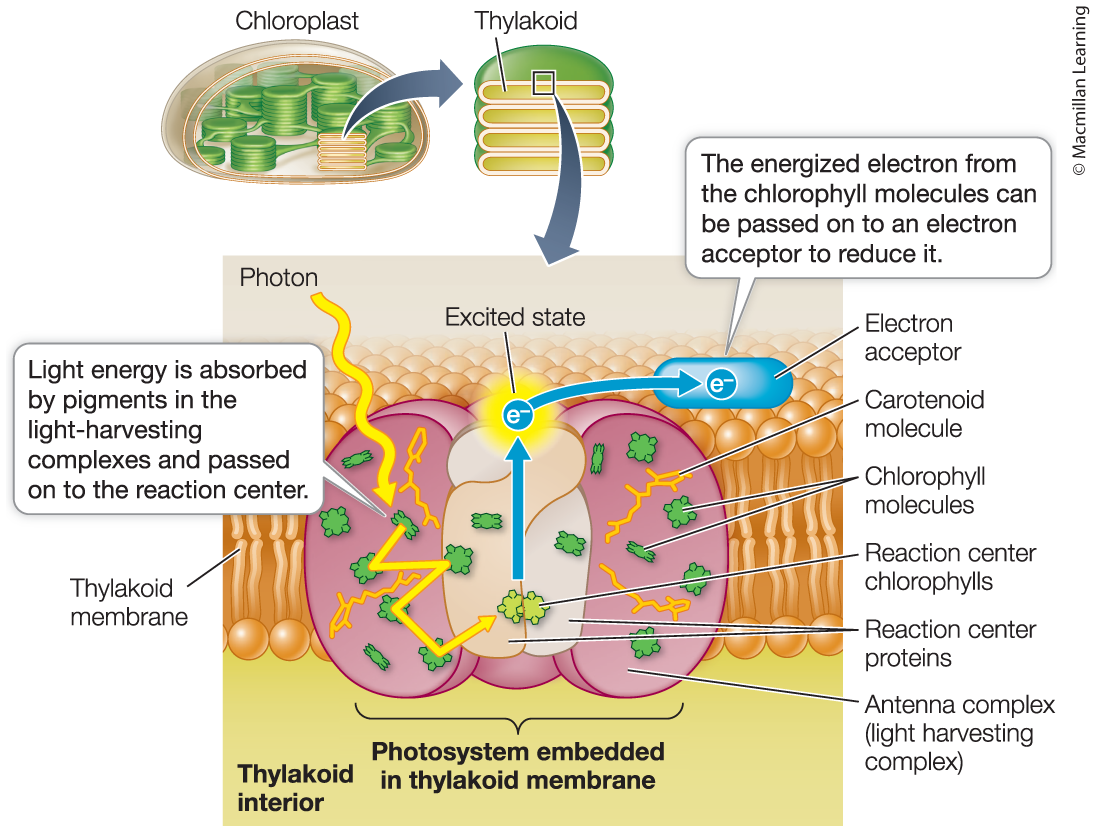
Photosystem
The total structure comprising the antenna complex and reaction center together
Photosystem II
The first photosystem in the electron transport chain, passing an excited electron to photosystem I
Replenishes electrons through the breaking of O—H bonds in water, with O then released and H used for the proton gradient
Photosystem I
The second photosystem in the electron transport chain, using an excited electron to reduce NADP to form NADPH in one pathway and create a proton gradient for ATP-forming reactions in another
Photophosphorylation
The use of ATP synthase powered by an electron-generated H+ gradient to produce ATP from ADP, in between photosystem II and I, supplying energy for later carbon fixation
Calvin cycle
The process of CO2 reduction to produce carbohydrates following the light reactions, consisting of:
CO2 fixation by rubisco with RuBP to form the three-carbon 3PG
Reduction of 3PG to the three-carbon sugar G3P, using ATP and NADPH
Regeneration of RuBP through the phosphorylation of produced RuMP via most of the G3P (one-sixth is exported for use in photosynthesis)
Rubisco
The enzyme that catalyzes the fixation of CO2 with RuBP to form the three-carbon 3PG molecule
Photorespiration
The fixation of O2 instead of CO2 by rubisco into 3PG, oxidizing a carbon molecule entirely into CO2 for release later on
Releases carbon into the atmosphere in a less efficient process, affecting plants with closed stomata more (typically in hot, dry environments)
Mitigated by some plants by using an enzyme that does not react with O2 for carbon fixation
Starch
A polysaccharide formed of linked glucose units used for energy storage in plants
Autotrophs
Organisms that take part in photosynthesis, providing energy for heterotrophs